
ORNL’s Breakthrough Polymer: Revolutionizing 3D Printed Sand Strength for Industrial Applications
Researchers at the Department of Energy’s Oak Ridge National Laboratory (ORNL) have achieved a significant advancement in additive manufacturing, specifically for binder jetting technology. Their groundbreaking work introduces a novel polymer binder designed to enhance the strength and integrity of silica sand structures. Published in the study, “Additive manufacturing of strong silica sand structures enabled by polyethyleneimine binder” by Gilmer et al., the findings reveal that this innovative binder can produce sand structures far superior in strength to those created with conventional binders. Remarkably, objects fabricated using this new polymer demonstrated the ability to hold up to 300 times their own weight, effectively doubling the overall strength of 3D printed parts.
This achievement further solidifies ORNL’s position at the forefront of additive manufacturing research and development. The institution has been a prolific source of innovation in this field, with numerous projects making headlines this year alone. Previous notable contributions include the development of 3D printed fuel assembly brackets, which have already been installed in a nuclear power plant in Alabama, showcasing the practical application of advanced AM components in critical infrastructure. Additionally, ORNL has collaborated with industry leader ExOne, known for its expertise in binder jetting technology, to explore the creation of advanced ceramic-metallic parts. This latest project continues to push the boundaries of binder jetting, now focusing on unlocking the full potential of sand as a robust and versatile printing material.

Tomonori Saito shows a 3D-printed sandcastle at the DOE Manufacturing Demonstration Facility at ORNL (photo credits: Carlos Jones/ORNL, U.S. Dept. of Energy)
Enhancing Binder Jetting: The Quest for Stronger Sand Components
Binder jetting, as an additive manufacturing technique, offers numerous advantages, including its speed, cost-effectiveness, and ability to process a wide range of materials from metals and ceramics to sand. In the binder jetting process, a liquid binding agent is selectively jetted onto a powder bed, layer by layer, to build a three-dimensional object. This method stands out for its capacity to produce complex geometries without the need for support structures, as the unbonded powder provides inherent support. Despite its benefits, a long-standing challenge with using sand in binder jetting has been the inherent weakness of the initial “green parts”—the structures formed directly after printing but before any post-processing like debinding and sintering. These green parts, while holding their shape, typically lack the mechanical strength required for many practical applications, particularly for end-use components.
The researchers’ breakthrough addresses this critical limitation. By developing a polyethyleneimine (PEI) binder specifically for silica sand, ORNL has paved the way for increasing the adoption of binder jetting in applications demanding higher mechanical performance. This is particularly timely given the growing popularity of binder jetting due to its efficiency and economic advantages over many other 3D printing methodologies. The ability to produce stronger green parts significantly broadens the scope of applications, allowing for the use of sand in components that bear substantial loads or require greater structural integrity.
The Science Behind the Super-Strength: Polyethyleneimine (PEI) Binder
The core of this innovation lies in the unique properties of the polyethyleneimine (PEI) polymer. Unlike conventional binders, the PEI developed by ORNL exhibits specific characteristics that make it exceptionally suited for strengthening silica sand structures. One crucial aspect of its design was its intended use in conjunction with infiltration, a post-processing method widely employed in binder jetting. Infiltration involves filling the porous structure of a printed part with a secondary material, typically a polymer or metal, to enhance its density, strength, and other mechanical properties. While infiltration can dramatically improve strength—sometimes by as much as eight-fold—finding a binder that is compatible and effective, especially with sand, has traditionally been challenging.
Tomonori Saito, a lead researcher on the project, elucidated the specific requirements and discoveries behind the PEI binder. “Few polymers are suited to serve as a binder for this application. We were looking for specific properties, such as solubility, that would give us the best result,” Saito stated. “Our key finding was in the unique molecular structure of our PEI binder that makes it reactive with cyanoacrylate to achieve exceptional strength.” This chemical reactivity is what sets the PEI binder apart, allowing for a robust interaction within the sand structure that fundamentally alters its mechanical properties, making the infiltrated parts remarkably strong and durable.
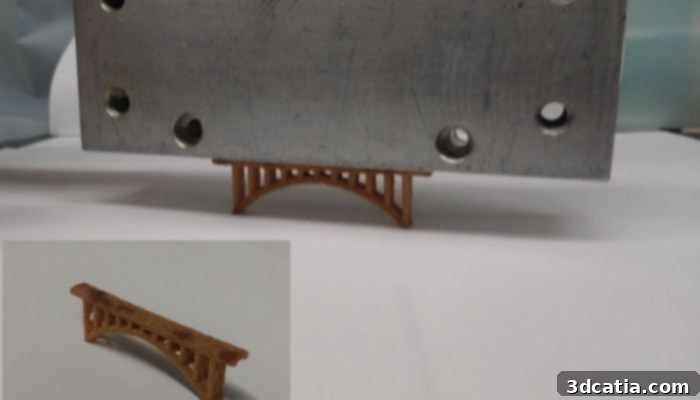
A 6.5 centimeter 3D-printed sand bridge, shown here, held 300 times its own weight (photo credits: Dustin Gilmer/University of Tennessee, Knoxville)
Transformative Applications in Automotive and Aerospace
The development of stronger 3D printed sand parts holds immense promise for various industrial sectors, particularly automotive and aerospace. Silica sand has been gaining significant interest in these fields due to its advantageous properties, such as being lightweight, readily available, and cost-effective. One prominent application is in the creation of sand cores for composite manufacturing. For instance, lightweight parts made from advanced materials like carbon fiber or fiberglass can be produced by wrapping them around 3D printed sand cores, which are then cured. The sand core’s crucial benefit in this process is its exceptional dimensional stability when exposed to heat, preventing warpage or deformation during the curing of the composite material, after which the sand core can be easily removed. However, the structural weakness of traditionally printed sand cores has limited their complexity and load-bearing capabilities.
With the introduction of the PEI binder, the ability to overcome these structural weaknesses opens up a new realm of possibilities. Stronger sand parts can support manufacturing processes at a much larger scale, enabling the rapid production of more intricate and robust components. In the automotive sector, this could translate to more efficient production of complex engine components, molds for lightweight chassis parts, or even directly printed functional prototypes that can withstand more rigorous testing. For aerospace, where weight reduction is paramount and part integrity is critical, stronger sand cores could facilitate the creation of lighter, more aerodynamically efficient composite structures with unparalleled precision and complexity, significantly reducing manufacturing lead times and costs. Furthermore, the enhanced strength could lead to the direct use of sand-based parts in non-critical structural applications or as robust tooling, further expanding the utility of binder jetting.
ORNL’s Continuous Contributions to Additive Manufacturing Excellence
This latest achievement with the PEI binder is a testament to ORNL’s ongoing commitment to advancing additive manufacturing technologies across diverse material classes and applications. The lab consistently pushes the boundaries of what is possible, from developing novel materials with unique properties to optimizing printing processes for industrial scale. Their work spans the entire AM ecosystem, fostering innovation that addresses real-world industrial challenges and contributes to national energy and manufacturing goals. The collective impact of ORNL’s projects, including the 3D printed nuclear fuel brackets and collaborations with companies like ExOne for ceramic-metallic parts, underscores their role as a vital hub for groundbreaking research that translates scientific discovery into tangible technological progress. This dedication ensures that additive manufacturing continues to evolve, offering increasingly sophisticated and reliable solutions for complex engineering problems.
Looking Ahead: The Future of High-Strength Sand 3D Printing
The development of the PEI binder marks a pivotal moment for sand binder jetting. By addressing the fundamental challenge of strength in 3D printed sand parts, ORNL has unlocked new potential for this cost-effective and versatile additive manufacturing technology. Industries can now look towards leveraging sand for a broader array of applications, moving beyond mere prototyping or casting molds to include functional components and advanced tooling that require significant structural integrity. This breakthrough not only promises to accelerate innovation in automotive, aerospace, and other manufacturing sectors but also opens doors for future research into even more potent binders and optimized post-processing techniques. The journey towards fully realizing the potential of additive manufacturing is a continuous one, and ORNL’s latest polymer discovery is a powerful step forward, propelling us closer to a future where 3D printed sand plays an even more critical role in the landscape of advanced manufacturing.
You can find more detailed information about this fascinating project in the official press release HERE or delve into the full scientific paper published in Nature Communications HERE.
What are your thoughts on this groundbreaking project for high-strength sand binder jetting? Share your insights and join the conversation in the comments below or connect with us on our Linkedin, Facebook, and Twitter pages! Don’t forget to sign up for our free weekly Newsletter here to get the latest 3D printing news delivered straight to your inbox! You can also find all our compelling videos on our YouTube channel.
*Cover Photo Credits: Ian Strain via Flickr