
Exploring the Cutting Edge: Top 5 3D Printing Innovations Shaping Our Future
Welcome to our weekly compilation of the most groundbreaking developments in the world of 3D printing! Additive manufacturing continues to revolutionize industries globally, pushing the boundaries of what’s possible and fundamentally reshaping how we design, produce, and even consume. This week, we delve into five remarkable instances where 3D printing technology is making a tangible difference, from sustainable food solutions and advancements in aerospace to revolutionary construction methods, life-changing medical procedures, and a deep dive into the future of industrial applications. Each story highlights the incredible versatility and transformative potential of this technology. If you’re eager to discover more fascinating insights and innovations in the 3D printing space, be sure to explore our dedicated Youtube channel, where a wealth of additional videos awaits. Prepare to be inspired by the relentless progress of 3D printing as we present this week’s top picks!
Top 1: Is 3D Technology the Future of Food? Redefining Culinary Sustainability
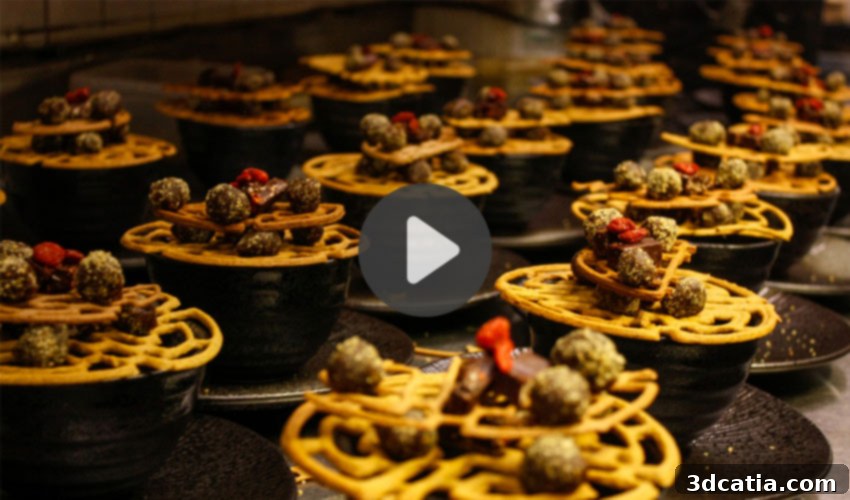
The global challenge of food waste is immense, with significant environmental and economic repercussions. However, innovative startups like Upprinting are pioneering a compelling solution, marking what can truly be considered a small revolution within the food sector. This visionary company is at the forefront of tackling food waste head-on by transforming discarded food materials into viable 3D printing ingredients. Through a sophisticated process, they can recreate food items in entirely new and often more appealing forms. This approach embodies a circular economic model, offering a powerful pathway to reduce waste, conserve resources, and promote sustainable consumption patterns. Beyond its environmental benefits, 3D printed food opens up exciting possibilities for personalized nutrition, intricate culinary designs, and novel dining experiences. Imagine dishes crafted with complex geometries and artistic flair, all while contributing to a healthier planet. Upprinting’s method doesn’t just reduce waste; it elevates the culinary art form by enabling precise control over texture, flavor, and visual presentation. This innovation demonstrates how technology can align with sustainability goals, creating a future where our food systems are not only efficient but also environmentally conscious and creatively inspiring. The potential impact on our collective consumption habits and the overall food industry is profound, offering a glimpse into a more sustainable and imaginative culinary landscape.
Top 2: Additive Manufacturing’s Soaring Impact in the Aerospace Industry
The aerospace industry consistently demands the highest levels of precision, performance, and efficiency, making it a natural fit for the transformative capabilities of additive manufacturing. Leading 3D printing service providers like Protolabs are showcasing the latest trends that are fundamentally reshaping aircraft design and production. A key technology driving this change is laser powder bed fusion. This advanced manufacturing process allows for the creation of incredibly complex, yet remarkably lightweight parts from various metal powders. Unlike traditional subtractive manufacturing, where material is removed from a larger block, laser powder bed fusion builds components layer by layer, resulting in minimal material waste and the ability to produce geometries previously impossible. This capability is a significant advantage in aerospace, where every gram saved contributes to improved fuel efficiency and reduced operational costs. The direct impact on the supply chain is equally considerable: metal additive manufacturing drastically reduces the number of individual components required for a single part, leading to fewer assembly steps, shorter lead times, and streamlined logistics. Engineers are increasingly turning to this technology to develop parts with highly complex internal structures and organic shapes, optimizing for strength-to-weight ratios and integrated functionalities that enhance overall aircraft performance and safety. As the technology matures, we anticipate even more widespread adoption, further solidifying additive manufacturing’s critical role in advancing aerospace innovation and efficiency.
Top 3: COBOD3D Construction Printer Headed to Saudi Arabia: Building the Future, Faster
The construction industry is traditionally known for its labor intensity, long project timelines, and significant material waste. However, the advent of 3D concrete printing is poised to disrupt these norms, offering unprecedented speed, efficiency, and design freedom. Danish manufacturer COBOD, a leader in large-scale 3D concrete printers, recently made headlines with the announcement of its advanced COBOD3D machine arriving in Saudi Arabia. To commemorate this milestone, the company hosted a press day, showcasing their impressive large-format printer in action. This innovative machine boasts remarkable capabilities, designed to construct virtually any type of building with a maximum width of 12 meters, an impressive length of 27 meters, and a height of 9 meters. Visitors to the event were given a firsthand look at the concrete printer’s precision and speed, witnessing structures being built layer by layer with unparalleled accuracy. The implications for the construction sector are nothing short of revolutionary. This technology promises significantly reduced construction times, lower labor costs, and decreased material waste. Moreover, it unlocks entirely new architectural possibilities, allowing for complex and organic designs that would be prohibitively expensive or impossible with conventional methods. With ambitious projects like NEOM City underway, Saudi Arabia’s adoption of such cutting-edge construction technology signifies a strong commitment to innovation, sustainability, and rapid development, potentially setting a new benchmark for global construction practices. The future of building is being laid, quite literally, one 3D printed layer at a time.
Top 4: First 3D Printed Middle Ear Transplant Prosthesis: A Breakthrough in Medical Technology
Hearing loss profoundly affects millions worldwide, often stemming from complex middle ear problems caused by congenital birth defects, chronic infections, traumatic injuries, or metabolic diseases. The impact on an individual’s quality of life can be devastating, affecting communication, social interaction, and overall well-being. In a remarkable medical breakthrough, Professor Mashudu Tshifularo from the University of Pretoria in South Africa, in collaboration with a dedicated team of 3D printing and design specialists, has pioneered the world’s first artificial middle ear transplant prosthesis. This groundbreaking achievement represents a significant leap forward in personalized medicine. Traditional prostheses often involve generic components that may not perfectly fit a patient’s unique anatomy, leading to suboptimal outcomes. However, by leveraging advanced 3D printing technology, Professor Tshifularo’s team was able to create custom-designed prostheses tailored precisely to the individual patient’s ear structure. This level of customization ensures a far more accurate fit, improving the chances of successful hearing restoration. The Carte Blanche documentary team captured this historic moment, providing a rare glimpse into the theatre where this revolutionary procedure took place. This innovation not only offers renewed hope for individuals suffering from severe hearing loss but also highlights the immense potential of 3D printing in creating patient-specific implants and devices, paving the way for more effective, less invasive, and highly personalized medical interventions across various specialties. It underscores how additive manufacturing is transforming healthcare, moving towards an era of bespoke solutions that address individual patient needs with unprecedented precision.
Top 5: What is the Future of Industrial 3D Printing? Experts Weigh In
Industrial 3D printing has rapidly evolved beyond its initial role as a tool for rapid prototyping, now standing at the precipice of becoming a cornerstone of modern manufacturing. To shed light on its current state and future trajectory, we turn to the invaluable insights of industry leaders: Dr. Stephan Beyer, CEO of BigRep, and Thomas Fechner, Head of New Business at Bosch Rexroth. Their perspectives illuminate critical questions about the broader adoption and transformative potential of this technology. Is industrial 3D printing still primarily confined to prototyping, or is it truly ready for large-scale production of end-use parts? The experts delve into the evolving cost-efficiency equation, examining how economies of scale, advancements in materials, and improved printing speeds are making additive manufacturing increasingly competitive for companies seeking flexible and customized production solutions. They discuss how 3D printing allows for on-demand manufacturing, significantly reducing inventory costs and enabling mass customization tailored to individual customer needs. Furthermore, a crucial aspect explored is the intrinsic link between industrial 3D printing and automation processes. As manufacturing shifts towards Industry 4.0 principles, the seamless integration of 3D printers with robotics, artificial intelligence, and sophisticated data analytics becomes paramount. This synergy creates highly automated, intelligent factories capable of optimizing production workflows, minimizing human intervention, and achieving unprecedented levels of efficiency and consistency. The discussion covers how this integration unlocks new possibilities for distributed manufacturing, agile supply chains, and the creation of smarter, more resilient production ecosystems. Their answers provide a comprehensive outlook on the trends, challenges, and opportunities that will define the future landscape of industrial 3D printing, promising a manufacturing revolution driven by innovation and interconnectedness.
As we’ve explored this week, 3D printing is not just a technology of the future; it’s actively shaping our present across an astonishing array of fields. From enabling sustainable food practices and revolutionizing aerospace and construction with unparalleled efficiency to delivering life-changing medical prostheses and fundamentally transforming industrial manufacturing, the impact of additive manufacturing is undeniable and ever-expanding. Each of these innovations underscores the incredible versatility and transformative power of 3D printing, demonstrating its capacity to solve complex problems and create entirely new possibilities. What are your thoughts on this week’s TOP 5 VIDEOS and the remarkable progress being made in the 3D printing world? We encourage you to share your insights and engage with our community by dropping a comment below or joining the discussion on our Facebook and Twitter pages! And to ensure you never miss out on the latest advancements, groundbreaking news, and expert analyses in the dynamic 3D printing industry, don’t forget to sign up for our free weekly Newsletter, delivered straight to your inbox.