
3DCeram’s CERIA AI: Revolutionizing Industrial Ceramic 3D Printing with Real-time Optimization and Enhanced Precision
In the rapidly evolving landscape of advanced manufacturing, the demand for precision, efficiency, and reliability in producing complex components has never been higher. French manufacturer 3DCeram stands at the forefront of this innovation, specializing in cutting-edge ceramic 3D printing solutions. With a core mission to empower its users in the industrialization of additive manufacturing and the seamless production of mass-produced parts, 3DCeram continues to push the boundaries of what’s possible with technical ceramics. Leveraging decades of expertise in stereolithography, the 3DCeram team has meticulously developed a comprehensive range of industrial machines designed to meet the diverse and stringent demands of various industries. Their focus remains unwavering: delivering unparalleled precision, exceptional speed, and the capability for large-format builds, essential for scaling production.
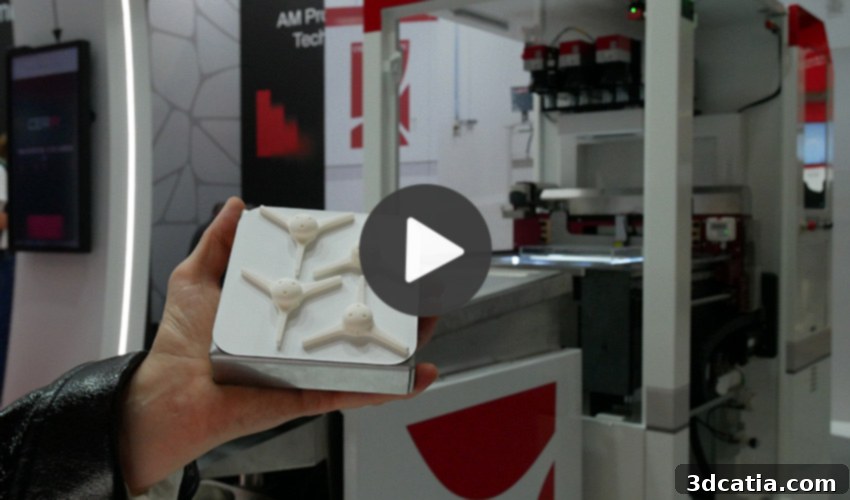
This year marked a significant milestone for 3DCeram at Formnext, the world’s leading exhibition for additive manufacturing. The company proudly unveiled CERIA, its groundbreaking artificial intelligence system. Integrated directly into its state-of-the-art 3D printers, CERIA represents a monumental leap forward in optimizing additive manufacturing on an industrial scale. This sophisticated AI is engineered to perform a dual analysis: scrutinizing the print file meticulously before printing even begins, and then continuously monitoring the manufacturing process in real time. This proactive and reactive approach dramatically reduces the risk of errors, ensuring higher success rates and material efficiency. To delve deeper into the capabilities of CERIA, understand 3DCeram’s advanced ceramic 3D printers, and explore their comprehensive post-processing solutions, we had the invaluable opportunity to speak with Kareen Malsallez, 3DCeram’s Marketing Manager, who provided insightful answers to all our questions.
The Evolving Landscape of Ceramic Additive Manufacturing
Ceramic materials are highly valued across numerous sectors—from aerospace and medical to luxury goods and defense—due to their superior properties such as high temperature resistance, excellent hardness, chemical inertness, and biocompatibility. However, traditional ceramic manufacturing often involves complex and time-consuming processes, limiting design freedom and scalability. Additive manufacturing, or 3D printing, has emerged as a transformative technology for ceramics, enabling the creation of intricate geometries and customized parts with unprecedented speed. Yet, industrializing ceramic 3D printing presents its own set of challenges, including material shrinkage, warping, internal stresses, and ensuring repeatable quality for mass production. These complexities demand sophisticated solutions that can predict and mitigate potential issues before they impact the final product.
3DCeram’s Expertise: Mastering Stereolithography for Technical Ceramics
At the heart of 3DCeram’s success is its profound expertise in stereolithography (SLA), a precise and versatile additive manufacturing technology. Unlike other 3D printing methods, SLA uses a light source to cure liquid resin layer by layer, allowing for exceptionally fine details and smooth surface finishes – critical attributes for technical ceramic components. 3DCeram has perfected this technology specifically for ceramic slurries, developing proprietary materials and processes that ensure consistent quality and performance. Their product range today offers unparalleled flexibility, enabling the design and production of technical ceramic parts in virtually all possible configurations. This versatility extends from small, highly specialized batches to large-scale production runs, catering to the diverse needs of various industries seeking high-performance ceramic solutions. The industrial machines are engineered with different plate sizes, offering varying levels of productivity and throughput, a key advantage that 3DCeram prominently highlighted at this year’s Formnext exhibition, underscoring their commitment to industrial scalability.
Introducing CERIA: The Intelligent Core of 3DCeram’s Printers
The integration of CERIA artificial intelligence into 3DCeram’s 3D printers represents a paradigm shift for the ceramic additive manufacturing industry. This proprietary AI system is not merely an enhancement; it is a fundamental evolution designed to overcome the inherent complexities of ceramic printing and elevate industrial production to new heights of reliability and efficiency. CERIA is intelligently structured into two distinct yet interconnected modules, each playing a crucial role in optimizing the entire ceramic 3D printing workflow:
CERIA Set: Proactive Error Prevention
The first module, CERIA Set, operates pre-emptively. Before a single layer of ceramic material is printed, CERIA Set thoroughly analyzes the 3D file and associated printing parameters. It leverages advanced algorithms and a vast database of material science and printing knowledge to identify potential printing errors and defects that might arise during the manufacturing process. This goes beyond simple geometric checks; CERIA Set can predict issues related to material shrinkage, potential warping, optimal support structure placement, and even suggest adjustments to print orientation or exposure settings. By anticipating these challenges, CERIA Set empowers users to fine-tune their print jobs, drastically reducing the likelihood of costly failures, wasted materials, and lengthy troubleshooting cycles. This proactive intelligence ensures that the printing process starts with the most optimized parameters, setting the stage for successful outcomes.
CERIA Live: Real-time Process Monitoring and Adjustment
The second module, CERIA Live, takes over once printing commences. This intelligent system continuously monitors the printing process in real time, acting as a vigilant supervisor. Utilizing embedded sensors and advanced image processing capabilities within the 3D printer, CERIA Live collects and analyzes data on each layer as it is cured. It can detect minute deviations from the expected build, such as inconsistencies in layer thickness, minor deformations, or the early signs of potential defects. Crucially, if discrepancies are identified, CERIA Live has the capability to make immediate, on-the-fly adjustments. This might include fine-tuning laser power, adjusting exposure times, or even making slight modifications to subsequent layer parameters to compensate for observed variations. This dynamic, adaptive control mechanism ensures that the integrity of the printed part is maintained throughout the entire build, resulting in higher quality components and significantly improved yield rates. The ability to intervene and correct issues in real-time is a game-changer for industrial ceramic production, where quality control and consistency are paramount.
The Benefits of AI in Industrial Ceramic 3D Printing
The integration of CERIA AI brings a multitude of benefits that directly address the core challenges of industrial ceramic additive manufacturing:
- Reduced Error Rates and Waste: By proactively identifying and reactively correcting potential issues, CERIA minimizes failed prints, leading to substantial savings in expensive ceramic materials and valuable production time.
- Enhanced Precision and Quality: Real-time monitoring and adjustments ensure that each layer is printed optimally, resulting in parts with superior dimensional accuracy, structural integrity, and consistent mechanical properties.
- Increased Productivity and Throughput: With fewer errors and optimized processes, production cycles become more efficient, enabling higher throughput and faster delivery of ceramic components.
- Greater Scalability and Repeatability: CERIA’s intelligent automation ensures that results are consistent across multiple machines and production runs, making it easier to scale up operations for mass production without compromising quality.
- Lower Operational Costs: Reduced material waste, decreased labor for error correction, and improved machine uptime contribute to a lower overall cost per part, making ceramic 3D printing more economically viable for industrial applications.
- Accelerated Innovation: By streamlining the manufacturing process and ensuring reliable results, engineers and designers can experiment with more complex geometries and new ceramic materials with greater confidence, accelerating product development.
Beyond Printing: Post-Processing Solutions and the Full Workflow
While 3D printing forms the core of ceramic additive manufacturing, the journey from digital file to functional part also involves critical post-processing steps. 3DCeram understands this holistic workflow and offers comprehensive solutions that extend beyond the printing phase. After the initial “green” part is printed, it typically undergoes debinding and sintering processes. Debinding removes the organic binders from the part, and sintering consolidates the ceramic particles into a dense, solid object. These steps are crucial for achieving the final mechanical properties and dimensional accuracy of the ceramic component. 3DCeram not only provides machines capable of producing high-quality green parts but also advises and supports its customers through these subsequent stages, ensuring a complete and optimized manufacturing pipeline. This end-to-end approach solidifies 3DCeram’s position as a true partner in industrial ceramic production.
3DCeram at Formnext: A Vision for the Future
Formnext has consistently served as the premier global platform for showcasing the latest advancements in additive manufacturing. 3DCeram’s presence there, particularly with the unveiling of CERIA, reinforces its leadership in the ceramic 3D printing segment. The exhibition provides an invaluable opportunity for industry professionals to witness these innovations firsthand. Visitors can explore the full range of 3DCeram’s industrial machines, engage with experts, and experience live demonstrations of CERIA’s capabilities. This direct interaction allows potential clients to understand how artificial intelligence can profoundly impact their production workflows, offering tangible benefits in terms of quality, speed, and cost-effectiveness. 3DCeram’s emphasis on diverse plate sizes and varying productivity levels at Formnext further highlights their commitment to providing scalable and tailored solutions for every industrial requirement.
The future of ceramic additive manufacturing is intrinsically linked with intelligent systems like CERIA. As industries increasingly demand customizability, high-performance materials, and rapid production cycles, the ability to automate, optimize, and self-correct manufacturing processes becomes indispensable. 3DCeram’s investment in AI signifies a clear vision: to make industrial ceramic 3D printing not just advanced, but also accessible, reliable, and highly efficient for mass production. This paves the way for wider adoption of technical ceramics in applications that were previously too challenging or expensive to address with traditional methods.
To discover more about 3DCeram’s pioneering machines and to witness the artificial intelligence in action, make sure to visit their stand D21 in Hall 11.1 at Formnext. This is an unparalleled opportunity to engage with the technology that is setting new benchmarks in industrial ceramic production.
What are your thoughts on 3DCeram’s innovative artificial intelligence solutions and their potential impact on ceramic additive manufacturing? We invite you to share your perspectives by leaving a comment below or by connecting with us on our social media channels. You can find us on LinkedIn, Facebook, and Twitter. For the very latest updates and insights from the world of 3D printing, don’t forget to sign up for our free weekly Newsletter here, delivered straight to your inbox! Additionally, you can explore all our in-depth videos and content on our dedicated YouTube channel.