
Revolutionizing 3D Printing: High-Performance, Eco-Friendly Resins from Vegetable Oil
As global concerns about the rapid depletion of natural resources and escalating environmental pollution intensify, the concept of a sustainable economy has risen to prominence, becoming a critical topic of discussion and innovation. Businesses across all sectors are increasingly recognizing the imperative to invest in circular economy development, and the additive manufacturing industry is no exception. This growing imperative has driven extensive research into biodegradable base materials, particularly for resins used in 3D printing. Among these, vegetable oil stands out as a highly promising candidate due to its abundance, renewability, and inherent biodegradability. Recently, a groundbreaking study published by scientists from Guangdong University of Technology in China unveiled a significant breakthrough: a dual-curing resin derived from vegetable oil that could be the key to achieving high-performance, environmentally friendly 3D printing. This development signals a major leap towards more sustainable practices within the additive manufacturing landscape.
The Landscape of Resins for Photopolymerization 3D Printing Technologies
Three-dimensional printing technologies based on photopolymerization represent a cornerstone of modern additive manufacturing, enabling the creation of intricate objects layer by layer through the precise curing of UV-sensitive resins. Prominent technologies in this category include Stereolithography (SLA), Digital Light Processing (DLP), and even Material Jetting (often referred to as PolyJet). These methods are renowned for their ability to produce parts with exceptionally fine details and smooth surface finishes, making them ideal for applications requiring high aesthetic quality and precision. However, the mechanical properties of parts printed with “standard” petroleum-based resins, while generally acceptable for many prototyping and non-functional applications, are often described as moderate. The true challenge emerges when considering biodegradable photopolymers, which traditionally exhibit even less impressive mechanical properties, limiting their widespread adoption in applications demanding robustness and durability.
Defining Biodegradable Photopolymers in Additive Manufacturing
In the context of additive manufacturing, biodegradable photopolymers are specifically engineered materials designed to be recycled, repurposed, or naturally decompose at their end-of-life, thereby preventing them from accumulating in landfills and contributing to environmental pollution. This sustainability aspect is crucial for mitigating the ecological footprint of manufacturing. These resins are typically formulated from various renewable sources and chemical modifications, including acrylate-modified polymers, cellulose-derived polymers, and, most notably for this research, vegetable oil-based acrylates. While these bio-based alternatives offer significant environmental advantages, they have historically struggled to match the mechanical performance of their petroleum-derived counterparts. This performance gap has been a major barrier to their broader commercial and industrial application, driving researchers to explore novel approaches to enhance their properties.
A particular challenge with existing vegetable oil-based resins lies in their preparation methods. These materials are often produced through mechanical blending, a process that, unfortunately, tends to compromise the integrity of their inter-penetrating networks. This structural weakening at the molecular level directly results in a significant loss of crucial mechanical properties, such as strength, stiffness, and impact resistance. Previous attempts to overcome this inherent limitation and preserve the desired mechanical characteristics in these bio-materials have largely been unsuccessful, highlighting the complexity of developing truly high-performance, sustainable resins without sacrificing critical functional attributes.
The Breakthrough: Dual-Curing Soybean Oil for Enhanced Performance
Dual-curing systems represent an advanced approach in material science, known for their ability to achieve a high curing rate and superior material performance, including significantly improved mechanical properties and toughness. These systems typically involve two distinct curing mechanisms that act either sequentially or simultaneously to fully cross-link the material, resulting in a more robust and durable final product. While such advanced resin systems have existed in other fields, their application within SLA technology, especially for bio-based materials, has been limited. Recognizing this gap and the urgent need for sustainable high-performance resins, researchers at Guangdong University of Technology embarked on an innovative study. Their primary focus was to harness the benefits of dual-curing systems to develop bio-based resins specifically tailored for stereolithography (SLA).
Guangdong University’s Innovative Approach to Bio-Based SLA Resins
The team at Guangdong University developed a novel formulation by cleverly combining urethane-modified soybean oil with an epoxy group, creating what they termed urethane epoxidized soybean oil. This bio-derived component was then integrated with cycloaliphatic diepoxide, a binary monomer additive, specifically to enhance its impact resistance. For a non-scientific audience, these chemical terms might seem complex, but the core innovation lies in the synergistic effect of these components within a dual-curing framework. The process involves two distinct curing reactions. The initial curing reaction, typically triggered by UV light in SLA, forms the solid physical layer of the 3D printed part, defining its shape and intricate geometries. Following this primary cure, a secondary reaction is initiated – often through a post-curing process involving heat or additional UV exposure. This secondary reaction acts as a crucial reinforcement mechanism, significantly boosting the mechanical properties of the material. Consequently, the final printed piece benefits from a dramatic improvement in overall performance, exhibiting a greater strength profile, enhanced impact resistance, and significantly higher toughness compared to conventionally cured bio-resins. This dual-stage curing mechanism effectively addresses the long-standing challenge of poor mechanical properties in bio-based photopolymers.
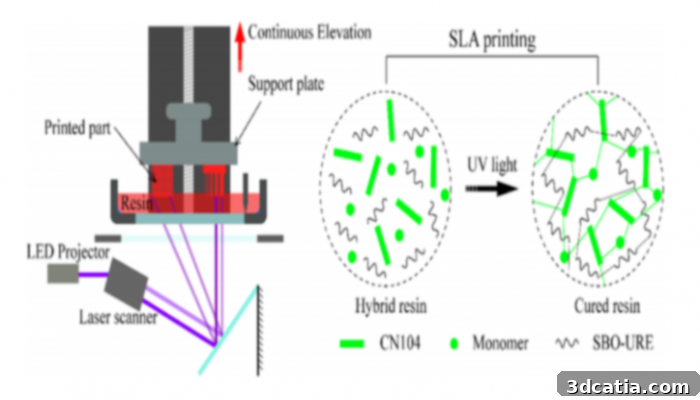
Image credit: Guangdong University of Technology
Groundbreaking Results and Their Implications
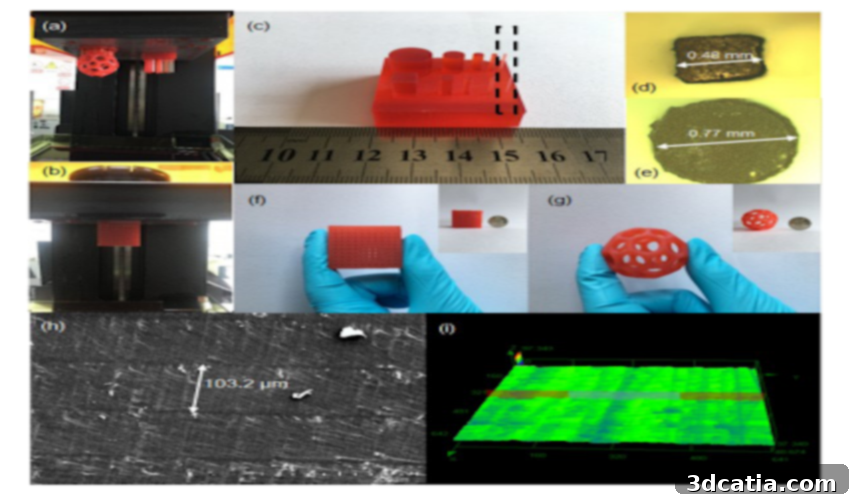
During the rigorous testing phase of this innovative new material, the researchers subjected the 3D-printed resin parts to an extensive series of mechanical evaluations. The results were not only promising but truly remarkable. They discovered that the strategic addition of excess soybean-urethane into the epoxy acrylate matrix not only led to a significant increase in the material’s mechanical strength but, crucially, did so without compromising its elongation properties. This finding is exceptionally important because, in materials science, enhancing strength often comes at the expense of ductility or flexibility. The ability to achieve both improved strength and retained elongation signifies a substantial breakthrough. It means that these novel hybrid resins can be used to produce high-resolution prototypes with “complex microarchitectures and excellent surface finishes,” offering unparalleled design freedom. Furthermore, the inherent bio-friendliness of the material, being derived from vegetable oil, positions it as a highly sustainable alternative to traditional petroleum-based resins. This combination of superior mechanical performance, high resolution, and environmental compatibility opens up a vast array of new possibilities for sustainable additive manufacturing.
Broader Impact and Future Outlook for Sustainable 3D Printing
This research from Guangdong University of Technology has profound implications for the future of the 3D printing industry. It marks a significant step towards decoupling high-performance additive manufacturing from its historical reliance on petroleum-derived materials. By demonstrating that bio-based resins can achieve mechanical properties comparable to, or even exceeding, traditional photopolymers, this study paves the way for a more sustainable and circular economy within manufacturing. The ability to produce parts with enhanced strength and toughness, alongside excellent surface finishes and complex geometries, means that sustainable 3D printing is no longer a compromise. It suggests that industries such as medical device manufacturing, consumer product design, and even certain aerospace applications could begin to adopt these eco-friendly materials for functional prototypes and end-use parts, reducing their carbon footprint without sacrificing quality or performance.
Looking ahead, this development will undoubtedly influence material development trends. It encourages further exploration into other types of vegetable oils and bio-derived polymers, as well as new dual-curing chemistries. Commercialization challenges, such as scaling production and reducing costs, will be the next frontier, but the scientific foundation is now firmly established. This research underscores the vital role of academic institutions in driving innovation and providing practical solutions to global sustainability challenges. It highlights how cutting-edge chemistry, when applied to additive manufacturing, can unlock materials that are both environmentally responsible and technologically advanced, ensuring that 3D printing can contribute meaningfully to a greener industrial future.
Join the Conversation on Sustainable 3D Printing
What are your thoughts on this exciting advancement in dual-curing resin technology utilizing vegetable oil? Do you believe this could significantly accelerate the adoption of sustainable practices in 3D printing? Share your insights and opinions in a comment below, or engage with us on our Facebook and Twitter pages! Don’t miss out on the latest innovations and news in the additive manufacturing world. Sign up for our free weekly Newsletter to receive all the crucial updates straight to your inbox.