
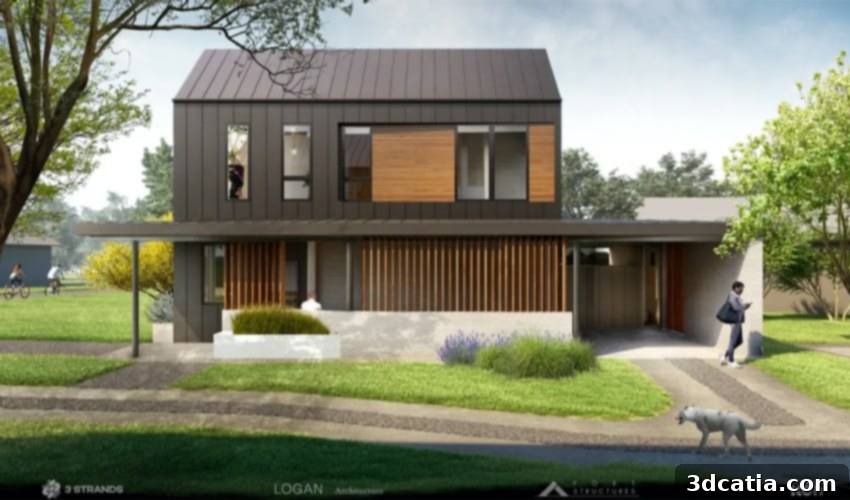
ICON Revolutionizes Housing: Unveiling Austin’s First 3D Printed Multi-Home Neighborhood
In a groundbreaking move set to redefine residential development, ICON, a leading American start-up in the 3D printing construction sector, has announced its most ambitious project yet. Collaborating with Kansas City developer 3Strands and Logan Architecture, ICON is pioneering a multi-home project in Austin, Texas, featuring four innovative 3D printed houses. This endeavor marks a significant stride in mainstream construction, making advanced additive manufacturing accessible to the general public. These homes, built using ICON’s proprietary Vulcan construction system, are designed to offer sustainable, resilient, and aesthetically pleasing living spaces. Anticipated to hit the market immediately upon completion, this initiative highlights ICON’s commitment to transforming the housing landscape on Earth, a slight pivot from their recent work with NASA on lunar infrastructure projects.
Dubbed the East 17th Street Residences, these future-forward homes are planned as multi-story structures, offering flexible layouts with two to four bedrooms. Ranging in size from approximately 1,000 to 2,000 square feet (90 to 185 square meters), they are strategically located in Austin’s rapidly expanding East Austin neighborhood. Each residence promises a blend of modern design and practical amenities, including inviting front porches, generous front yards, covered parking, and open-concept floor plans that maximize natural light and living space. High-performance HVAC systems will ensure year-round comfort and energy efficiency. The construction relies on ICON’s proven Vulcan building system, a technology that has already successfully delivered residences in Mexico, demonstrating its global applicability and reliability in diverse environments. Jason Ballard, co-founder and CEO of ICON, expressed his vision for the future, stating, “With ICON’s 3D printing technology, we anticipate more high-velocity progress in the years ahead to help bring housing and construction into the modern world and in-line with humanity’s highest hopes.” For the interior aesthetics, acclaimed designer Claire Zinnecker, known for her contemporary and minimalist approach, will lead the charge, ensuring that the interiors are as innovative and appealing as the exteriors.
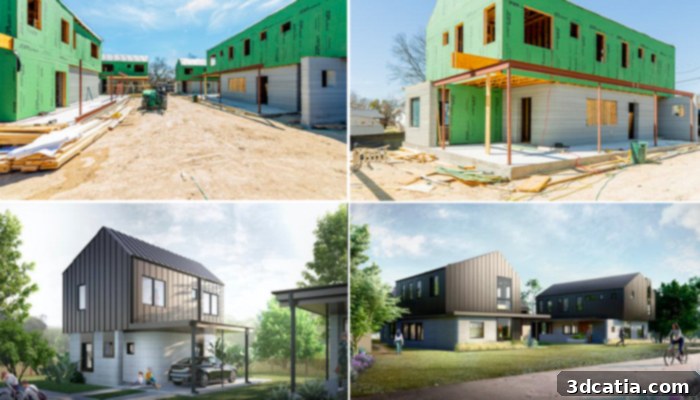
Architectural renderings provide a first look at the East 17th Street Residences project in East Austin, showcasing the innovative design and integration of 3D printing technology (photo credits: ICON and 3Strands).
The Vulcan System: Pioneering Next-Generation 3D Printed Homes
The adoption of 3D printing in construction, or additive manufacturing for infrastructure, is rapidly gaining momentum worldwide. While various technologies exist for building diverse structures, the ICON Vulcan construction system stands out as a pivotal innovation for this Austin project. This advanced system is designed for efficiency and scalability, capable of extruding wall structures up to 8.5 feet (2.6 meters) in height. The machine itself measures 11.5 feet tall (3.5 meters) and, critically, offers an infinite print length, enabling it to adapt to various architectural footprints. Although the core Vulcan unit spans 33 feet (10 meters), its flexibility allows it to print on foundations up to 28 feet wide, accommodating a broad range of home designs. With an impressive print speed ranging from 5 to 7 inches (13 to 18 centimeters) per second, the Vulcan system dramatically accelerates construction timelines. These remarkable features not only open up unprecedented possibilities for developers and builders but also translate into significant time savings and substantial cost reductions, making quality housing more accessible and efficient to produce.
Lavacrete: The Foundation of Resilient and Sustainable 3D Printed Construction
A critical component of ICON’s revolutionary approach to construction is Lavacrete, their proprietary cement-based material exclusively compatible with the Vulcan system. Unlike conventional building materials, Lavacrete boasts superior strength and enhanced longevity, promising homes that are built to last. ICON rigorously develops and tests Lavacrete to ensure it surpasses traditional construction standards. This advanced material is not merely about durability; it significantly elevates the resilience of the printed structures. ICON proudly asserts that Lavacrete technology enables homes to withstand severe environmental challenges, including fire, flooding, and other natural disasters. This inherent resistance is particularly vital in regions like Texas, which are unfortunately susceptible to extreme weather events such as hurricanes and tornadoes. By integrating such robust materials, 3D printing emerges as a compelling future for construction, offering a safer, more sustainable, and cost-effective alternative to conventional building methods. The ability to rapidly deploy disaster-resistant housing could revolutionize relief efforts and provide stable, secure homes in vulnerable areas. For more detailed information on this innovative project and ICON’s broader vision, we encourage you to visit their official website HERE.
The Broader Impact: Sustainability, Affordability, and the Future of Housing
ICON’s East 17th Street Residences project extends beyond merely constructing homes; it represents a significant leap towards addressing pressing global challenges related to housing. The sustainable nature of 3D printing in construction is multifaceted. By utilizing the Vulcan system and Lavacrete, ICON dramatically reduces construction waste compared to traditional building sites. The precision of additive manufacturing means materials are used more efficiently, minimizing excess and promoting a cleaner building process. Furthermore, the localized production of structures can lessen the carbon footprint associated with long-distance transportation of materials. This efficiency also plays a crucial role in enhancing housing affordability. Faster construction times and reduced labor costs can lead to more economical homes, making homeownership a more attainable dream for a wider demographic. This is particularly relevant in rapidly growing urban centers like Austin, where housing demand consistently outstrips supply, leading to soaring prices.
The resilience offered by Lavacrete also has profound implications for sustainable living. Homes that can withstand extreme weather events reduce the need for costly repairs and reconstructions, thereby decreasing material consumption and long-term environmental impact. This forward-thinking approach positions 3D printed homes as a viable solution for future-proofing communities against climate change. ICON’s vision, as articulated by Jason Ballard, is not just about building houses faster or cheaper, but about bringing construction into the modern era, aligning it with humanity’s highest hopes for sustainability, accessibility, and quality of life. The collaboration with 3Strands and Logan Architecture underscores the growing confidence and interest from traditional development and architectural firms in embracing these advanced technologies. This convergence of innovation and conventional expertise is essential for scaling 3D printed construction and integrating it seamlessly into the existing urban fabric.
Moreover, the success of projects like the East 17th Street Residences could inspire similar initiatives globally, catalyzing a broader adoption of 3D printing in diverse construction applications. From developing nations seeking rapid and affordable housing solutions to advanced economies aiming for greener and more efficient building practices, the potential is immense. ICON’s ventures, including their ambitious projects for extraterrestrial construction with NASA, highlight their role as a trailblazer, pushing the boundaries of what is possible with additive manufacturing. Their work on Earth, however, remains central to their mission—to deliver durable, beautiful, and accessible homes for everyone. The continuous refinement of the Vulcan system and Lavacrete material further promises an exciting future where homes are not just built, but intelligently engineered for the challenges and opportunities of the 21st century.
Engage with the Future of Housing
The East 17th Street Residences project in Austin stands as a testament to the transformative power of 3D printing in the construction industry. It invites us to reconsider traditional building paradigms and embrace a future where homes are built with unprecedented speed, efficiency, and sustainability. We are eager to hear your thoughts on these pioneering 3D printed homes. Would you consider purchasing a residence constructed with this innovative technology? Share your perspectives and join the conversation by leaving a comment below or engaging with us on our social media platforms. Find us on Facebook, Twitter, and LinkedIn. For the latest updates and breaking news in the world of 3D printing, sign up for our free weekly Newsletter here and have cutting-edge insights delivered directly to your inbox!