
Revolutionizing Maritime Maintenance: Onboard 3D Printing Transforms Ship Operations
The global maritime industry stands as the backbone of international trade, with an astounding volume of goods transported across the world’s oceans daily. In 2024, approximately 901.2 million ships actively navigated vital maritime trade routes, a figure projected to grow to an estimated 928.1 million by the end of 2028. Asia, in particular, dominates this intricate network, originating a significant 56 percent of the world’s maritime traffic. The sheer scale and continuous operation of these vessels underscore a critical challenge: consistent and efficient maintenance. Cargo ships endure rigorous conditions and long voyages, making regular maintenance, repair, and overhaul (MRO) not merely a procedural step but an absolute necessity for ensuring the safe and timely arrival of goods. Beyond economic implications, the failure to adequately maintain these massive vessels can lead to severe accidents, including ship sinkings. Such incidents result in colossal economic losses and, more tragically, inflict irreparable damage upon our marine ecosystems, leading to widespread pollution and the demise of countless marine species.
Traditionally, ship maintenance involves complex logistics, often requiring vessels to divert to specific ports or enter dry dock for repairs. This process can be time-consuming and expensive, leading to significant downtime, delays in delivery schedules, and increased operational costs due to spare parts procurement and transport. The global supply chain for maritime components is vast and often slow, with lead times for specialized parts sometimes stretching into weeks or even months. This dependency on external suppliers and fixed repair facilities creates vulnerabilities, making the industry susceptible to disruptions and increasing the overall carbon footprint associated with transporting spare parts. The need for a more agile, cost-effective, and environmentally conscious approach to ship maintenance has become paramount, pushing innovators to explore groundbreaking solutions.
A Game-Changing Solution from South Korea: The 3D Printing Digital Workshop
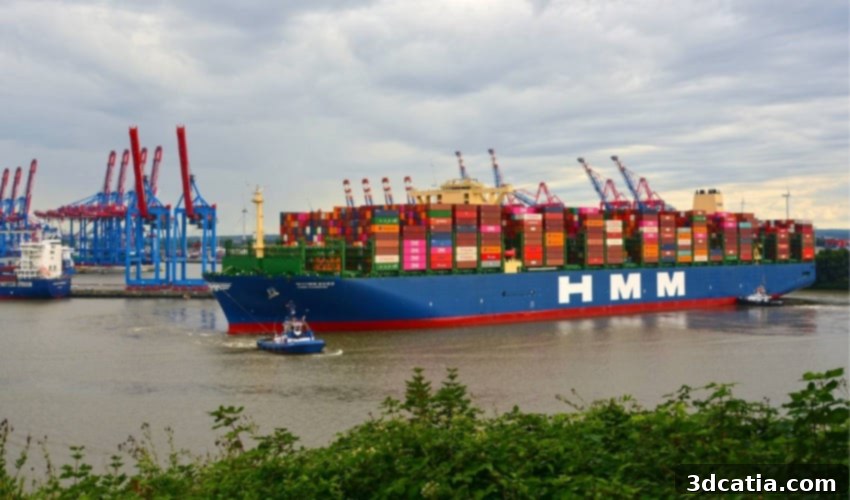
Amidst these challenges, a revolutionary solution is emerging from South Korea, promising to transform how container ships are maintained. HD Hyundai Heavy Industries, a global leader in shipbuilding, has announced the development of a pioneering 3D printing technology designed to enable on-site maintenance, repair, and overhaul (MRO) for vessels. This breakthrough system allows ships to independently perform crucial repairs while actively in operation, a capability that represents a monumental shift from conventional practices. Dubbed the “3D Printing Digital Workshop,” this project introduces an unprecedented level of autonomy and efficiency to maritime operations. The successful demonstration of this innovative 3D printing system recently took place at HD Hyundai Heavy Industries in Mokpo, aboard the “HMM Green Hope,” a 9000 TEU-class container ship operated by Hyundai Merchant Marine (HMM). This successful evaluation marks a significant milestone in integrating advanced manufacturing techniques directly into the maritime domain.
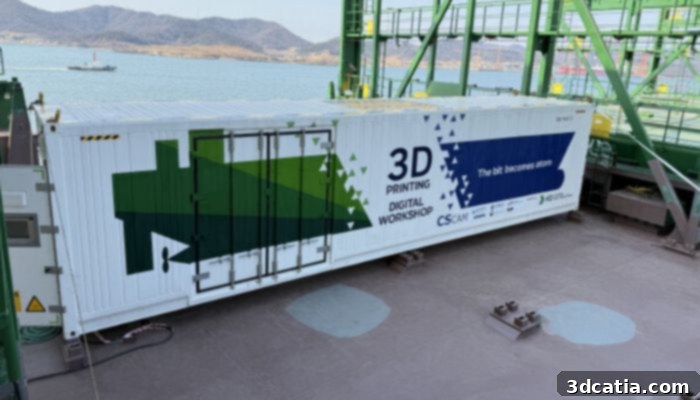
The 3D Printing Digital Workshop (photo credits: HD Hyundai)
The inception of the 3D Printing Digital Workshop is the result of a strategic initiative backed by the South Korean Ministry of Trade, Industry and Energy. This governmental support underscores the national importance and potential economic impact of this technology, with the ministry anticipating the project’s comprehensive completion in the near future. To bring this ambitious vision to fruition, HD Hyundai Heavy Industries forged a powerful consortium, pooling expertise and resources from several key players. Esteemed partners in this collaborative effort include HD Korea Shipbuilding & Offshore Engineering, Ulsan Metropolitan City, American Bureau of Shipping (ABS), CSCAM, and Korean Register. This multi-stakeholder approach ensures that the technology is robust, compliant with international standards, and ready for widespread adoption across the global fleet.
Validation and Technological Advancement
The significance of this development was highlighted on March 17, when the American Bureau of Shipping (ABS), a leading international classification society, actively participated in the 3D Printing Digital Workshop demonstration. Following their involvement, ABS released a statement on X (formerly Twitter), celebrating the successful integration and validation of the system:
This event celebrated the successful installation of the first 3D Printing Digital Workshop onboard HMM’s 9,000 TEU Class Container ship, the concept of which ABS validated. The sea trials, including performance tests to verify the system’s design, have now been completed, representing a substantial advancement in the joint efforts to propel #maritime technology forward.
This endorsement from ABS, a critical body in ensuring maritime safety and compliance, provides strong validation for the technology’s readiness and reliability. The successful completion of sea trials, which included rigorous performance tests, confirms the system’s ability to operate effectively in real-world maritime environments, paving the way for its broader adoption.
How the 3D Printing Digital Workshop Works: On-Demand Metal Manufacturing at Sea
The operational ingenuity of the 3D Printing Digital Workshop lies in its capacity to immediately produce approximately 350 types of small and medium-sized parts essential for ship maintenance. These include vital components such as bolts, flange nuts, and other connecting pipe elements. What makes this system truly revolutionary is its capability to manufacture these critical parts using metal powder, specifically high-strength stainless steel. Traditionally, on-site 3D printing on ships has been limited primarily to plastic materials, suitable only for non-structural or temporary components. The ability to print robust metal parts directly on board represents a paradigm shift, enabling the creation of functional, durable components that can withstand the demanding conditions of maritime use.
The process likely involves advanced metal additive manufacturing techniques, such as powder bed fusion or directed energy deposition, adapted for the unique marine environment. These methods precisely melt and fuse metal powder layer by layer, building intricate parts with high accuracy and mechanical integrity. A crucial technological hurdle for onboard printing is stability. To counteract the relentless oscillations and vibrations caused by wave motion during long voyages, the 3D Printing Digital Workshop is equipped with sophisticated technology designed to actively manage and reduce these disturbances. This stabilization system ensures that the printing process remains precise and uninterrupted, guaranteeing the quality and reliability of the manufactured parts, even in rough seas. This combination of metal printing capability and motion compensation technology positions the Digital Workshop as a truly self-sufficient MRO solution.
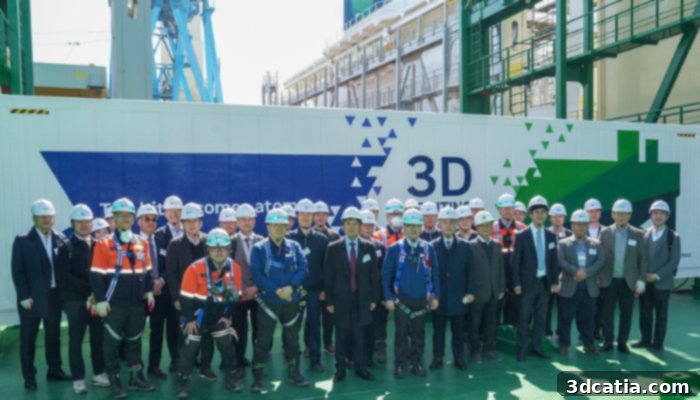
Photo Credits: ABS via X
Commercialization and Future Vision: A Digital Ecosystem for Global Shipping
HD Hyundai Heavy Industries’ overarching goal is the widespread commercialization of this transformative 3D printing technology. A key element of their strategic vision involves the creation of a comprehensive digital library containing an extensive collection of models for various maintenance parts. This digital repository will serve as the foundation for a sophisticated network connecting ships with ports globally. Through this innovative system, necessary parts can be ordered remotely and produced on-demand, either on the vessel itself or efficiently supplied by neighboring ports equipped with similar 3D printing capabilities. This distributed manufacturing model promises to drastically enhance the speed and efficiency of maintenance operations.
The commercialization of the 3D Printing Digital Workshop is set to deliver substantial benefits across the maritime industry. It will lead to significant time and cost savings by minimizing the need for lengthy dry-dock periods and reducing reliance on traditional spare parts supply chains. Inventory costs, a major expense for shipping companies, will be dramatically minimized as parts can be produced precisely when and where they are needed, eliminating the need for vast physical inventories. This “just-in-time” manufacturing approach will also limit additional expenses associated with warehousing and logistics, while drastically reducing the downtime traditionally required for ship maintenance. Furthermore, HD Korea Shipbuilding & Offshore Engineering is actively exploring ways to expand the applicability of this technology to include other critical materials, such as carbon steel powder, which is frequently used in shipbuilding, thereby broadening the range of printable components and reinforcing the system’s versatility.
South Korea’s Strategic Position in the Evolving Maritime Market
South Korea is strategically positioning itself as a formidable force within the dynamic global shipping market, leveraging cutting-edge technologies like 3D printing to gain a competitive edge. This commitment to innovation is encapsulated by an HMM official, who stated, “We will actively participate in various research and development of the latest technologies and strengthen our competitiveness through the introduction of new technologies.” This forward-thinking approach is critical in an industry that must not only constantly innovate but also meticulously optimize its resources to meet continuous commercial demands and evolving environmental regulations. With the ability to print essential metal components on-site, container ships will be far better equipped to address the complex challenges inherent in long-range shipping, ensuring greater operational resilience and responsiveness.
In essence, additive manufacturing, particularly metal 3D printing, is perfectly suited to the burgeoning needs of the maritime sector. It offers a powerful tool for enhancing operational efficiency, reducing environmental impact, and bolstering supply chain security. By embracing such advanced technologies, the industry can look forward to a future where maintenance is proactive, parts are readily available, and ships can navigate the world’s oceans with unprecedented independence and reliability. This not only promises a more sustainable shipping industry but also ensures that the global flow of goods remains robust and uninterrupted, driving economic prosperity worldwide.
What are your thoughts on the 3D Printing Digital Workshop and its potential impact on the maritime industry? Share your insights with us in the comments below or connect with us on our social media channels. Don’t forget to subscribe to our free weekly newsletter for the latest updates in 3D printing straight to your inbox! You can also find all our videos on our YouTube channel.
*Cover Photo Credits: Hyundai Merchant Marine (HMM)