
Revolutionizing Additive Manufacturing: Northwestern’s Dynamic 3D Printing Breakthrough
Pioneering the next generation of additive manufacturing, researchers at Northwestern University have unveiled a remarkably faster and more versatile photopolymerization-based 3D printer. This innovative system, which harnesses the very speed of light, boasts an astounding capability to deposit an incredible 4,000 layers in an mere two minutes – a feat that dramatically accelerates the traditional 3D printing timeline. But speed is just one facet of this groundbreaking technology. What truly sets this dynamic 3D printer apart is its integration with a sophisticated robotic arm, empowering it to precisely move and rotate each individual layer throughout the printing process. This unprecedented degree of freedom enables the creation of parts that exhibit an inherent sense of movement and dynamism, producing structures with complex geometries and functionalities that were previously deemed impossible to achieve through conventional additive manufacturing techniques. This article delves into the intricate workings of this dynamic 3D printing method, exploring how it promises to reshape design and production possibilities across numerous industries.
The foundation of all 3D printing processes traditionally begins with the meticulous digital modeling of a desired final part. This intricate model is then virtually “sliced” into numerous horizontal layers, following a precise, predetermined plan. Subsequently, these two-dimensional layers are deposited sequentially onto a build plate, typically from bottom to top, gradually accumulating to form the final three-dimensional structure. The duration and precision of this manufacturing process are heavily dependent on factors such as the size and complexity of the structure, as well as the specific capabilities of the 3D printer employed. Northwestern’s visionary team, however, sought to inject dynamism into this established “routine.” Their breakthrough provides an unprecedented ability to manipulate the original design layer by layer, crucially allowing the system to rotate the print direction without requiring a complete redesign or recreation of the model. Cheng Sun, an esteemed associate professor of mechanical engineering at the McCormick School of Engineering, encapsulates this paradigm shift, explaining, “The 3D printing process is no longer a way to merely make a replica of the designed model. Now we have a dynamic process that uses light to assemble all the layers but with a high degree of freedom to move each layer along the way.” This statement underscores a fundamental evolution in additive manufacturing, moving beyond static replication to a dynamic fabrication method that unlocks new dimensions of design and material application, profoundly influencing how complex products can be conceived and brought to life.
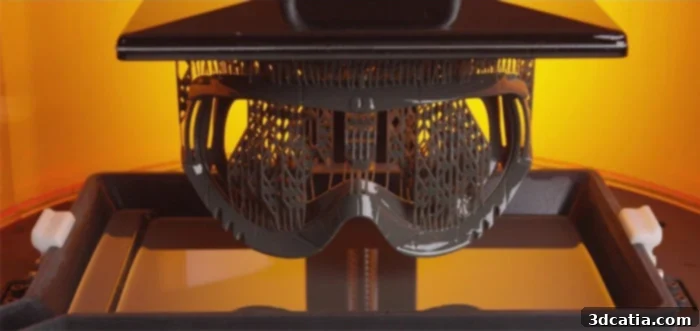
Conventional 3D resin printers create successive layers to design the part. (Photo Credit : DWS)
Unpacking the Dynamic Process: How Northwestern’s Innovative 3D Printer Works
At the heart of this innovative dynamic 3D printing system, meticulously developed by Cheng Sun and his dedicated team, lies a sophisticated DLP (Digital Light Processing) 3D printer seamlessly integrated with a high-precision robotic arm. This crucial combination liberates the machine from the conventional constraints of a fixed Z-axis, a limitation common in most 3D printers that restricts the direction of layer deposition. Instead, the robotic arm grants the system unparalleled agility, allowing it to dynamically alter the printing direction and precisely adjust the orientation of layers in real-time as the object takes shape. Functionally, the core DLP 3D printer operates on principles similar to a classic resin machine: it employs the focused light from a video projector to selectively cure and solidify a liquid photopolymer resin. The distinct advantage of leveraging DLP technology in this context is its inherent ability to polymerize an entire layer of material simultaneously, rather than the more time-consuming, point-by-point solidification characteristic of laser-based stereolithography (SLA) systems. This whole-layer curing capability is paramount to the system’s extraordinary speed, facilitating a continuous and exceptionally rapid manufacturing process. The team’s impressive claim of printing 4,000 layers in just two minutes stands as compelling evidence of DLP’s efficiency and the system’s optimized design, drastically reducing build times for complex components and pushing the boundaries of what is achievable in rapid prototyping and production.
Beyond Speed: Unleashing Multi-Material Capabilities and Novel Applications
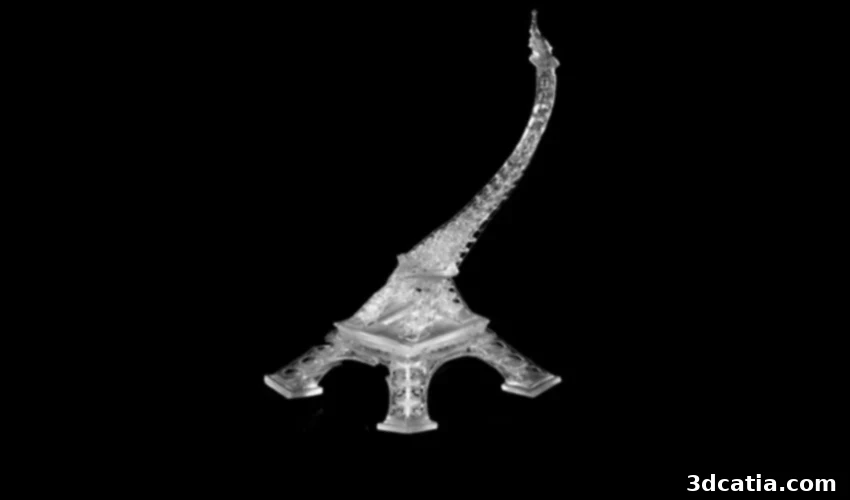
Elaborating further on the capabilities of this groundbreaking system, Cheng Sun emphasized both the efficiency and adaptability of their method: “This is a very fast process, and there is no interruption between layers. We hope the manufacturing industry will find benefit in it. The general printing method is compatible with a wide range of materials.” This statement hints at one of the most exciting potential aspects of this dynamic 3D printing technology: its ability to seamlessly combine different types of resins within a single printing session. If fully realized and commercialized, this functionality would represent a significant breakthrough in the stereolithography market, which has traditionally been limited to printing components from a single, homogenous material at a time. While the team remains commendably discreet about the specific mechanisms enabling this multi-material functionality, they have provided compelling practical evidence of its potential. For instance, they successfully 3D printed a flexible pneumatic clamp featuring a rigid base seamlessly integrated with flexible actuating appendages. This specific example powerfully demonstrates the system’s capacity to incorporate materials with vastly different mechanical properties within a single, integrated part, opening doors for creating components with localized stiffness, flexibility, or other bespoke characteristics tailored to specific functional requirements. Other impressive test pieces created by the machine further showcase its precision and versatility, including intricate models like the iconic Eiffel Tower and a delicate double helix structure, highlighting its capability to handle highly detailed and complex geometries while hinting at its broader potential for industrial and artistic applications.
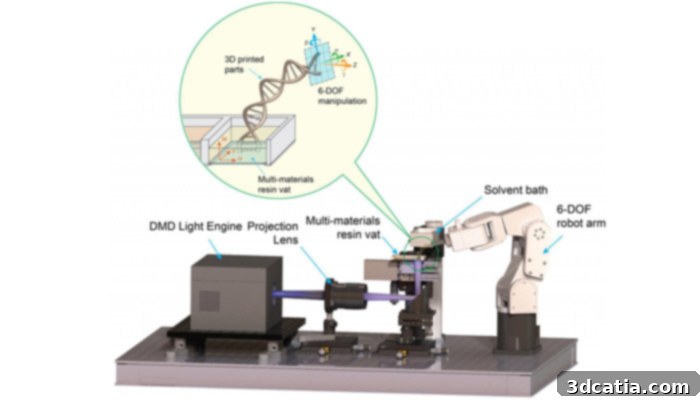
This method of dynamic 3D printing relies on the use of a robotic arm for precise layer manipulation. (Photo Credit : Northwestern University)
Northwestern’s Enduring Legacy in Additive Manufacturing Innovation
This pioneering dynamic 3D printing method is but one of numerous significant additive manufacturing innovations to emerge from the fertile research environment of Northwestern University. Over the years, the institution has consistently proven itself to be a prolific source of groundbreaking research with profound and far-reaching applications across a multitude of sectors. From developing other high-throughput methods aimed at accelerating 3D printing processes, such as the HARP (High-Area Rapid Printing) technology that achieved record-breaking printing speeds, to revolutionary advancements in bioprinted ovaries offering new hope in reproductive medicine, and critical studies on the impact of 3D printed resins on reproductive health, Northwestern University’s contributions have consistently pushed the boundaries of what is possible in scientific and engineering disciplines. This latest dynamic 3D printing innovation further cements its reputation as a leading global hub for advanced manufacturing research, demonstrating a sustained commitment to fostering breakthroughs that address complex challenges and open new avenues for technological progress.
Looking ahead, Cheng Sun’s ambition extends beyond merely applying this novel 3D printing method to existing technologies within the additive manufacturing landscape. He envisions a future where this dynamic approach could also be adapted and integrated into subtractive manufacturing processes, such as precision machining or laser cutting. Such an integration would represent a monumental leap, offering synergistic opportunities for manufacturers to combine the unparalleled design freedom and material efficiency of additive techniques with the precision, surface finish, and material diversity of subtractive methods. This potential cross-pollination of manufacturing philosophies could unlock significant efficiencies, material savings, and unprecedented design possibilities, presenting transformative opportunities for the entire manufacturing industry. The official press release, which delves into further technical details and insights from the research team, can be accessed HERE for those eager to explore the foundational scientific work behind this exciting development and understand its deeper implications for future manufacturing paradigms.
*Cover Photo Credit : Northwestern University
The advent of Northwestern’s dynamic 3D printing method marks a pivotal moment in the evolution of additive manufacturing. By combining unprecedented speed with revolutionary layer manipulation capabilities and the potential for multi-material integration, this technology promises to enable the creation of highly functional, complex, and previously unimaginable parts. It stands as a testament to ongoing innovation, challenging existing paradigms and paving the way for a future where manufacturing is not just faster, but also infinitely more flexible and creative. What are your thoughts on this novel dynamic 3D printing method and its potential impact on future manufacturing across various sectors, from aerospace to biomedical engineering? We invite you to share your insights in a comment below or join the conversation on our Facebook, Twitter and LinkedIn pages! For the very latest updates, breaking news, and in-depth analyses in the fast-evolving world of 3D printing, remember to sign up for our free weekly Newsletter here, delivered straight to your inbox!