
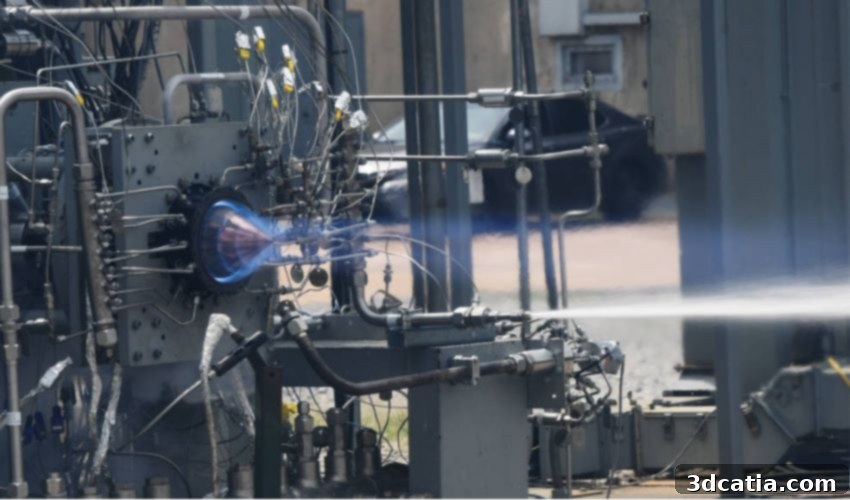
3D-Printed Rocket Engine Propels NASA Towards Sustainable Deep Space Exploration
The year 2023 has quickly distinguished itself as a landmark period for the integration of additive manufacturing into the realm of space exploration. Just recently, the European Space Agency (ESA) announced the inclusion of 3D-printed components on a rover destined for a Moon landing in April, underscoring the growing confidence in this innovative technology. Now, NASA has delivered an equally groundbreaking announcement, revealing the successful development and extensive testing of the first full-scale Rotating Detonation Rocket Engine (RDRE). This achievement is not merely an engineering feat; it represents a potential paradigm shift in the design and operation of future propulsion systems, demonstrating additive manufacturing’s capacity to produce hardware capable of enduring the extreme conditions of deep space missions over extended durations.
For over half a century since humanity first set foot on the Moon, the drive to push the boundaries of space exploration has only intensified. Leading organizations like NASA and the ESA, alongside a burgeoning private sector, are increasingly setting their sights on ambitious missions to explore our solar system and beyond. The successful test of the RDRE brings us closer than ever to these goals, offering definitive proof that additive manufacturing will play a foundational role in this exciting new chapter of space exploration, making missions more efficient, cost-effective, and ultimately, sustainable.
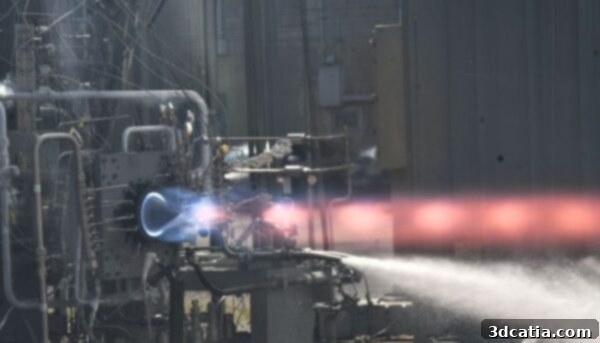
The full test of the RDRE at Marshall Space Flight Center (photo credits: NASA)
The Revolutionary Rotating Detonation Rocket Engine (RDRE)
The RDRE stands out as a remarkable innovation in propulsion technology for several compelling reasons. Its advanced rocket engine design departs significantly from conventional liquid-fueled engines by generating thrust through a phenomenon known as detonation – a supersonic combustion process. Unlike the relatively slower deflagration process in traditional engines, detonation involves a shockwave that compresses and ignites the fuel-oxidizer mixture almost instantaneously. This fundamental difference is key to its enhanced performance. By harnessing the immense power of continuous, rotating detonations, the RDRE can produce substantially more thrust while consuming considerably less fuel compared to its predecessors. This incredible efficiency is paramount for any endeavor aiming to reach distant deep-space destinations, such as establishing permanent bases on the Moon or undertaking crewed missions to Mars, where every kilogram of fuel saved translates into significant mission advantages.
The pursuit of such high-efficiency propulsion is driven by the inherent challenges of space travel. Launching payloads into orbit and then propelling them across vast interplanetary distances requires immense energy. Traditional engines, while powerful, operate with thermodynamic limitations that make long-duration, deep-space missions logistically complex and prohibitively expensive due due to the sheer volume of fuel required. The RDRE’s ability to achieve higher thrust-to-weight ratios and improved specific impulse directly addresses these challenges, promising a future where spacecraft can carry more scientific instruments, more crew provisions, or more structural components with the same or even less propellant mass. This efficiency is a critical enabler for the next generation of deep space exploration, paving the way for more ambitious and sustainable human and robotic missions.
Additive Manufacturing: The Key to RDRE Success
Beyond its novel combustion principle, a crucial aspect that makes this latest test so compelling is the manufacturing method used for the RDRE’s hardware: 3D printing. Specifically, the engine components were fabricated using powder bed fusion additive manufacturing, leveraging NASA’s proprietary copper-alloy, GRCop-42, developed specifically for high-temperature, high-pressure space applications. Additive manufacturing, or 3D printing, has revolutionized component design and production in aerospace, allowing for the creation of incredibly complex internal geometries that are impossible to achieve with traditional manufacturing techniques. For an engine like the RDRE, which relies on precise and intricate channels to manage the detonation waves and combustion gases, this capability is invaluable.
The choice of 3D printing and GRCop-42 was no accident. GRCop-42, an alloy of copper, niobium, and chromium, is renowned for its exceptional thermal conductivity and mechanical strength, even at the extreme temperatures generated by detonation. These material properties are critical for ensuring the structural integrity and operational longevity of rocket engine components subjected to intense heat and pressure cycles. Furthermore, additive manufacturing enables rapid prototyping and iteration, allowing engineers to quickly design, print, and test multiple variations of complex parts. This iterative process significantly accelerates development cycles, reducing the time and cost associated with bringing advanced propulsion systems from concept to flight-ready hardware. The ability to consolidate multiple parts into a single, complex 3D-printed component also reduces assembly time, minimizes potential failure points, and decreases overall weight, all of which are vital advantages in space applications.
Indeed, a primary objective of the testing was to rigorously assess whether the 3D-printed hardware could operate reliably for extended durations while withstanding the extreme heat and immense pressure environments inherent to detonation. The results were unequivocally successful. Over a period of nearly ten minutes of active testing, the engine was fired more than a dozen times at NASA’s Marshall Space Flight Center, demonstrating its robustness and consistent performance. The test series proved that AM-fabricated hardware is not only viable for such demanding applications but can also surpass the performance thresholds of previously established designs.
Groundbreaking Test Results and Milestones
During these rigorous tests, the RDRE achieved a series of impressive milestones. As captured in the video footage, the engine successfully produced over 4,000 pounds of thrust for nearly a minute, operating at an average chamber pressure of 622 pounds per square inch (psi). This pressure rating represents the highest on record for this type of engine design, signifying a significant leap forward in the efficiency and power density of rocket propulsion. Such high-pressure operation means more power can be generated from a smaller engine, translating to lighter, more compact propulsion systems that are ideal for the constraints of spacecraft design.
Beyond raw power, the engine also demonstrated other critical functionalities essential for versatile space missions. It successfully performed deep throttling, a capability that allows an engine to operate efficiently across a wide range of thrust levels. This flexibility is vital for various mission phases, from precise orbital maneuvers to controlled landings on celestial bodies. Additionally, the RDRE achieved successful internal ignition, demonstrating its ability to reliably start and restart in the vacuum of space. These combined achievements underscore the engine’s maturity and readiness for potential integration into future flight vehicles, opening up new possibilities for mission profiles that require dynamic thrust adjustments and dependable operation far from Earth.
Implications for Future Space Exploration and Sustainability
The successful validation of the RDRE technology fills NASA with optimism regarding its potential integration into future flight vehicles and commercial space applications. The ability of this engine to move more payload and mass with less fuel is a game-changer. For deep space missions, this means larger scientific instruments, more life support systems for longer crewed missions, or additional components for lunar or Martian bases. For the burgeoning commercial space industry, it translates to reduced launch costs and increased operational efficiency for satellite deployment, space tourism, and in-orbit services.
Ultimately, these advancements contribute directly to making space exploration more sustainable. By maximizing the utility of every kilogram launched, RDREs can help conserve precious resources, reduce waste, and lower the overall environmental footprint of space activities. Moreover, the rapid prototyping capabilities afforded by additive manufacturing mean that the development cycles for future engines can be dramatically shortened, allowing for quicker innovation and adaptation to evolving mission requirements. This agility is crucial in a field as dynamic as space exploration, ensuring that propulsion technology can keep pace with ambitious new goals. The combination of increased performance, reduced fuel consumption, and accelerated development signifies a powerful leap forward in our quest to explore and utilize space efficiently and responsibly. For more details on this groundbreaking achievement, you can refer to NASA’s official press release HERE.
The Future is Now: 3D Printing and Deep Space
The successful test of NASA’s 3D-printed Rotating Detonation Rocket Engine is more than just an engineering triumph; it’s a powerful testament to the transformative potential of additive manufacturing in the space sector. From the complexities of engine components capable of withstanding extreme conditions to the overall efficiency and sustainability of future missions, 3D printing is unequivocally carving out a pivotal role in humanity’s ongoing journey into the cosmos. This technology is not merely an incremental improvement; it represents a fundamental shift in how we conceive, design, and build the hardware that will propel us to the Moon, Mars, and beyond, paving the way for a new era of exploration, discovery, and commercial endeavors in space.
What are your thoughts on the successful test of the RDRE? Do you envision a near future where deep space missions are routinely powered by engines made using advanced 3D printing techniques? Let us know your insights in a comment below, or engage with us on our LinkedIn, Facebook, and Twitter pages! Don’t forget to sign up for our free weekly Newsletter here, ensuring the latest 3D printing news is delivered straight to your inbox! You can also find all our compelling videos on our YouTube channel.
*Cover Photo Credits: NASA