
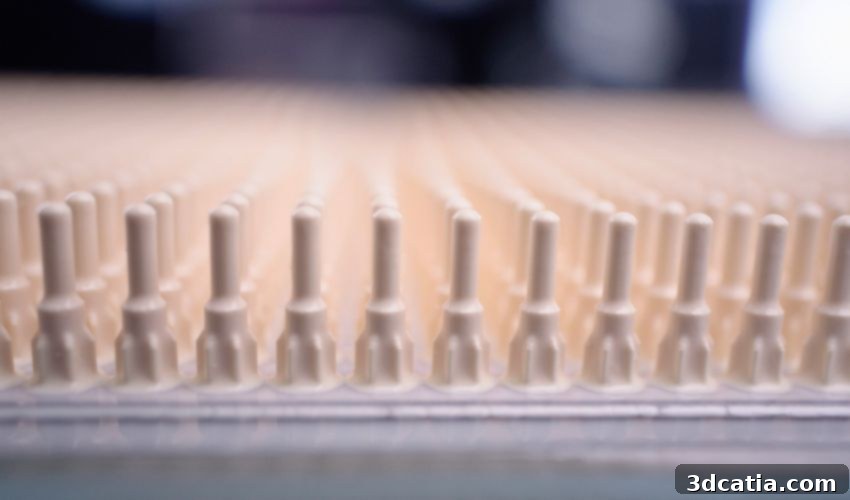
Revolutionizing Manufacturing: The Power of Ceramic 3D Printing in Industrial Applications
Among the myriad of materials revolutionizing the manufacturing landscape, technical ceramics stand out, generating considerable interest and driving significant advancements in various sectors. This surge in attention is clearly reflected in the robust growth of the ceramic 3D printing market, which continues to expand its footprint across diverse industries year after year. A recent report by Fundamental Business Insights underscores this trend, valuing the global 3D printing ceramic market at approximately $45.12 million in 2023. Projections indicate an impressive ascent to $519.72 million by 2032, propelled by a remarkable compound annual growth rate (CAGR) of 31.2% between 2024 and 2032. This exponential growth highlights the increasing recognition of ceramic additive manufacturing as a cornerstone technology for future industrial innovation.
The primary catalyst behind this expansion is the unparalleled suite of advanced properties inherent in technical ceramics. These include exceptional chemical resistance, superior electrical insulation, remarkable high-temperature resilience, and inherent biocompatibility. Such characteristics render technical ceramics indispensable for critical and demanding industries. From the high-stakes environments of aerospace and automotive engineering to the precision requirements of the energy sector and the life-saving applications in medical technology, ceramic materials offer solutions where traditional materials often fall short. Their ability to withstand extreme conditions and maintain structural integrity makes them ideal for components operating under stress, heat, or corrosive environments, paving the way for innovations previously considered impossible.
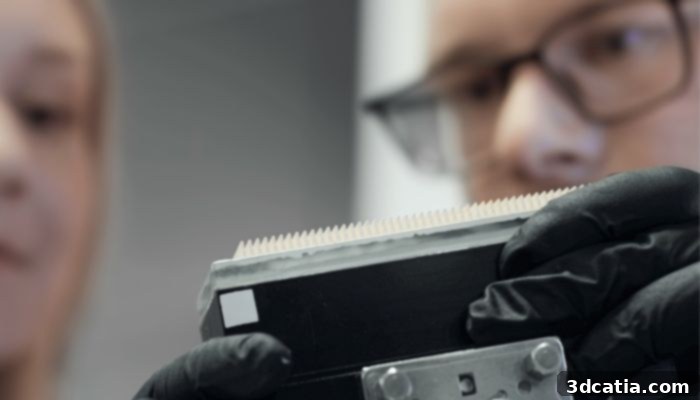
Ceramic additive manufacturing is an increasingly prevalent technology for industrial applications, enabling the creation of high-performance components.
While technical ceramics are undeniably perfect for high-performance applications, their processing can present significant challenges. Traditional manufacturing methods often struggle to maintain consistent material properties and uncompromising quality across individual parts, especially when scaling up production or dealing with intricate geometries. Issues such as uncontrolled porosity, undesirable surface roughness, and deviations in dimensional accuracy frequently arise, impacting the reliability and performance of the final components. These challenges traditionally limited the widespread adoption of ceramics in complex or high-volume industrial settings, necessitating innovative approaches to overcome manufacturing bottlenecks.
To address these inherent complexities and unlock the full potential of technical ceramics, a growing number of specialized companies are focusing on ceramic 3D printing. These pioneers are demonstrating the feasibility and reliability of additive manufacturing for producing complex, serial ceramic components for demanding industrial applications. Among these industry leaders is Bosch Advanced Ceramics, a prominent entity established in 2014 as part of the Bosch Business Innovations subsidiary within the globally renowned Bosch Group. Since its inception, Bosch Advanced Ceramics has dedicated its expertise to industrial production through ceramic additive manufacturing, with a clear strategic goal: to bridge the critical gap between initial prototyping and the high-volume industrial production of advanced ceramic components. By mastering the entire process chain, they enable industries to transition seamlessly from conceptual design to fully functional, serially produced parts, pushing the boundaries of what is achievable with ceramic materials.
Key Advantages of Ceramic Additive Manufacturing for Industrial Applications
The advantages of adopting additive manufacturing (AM) over conventional fabrication methods are extensively documented and widely acknowledged. These benefits encompass a broad spectrum of improvements, including the unprecedented ability to produce highly detailed and intricately complex parts, which often cannot be realized through traditional means. Furthermore, AM processes offer a more flexible and optimized production workflow, allowing for greater design freedom and rapid iteration. This technology also facilitates the integration of multiple functionalities into a single component, leading to more innovative product designs, reduced assembly times, and enhanced performance. Consequently, businesses can achieve faster time-to-market cycles and realize significant savings in terms of both financial investment and production duration. However, the benefits of ceramic additive manufacturing extend even further, offering unique advantages specifically tailored to the nuances of ceramic materials.
Delving deeper into ceramic additive manufacturing reveals additional critical advantages. One significant benefit is the elimination of the need for expensive and time-consuming molds, particularly for the production of small, highly complex parts. Traditional molding processes for ceramics involve substantial upfront costs and long lead times for mold design, manufacturing, and delivery. Ceramic AM bypasses these hurdles entirely, drastically reducing both expenses and waiting periods. This agility empowers designers and engineers with unparalleled flexibility, enabling rapid changes to design and production requirements without incurring prohibitive costs or delays. The ability to iterate quickly and adapt designs on the fly provides a crucial competitive edge, allowing companies to respond swiftly to market demands and continually innovate their product offerings. This flexible manufacturing paradigm is a game-changer, moving ceramic production beyond its traditional limitations and fostering a new era of agile development.
Capitalizing on these multifaceted advantages, an increasing number of companies are now leveraging additive manufacturing for the scaled production of high-performance ceramic components. This widespread adoption definitively proves that ceramic AM is no longer confined to the realm of prototyping, a misconception sometimes held. Instead, it has matured into a robust, industrial-grade technology capable of delivering production-ready parts in significant volumes. This shift signifies a crucial evolution in manufacturing, positioning ceramic AM as a mainstream solution for critical applications across various industries.
Ashu Sharma, CSO of Bosch Advanced Ceramics, emphasizes the importance of communicating these transformative benefits, as not all potential customers are fully aware of the technology’s capabilities. He notes, “As additive manufacturing is a relatively young technology, many of our customers are not aware of all its benefits. We inspire our customers in technical meetings, showing them how to leverage these benefits and get the best use out of the technology.” The ongoing challenge, therefore, lies in effectively educating the broader industrial community about the immense potential of ceramic AM and showcasing the extensive range of applications it can facilitate, thereby unlocking new opportunities for innovation and efficiency.
Transformative Use Cases of Ceramic AM Across Multiple Industries
The theoretical benefits of ceramic additive manufacturing translate into tangible, advanced parts across numerous sectors. To illustrate this, Bosch Advanced Ceramics provided concrete examples of successfully implemented use cases. These demonstrations reveal the remarkable adaptability of this technology and these advanced materials to a wide variety of applications and diverse industrial requirements, proving their versatility and impact.
Bosch Advanced Ceramics actively serves a range of industries, each presenting unique engineering challenges and demanding highly customized solutions. Key sectors include medical technology, semiconductor manufacturing, energy, automotive, and advanced electronics. One of the company’s notable recent projects involved the production of exceptionally small and intricate insulation sleeves for a leading medical technology firm. The objective was to create a sleeve designed to electrically insulate a delicate 0.5-mm wire within a laparoscopic surgical instrument. The core challenge was to manufacture a component with an extremely precise maximum external diameter of just 1.3 mm and an astonishingly thin wall thickness of only 90 µm. Such exacting requirements are almost impossible to achieve consistently with conventional manufacturing methods due to material limitations and tooling constraints.
Ceramic AM technology proved instrumental in enabling Bosch Advanced Ceramics to meet this formidable challenge. The flexibility of additive manufacturing allowed for rapid iterations in design and process parameters, facilitating quick refinement of their manufacturing approach. Leveraging Lithoz’s advanced Lithography-based Ceramic Manufacturing (LCM) technology, the company successfully produced up to 1,400 parts in a single printing process, achieving a total output of as many as 50,000 parts within a year. The successful realization of this project not only showcased the power of ceramic AM but also paved the way for the implementation of innovative and less invasive laparoscopic instrumentation, ultimately benefiting patients through enhanced surgical precision and reduced trauma.
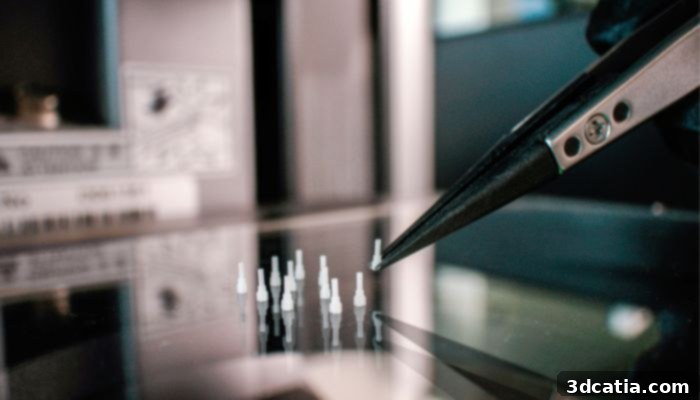
The 3.65mm-sleeve, manufactured from alumina, provides excellent thermal resistance, chemical stability, and electrical insulation essential for advanced medical devices.
Another compelling application demonstrating the versatility of ceramic 3D printing comes from a collaboration with STIWA, a prominent automated machinery company. STIWA required an innovative dispensing needle for its precision automated adhesive processes. Traditionally, metal dispensing needles are employed for accurately applying highly viscous adhesives. These components are subjected to significant wear and tear, necessitating extreme robustness and wear resistance, as any downtime in high-volume production lines can lead to substantial financial losses. Bosch Advanced Ceramics stepped in to develop an alternative dispensing needle made from advanced technical ceramics, leveraging the capabilities of 3D printing to create a superior solution.
The ceramic dispensing needle was precisely printed on a Lithoz printer using Alumina 99.8%. What truly distinguishes this component is its remarkably complex internal geometry: an internal cone that tapers gradually from a few millimeters down to an incredibly fine 0.8 mm, characterized by sophisticated curvature. Such an intricate internal structure is virtually impossible to achieve with the precision and consistency required using traditional manufacturing techniques. Furthermore, the high precision inherent in the ceramic AM process ensured an exceptionally low surface roughness, which is crucial for promoting a smooth and consistent flow of adhesive through the tiny orifice, thereby optimizing the accuracy and reliability of automated dispensing operations.
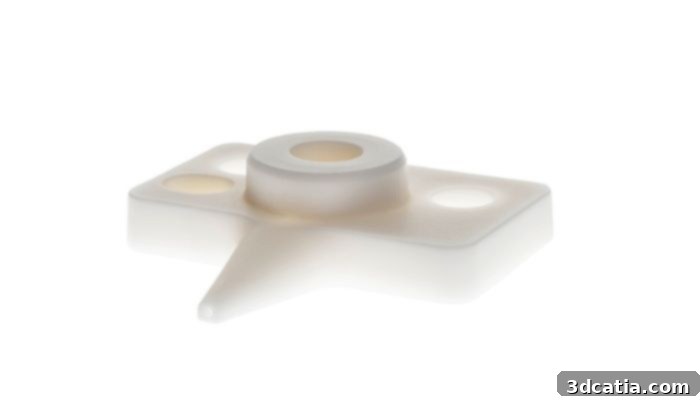
The ceramic dispensing needle features a complex internal geometry, allowing for precise and efficient adhesive dispensing.
Finally, the semiconductor industry, with its stringent demands for purity, precision, and extreme material properties, stands to gain immensely from ceramic 3D printing. Bosch Advanced Ceramics successfully fabricated a large 200 mm ring blade for the delicate handling and processing of wafers within cassettes or process chambers. This impressive component, crafted from >99.8% alumina, measures 250x200x3.5 mm and remarkably weighs only 280 grams. A critical design feature is the 120-mm continuous inner channel integrated within the piece, specifically designed to facilitate the controlled flow of gases or liquids, crucial for various wafer processing steps.
Crucially, unlike metallic components, alumina does not contaminate wafers or compromise the ultra-high purity required in semiconductor manufacturing environments, significantly mitigating contamination risks. Its non-reactive nature, coupled with outstanding chemical and temperature resistance, makes it an ideal material for the demanding semiconductor environment, ensuring consistent and reliable performance over extended periods. For this particular application, Bosch Advanced Ceramics utilized a high-performance printer from 3D Ceram, which enabled the precise production of this sizable ring with exceptional density and accuracy as a single, monolithic piece. This capability highlights how ceramic AM addresses some of the most critical challenges in advanced microelectronics manufacturing.
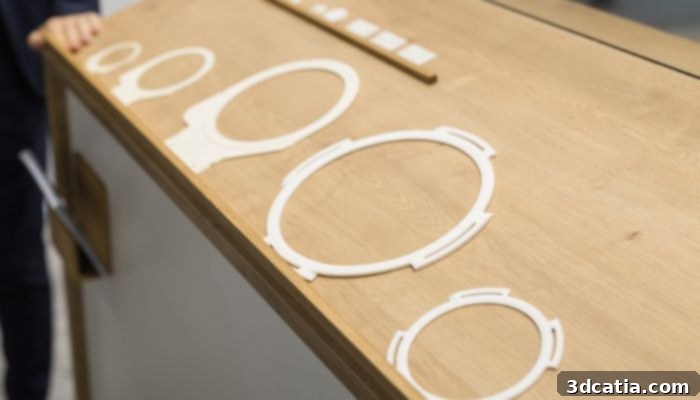
Ceramic additive manufacturing offers unparalleled scalability and flexibility in both part design and production, driving innovation across industries.
These compelling use cases vividly illustrate the transformative potential of ceramic additive manufacturing across a broad spectrum of industrial requirements. By consistently delivering reliable, high-quality solutions for even the most demanding and technically challenging applications, this advanced technology is unequivocally proving to be a game-changer. Collaborating with specialized experts who possess the capability to support a project from its initial conceptualization through to full-scale, serial production—such as Bosch Advanced Ceramics—provides a significant and undeniable competitive advantage in today’s rapidly evolving industrial landscape. These partnerships enable companies to harness the full power of ceramic AM, ensuring optimal design, efficient production, and superior performance of final components.
Sophie Berninger, CEO of Bosch Advanced Ceramics, further elaborates on their achievements: “By mastering the entire process chain from design iteration to final component, we’ve grown the technology beyond the prototype stage and are now actively producing ceramic components in series using 3D printing, demonstrating the viability and reliability of additive manufacturing for a range of industries. The ability to produce high precision technical ceramics with complex geometries offers real benefits, from reduced lead times to more efficient use of materials. As technology continues to develop, it’s clear that additive manufacturing will be a key driver of innovation, helping industries to remain competitive in a rapidly changing landscape.” Her statement underscores the strategic importance of ceramic AM as a catalyst for innovation and competitiveness. To delve deeper into Bosch Advanced Ceramics’ capabilities and explore more ceramic AM applications, please click HERE.
What are your thoughts on the pivotal role of ceramic additive manufacturing in advancing industrial applications? Let us know your insights in a comment below or connect with us on our LinkedIn, Facebook, and Twitter pages! Don’t forget to sign up for our free weekly Newsletter here, to receive the latest 3D printing news directly to your inbox! You can also find all our engaging videos on our YouTube channel.
*All Photo Credits: Bosch Advanced Ceramics