
Unlocking Innovation: The Explosive Growth of Ceramic 3D Printing Towards a $400 Million Market by 2032
The landscape of advanced manufacturing is undergoing a profound transformation, with ceramic additive manufacturing emerging as a pivotal technology poised for unprecedented growth. A groundbreaking new report, meticulously compiled by the reputable research firm IDTechEx, casts a spotlight on this burgeoning sector, projecting its market value to soar to an impressive $400 million by the year 2032. This remarkable forecast represents a staggering seven-fold increase from its current standing, a surge driven by an escalating number of industry players who are strategically investing in and banking on the immense potential of this innovative technology. The comprehensive study delves into a multitude of crucial aspects, offering a detailed analysis of the primary applications propelling the demand for ceramic 3D printing, an in-depth look at the leading material and machine manufacturers shaping the market, and an exploration of the diverse sectors of activity that are most actively leveraging this advanced process. Significantly, the report’s 10-year forecasts paint a vividly optimistic picture, unequivocally underscoring that ceramic additive manufacturing has a profoundly bright future ahead, even as it navigates its journey from being an often unknown and relatively nascent technology to a mainstream manufacturing solution.
Compared to its more established counterparts, such as polymer 3D printing or advanced metal additive processes, ceramic additive manufacturing has historically occupied a more specialized niche, predominantly utilized for cutting-edge research and rapid prototyping purposes. However, this perception is quickly shifting as the technology matures, demonstrating capabilities that are simply unattainable through conventional methods. The fundamental allure of ceramic 3D printing lies in its unparalleled ability to facilitate the creation of highly complex, intricately designed tools and parts, often at a significantly reduced cost and with much shorter lead times compared to traditional manufacturing techniques. Conventional ceramic production methods, including hot isostatic pressing, extrusion, and injection molding, have been the backbone of the ceramics industry for decades. Yet, these methods are frequently associated with prohibitively high capital costs, extensive tooling requirements, and prolonged production cycles, presenting significant barriers to rapid innovation and agile manufacturing. This is precisely where the transformative power of additive manufacturing intervenes, mirroring the disruption and efficiency it has already brought to the metal and polymer markets by offering unprecedented design freedom, enhanced cost-efficiency, and accelerated production timelines.
The inherent properties of ceramic materials themselves are a primary driver of this surging interest and widespread adoption. Ceramics are universally renowned for their exceptional hardness, outstanding high-temperature resistance, remarkable chemical inertness, superior electrical insulation capabilities, and excellent biocompatibility. These unique attributes make them indispensable in an ever-growing array of demanding applications where other materials simply cannot perform effectively. For instance, their ability to withstand extreme thermal environments makes them ideal candidates for critical aerospace components, high-performance engine parts, and advanced thermal protection systems. Their inherent chemical resistance is crucial in industrial applications involving harsh corrosive agents and aggressive chemical environments, while their precise electrical properties are vital for next-generation electronics, sensors, and communication devices. Moreover, the biocompatibility of specific ceramics opens vast new possibilities in the medical and dental fields, enabling the creation of custom implants, prosthetics, and sophisticated medical devices tailored to individual patient needs. Additive manufacturing acts as a catalyst, unlocking the full potential of these advanced materials by allowing engineers to design and produce geometries previously deemed impossible, integrating complex functionalities and optimizing performance in ways that traditional manufacturing simply cannot achieve.
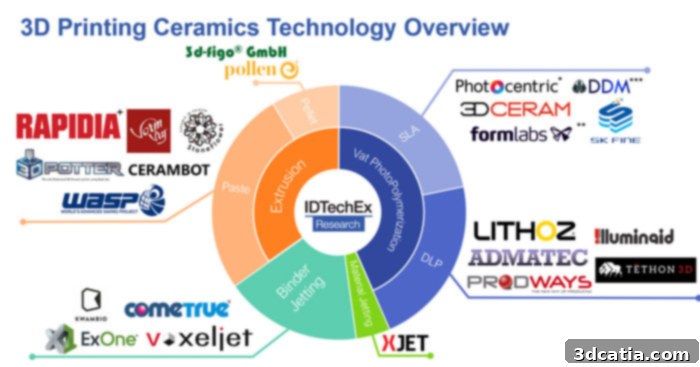
Manufacturers of ceramic 3D printing solutions are at the forefront of driving market expansion (photo credits: IDTechEx)
The comprehensive IDTechEx study, aptly titled “3D Printing Ceramics 2022-2032: Technology and Market Outlook,” offers an exhaustive exploration of the key market players and the dynamic technological landscape. It meticulously addresses critical questions concerning who the leading machine manufacturers are, the innovators driving advancements in material development, the software providers enabling complex designs and simulations, and, crucially, the diverse range of end-users who are fueling demand across various industries. The report meticulously scrutinizes the array of existing processes currently employed in ceramic 3D printing, including advanced techniques such as binder jetting, various light curing methods (encompassing stereolithography, digital light processing, and vat photopolymerization), material extrusion (such as robocasting and FDM-like processes), and even sophisticated material jetting technologies. Some pioneering companies have specialized in this intricate market from its very inception, becoming synonymous with ceramic additive excellence; prominent examples of these dedicated innovators include Lithoz and 3D Ceram. Concurrently, other established additive manufacturing players have strategically adapted and refined their existing machine platforms to render them fully compatible with the unique and demanding requirements of ceramic materials, thereby significantly expanding the accessibility and reach of this transformative technology. As insightfully noted by IDTechEx analysts, “These companies’ interest in ceramic 3D printing indicates that the path for future growth for the market is open,” a powerful statement signaling robust confidence and an environment ripe for sustained innovation and considerable expansion.
Beyond the impressive technological advancements, the IDTechEx report meticulously highlights the transformative impact of ceramic 3D printing across a diverse spectrum of applications. Initially, these additive processes found their primary utility in fundamental R&D and sophisticated rapid prototyping endeavors, enabling engineers and designers to quickly iterate and validate complex designs with unprecedented speed and cost-effectiveness. However, the market trajectory is rapidly shifting towards broader commercialization and the production of functional, high-performance end-use parts. Key industrial sectors are now demonstrating significant interest and substantial investment in this technology for the production of small series, highly customized, or geometrically intricate components that demand the unique properties of ceramics. These critical sectors include, but are not limited to, the aerospace industry, where lightweight, high-temperature resistant, and durable parts are absolutely crucial for mission success; defense applications, which demand specialized materials for extreme conditions and enhanced operational capabilities; the dental sector, benefiting immensely from custom-fit, biocompatible crowns, bridges, and implants that offer superior patient comfort and longevity; and chemical engineering, which requires chemically inert, highly robust, and intricately designed components for complex systems. The diagram below graphically illustrates the burgeoning opportunities within this dynamic market, unequivocally indicating a promising acceleration towards widespread commercialization and industrial adoption.
The study further emphasizes the substantial room for continued growth in R&D sales, a clear and compelling indicator of the foundational work being meticulously laid for future market expansion and technological breakthroughs. A vast and interconnected network of research institutes and universities worldwide are actively engaged in pushing the boundaries of ceramic additive manufacturing, tirelessly working to advance the underlying technology and explore its potential in a myriad of innovative and impactful applications. These cutting-edge areas include, but are not limited to, the development of advanced medical devices and highly customized implants leveraging state-of-the-art bioceramics; novel solutions for next-generation energy storage, such as high-performance solid-state batteries and efficient fuel cells; groundbreaking approaches to carbon capture technologies aimed at addressing climate change; and the creation of intricate components for high-frequency electronics. Each of these applications capitalizes on the unparalleled combination of the unique properties inherent in ceramics with the unparalleled design freedom offered by 3D printing, promising revolutionary breakthroughs that could fundamentally redefine entire industries and solve some of humanity’s most pressing challenges.
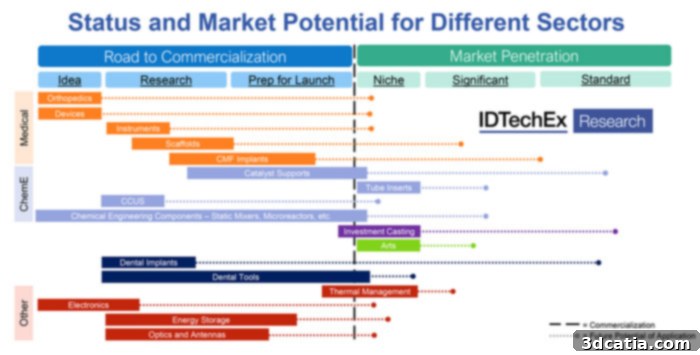
Illustrating diverse applications and the immense market potential of ceramic additive manufacturing (Photo Credits: IDTechEx)
While the outlook for ceramic 3D printing is undeniably bright and filled with promise, the journey towards widespread industrial adoption is not without its significant challenges. One of the primary hurdles lies in ongoing material development, particularly in perfecting ceramic feedstocks for various printing processes to ensure consistent quality, precise mechanical properties, and ultimately, cost-effectiveness at scale. Post-processing steps, especially the critical stages of debinding and high-temperature sintering, are also inherently complex and demand precise control to achieve the desired density, structural integrity, and flawless surface finish of the final parts. Scalability remains another crucial area of focus, as manufacturers aim to transition from small batch production and prototyping to larger volumes while consistently maintaining superior quality and simultaneously reducing per-unit costs. Furthermore, the often high initial investment in specialized equipment and the pervasive need for highly skilled operators present legitimate barriers to entry for some potential adopters. Despite these formidable challenges, continuous and relentless innovation in material science, rapid improvements in printer technology, and significant advancements in post-processing techniques are actively addressing these issues, paving the way for more robust, efficient, and increasingly accessible ceramic additive manufacturing solutions that will empower a new era of engineering and production.
One undeniable certainty that emerges from this comprehensive analysis is the consistent and accelerating growth trajectory of the ceramic additive manufacturing market, irrespective of the specific sector or application. The powerful convergence of relentless technological innovation, increasing industrial demand for high-performance materials, and significant strategic investment from both established players and nimble startups points towards a period of unprecedented expansion and groundbreaking discoveries. The next few years are anticipated to be particularly dynamic and profoundly interesting for the entire industry, witnessing further revolutionary breakthroughs in materials, advanced processes, and transformative applications that will unequivocally solidify ceramic 3D printing’s position as a cornerstone of modern, high-performance manufacturing. This transformative technology is not merely an incremental improvement; it represents a fundamental paradigm shift in how high-performance ceramic components are designed, produced, and ultimately utilized across a myriad of critical and demanding industries. Its unparalleled ability to create parts with intricate geometries, superior performance characteristics, and tailored properties promises to unlock entirely new frontiers in engineering, product development, and scientific exploration.
To gain even deeper insights into the intricate workings of this burgeoning market, including highly detailed analyses of cutting-edge technologies, key market drivers, existing challenges, and profiles of leading players, the comprehensive IDTechEx report is an invaluable and indispensable resource. You can explore the full “3D Printing Ceramics 2022-2032: Technology and Market Outlook” report by following the direct link HERE.
*Thumbnail Photo Credits: Formlabs
We’d love to hear your valuable thoughts and experiences! Do you currently utilize ceramic 3D printing in your operations, research, or personal projects? Share your insights, challenges, or questions with us in a comment below. You can also join the broader conversation and connect with our community on our vibrant Facebook and Twitter pages. Don’t forget the opportunity to sign up for our free weekly newsletter, ensuring you receive all the latest news, breaking trends, and groundbreaking innovations in the dynamic world of 3D printing delivered directly to your inbox!