

Biomimicry in 3D Printing: Crafting Next-Generation Body Armor Inspired by Nature’s Toughest Animals
For millennia, the natural world has served as an inexhaustible wellspring of inspiration for human ingenuity. From the earliest tools mimicking animal claws to the aerodynamic designs of modern aircraft inspired by birds, biomimicry – the emulation of nature’s best ideas to solve human problems – has consistently pushed the boundaries of innovation. Today, this profound connection between nature and technology is reaching new heights, particularly within the realm of advanced manufacturing. Cutting-edge technologies, most notably 3D printing and other additive manufacturing processes, are now being employed to create revolutionary forms of 3D printed body armor. This next-generation protective gear is directly modeled on some of Mother Nature’s most resilient and robust creations, promising unparalleled strength, flexibility, and impact resistance. This convergence of natural design principles and sophisticated fabrication techniques heralds a thrilling future for personal protection and beyond.
The demand for more effective, lighter, and more adaptable protective materials is ever-growing across various sectors, from military and law enforcement to industrial safety and even sports. Traditional body armor, while effective, often comes with trade-offs in terms of weight, bulk, and flexibility. Scientists and engineers are increasingly looking to biological structures that have evolved over millions of years to withstand extreme forces, seeking to understand the underlying mechanisms that grant them such extraordinary properties. By deciphering these natural blueprints and translating them into synthetic materials through the precision of 3D printing, researchers aim to overcome the limitations of conventional protective solutions. This exciting field is not just about making things stronger; it’s about making them smarter, leveraging nature’s elegant solutions for enhanced performance and safety.
Alligator Gar Fish: Scales of Steel for Advanced Protection
Among nature’s myriad wonders, the Alligator Gar fish stands out as a prime example of biological armor engineering. Its incredibly tough and penetration-resistant skin has recently captivated the attention of material scientists, as showcased by groundbreaking research from McGill University. The unique architecture of the gar fish’s scales makes it an ideal candidate for replication through advanced 3D printing techniques. What makes the gar fish’s skin so exceptional is not just the hardness of individual scales, but their ingenious overlapping arrangement, which functions as a biological shock absorber system. This intricate design not only vastly enhances the overall strength of the skin but crucially maintains remarkable flexibility, allowing the fish to move unimpeded while remaining exceptionally well-protected from predators.
Scientists have meticulously studied the microscopic and macroscopic structure of these scales. Each ganoid scale is composed of a hard, bony outer layer of ganoine and a more flexible inner layer of dentin, connected by collagen fibers. The magic happens where these rhomboid scales interlock, forming a tight yet dynamic armor plating. When an external force, such as a bite from a predator, strikes the gar’s skin, the overlapping scales can slide slightly against each other, distributing the impact energy over a larger area and preventing localized penetration. This clever design minimizes stress concentration and prevents catastrophic failure, a principle that is invaluable for designing effective body armor.
The goal of biomimicry in this context is to accurately recreate these complex patterns and material gradients to develop artificial gar-inspired materials. Using sophisticated 3D printing methods, researchers can fabricate prototypes that mimic the interlocking, multi-layered nature of the gar scales. This involves selecting appropriate materials, such as advanced polymers, composites, or even ceramic-polymer blends, that can replicate the varying stiffness and ductility observed in natural gar scales. The precision offered by additive manufacturing allows for the creation of intricate geometries and controlled material placement that would be impossible with traditional manufacturing techniques.
The initial focus for these innovative materials includes protective gloves, which could provide a significantly higher level of protection than is currently available. Such gloves would find invaluable applications in high-risk sectors like waste recycling, where workers face constant threats from sharp objects and industrial machinery. Similarly, in engineering and manufacturing environments, enhanced hand protection could drastically reduce injuries. The military sector is another obvious beneficiary, where lightweight, flexible, yet extremely durable gloves could offer superior protection without compromising dexterity. Preliminary testing of these gar-inspired materials is already being carried out by companies such as Superior Gloves, with initial reports looking highly promising. These tests typically involve controlled penetration experiments, impact resistance assessments, and evaluations of flexibility and wearer comfort, all of which are critical for real-world adoption.

An alligator gar fish with super-strong scales
Beyond gloves, the long-term vision encompasses full body armor, vehicle protection, and even aerospace components. Imagine body armor that is not only significantly lighter and more flexible than current ballistic vests but also offers superior multi-hit capability and energy dissipation. The principles learned from the gar fish’s scales could revolutionize protection, providing soldiers, first responders, and industrial workers with unprecedented levels of safety without hindering their mobility or increasing fatigue. The scalability of 3D printing also suggests the possibility of custom-fitted armor solutions, further enhancing both protection and comfort.
Conch Shells: Structurally Superior Protection from Seemingly Weak Materials
Another fascinating creature offering profound insights into material science is the conch. These marine gastropods possess shells that are incredibly strong and impact-resistant, an astonishing feat considering they are primarily made from calcium carbonate – a material typically considered weak and brittle, like chalk. The secret to the conch shell’s resilience lies not in the inherent strength of its constituent material, but in its sophisticated, hierarchical architectural arrangement. This demonstrates a fundamental principle of biomimicry: that structure can be as important, if not more important, than composition when it comes to material properties.
The conch shell’s internal structure, known as nacre or “mother-of-pearl,” is a masterpiece of natural engineering. It’s organized in a “brick-and-mortar” fashion, where microscopic layers of hard aragonite plates (the “bricks”) are interleaved with thin layers of soft, protein-rich organic matrix (the “mortar”). This arrangement, however, goes beyond simple layering; the aragonite bricks are themselves structured at multiple scales, from nanometer-sized crystallites to micron-sized tiles, all precisely interlocked and oriented. When subjected to impact, the soft organic matrix allows the hard aragonite plates to slide and deform slightly rather than fracture immediately. This mechanism effectively dissipates energy, preventing cracks from propagating through the entire structure. The result is a material that is orders of magnitude tougher than its individual components.
This remarkable ability to construct astonishingly tough shells from relatively soft materials, purely through structural optimization, has not gone unnoticed by material scientists. Among those inspired is Markus Buehler, a materials scientist at MIT, whose team has made significant strides in replicating the conch shell’s structure using advanced 3D printing techniques. Researchers first analyze the intricate architecture of the conch shell using techniques like electron microscopy and X-ray diffraction. This data is then translated into digital models, often using sophisticated computational design tools, which can then be fabricated layer by layer using high-resolution 3D printers.
These 3D printed polymer replicas of the conch shell’s hierarchical structure have already undergone rigorous testing, including a specialized ‘drop tower test.’ In this experimental setup, a precisely controlled weight is dropped from a specific height onto the conch-like polymer samples, generating impact forces roughly equivalent to those produced by a bullet or other high-velocity projectiles. The results from these tests have been surprisingly optimistic, showing that the biomimetic structures exhibit significantly enhanced energy absorption and crack resistance compared to solid materials made from the same polymer. This demonstrates that by mimicking nature’s design, even common engineering plastics can be made to behave like super-tough materials.
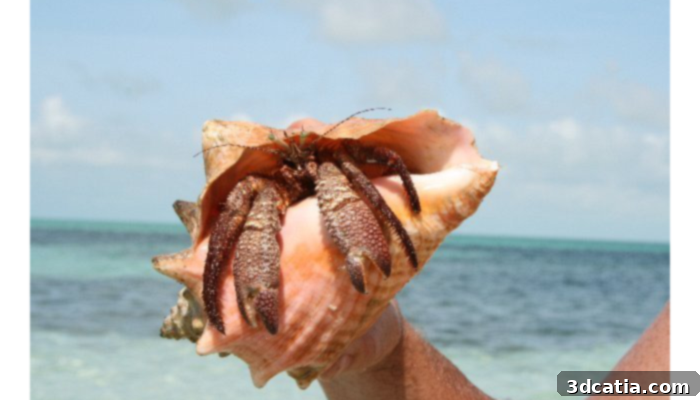
The potential applications for materials arranged in this conch-like, hierarchical structure are vast and revolutionary. Beyond body armor, this principle could be applied to sports helmets, providing superior protection against concussions and impact injuries with less bulk and weight. It could lead to the development of stronger, lighter protective casings for sensitive electronics, or even enhance the safety features in automotive and aerospace components, where impact resistance and weight reduction are paramount. While initial experiments use polymers due to their ease of 3D printing, the ultimate goal for many high-performance applications will require substituting these polymers for tougher materials, such as advanced ceramics or metal alloys, which are inherently stronger but typically more brittle. The challenge lies in extending these complex multi-scale structures to materials that are harder to process with 3D printing, requiring further breakthroughs in additive manufacturing technologies.
Though still largely in the experimental and research phase, these developments inspired by the conch shell represent some of the most exciting advancements in biomimicry and additive manufacturing. They promise a future where protective gear is not only stronger but also more adaptable, lighter, and potentially more cost-effective due to optimized material usage. We can undoubtedly expect to see more of these bio-inspired structural innovations emerge in the coming years, transforming how we design and engineer for protection across countless industries.
The Synergy of Biomimicry and Additive Manufacturing
The examples of the Alligator Gar fish and the conch shell vividly illustrate the transformative power of combining biomimicry with additive manufacturing. Nature, through millions of years of evolution, has perfected designs for strength, flexibility, energy absorption, and damage tolerance. Additive manufacturing, or 3D printing, provides the unprecedented capability to translate these intricate, multi-scale biological architectures into functional synthetic materials. Unlike traditional manufacturing methods that are often limited to simpler geometries and material compositions, 3D printing allows for the precise placement of material, the creation of complex internal structures, and even the integration of multiple materials within a single print. This synergy is a game-changer for material science and engineering, enabling the creation of materials with properties that far exceed those of their conventional counterparts.
The paradigm shift here is profound: instead of relying solely on the intrinsic strength of bulk materials, engineers can now design “smart” structures where the geometric arrangement of even moderately strong materials results in exceptional performance. This approach paves the way for a new generation of lightweight, high-performance materials that are not only stronger and more durable but also potentially more sustainable through optimized material usage. From personalized medical implants to advanced aerospace components and, as we’ve explored, revolutionary body armor, the applications are boundless.
While the field is rich with promise, challenges remain. These include scaling up production from lab prototypes to industrial quantities, developing a wider range of printable materials that can achieve the exact properties of natural tissues, and reducing the costs associated with advanced 3D printing technologies. However, with continuous advancements in material science, computational design, and additive manufacturing processes, these hurdles are steadily being overcome. The future holds the potential for customized, bio-inspired protective solutions that are lighter, more effective, and more comfortable than anything available today, fundamentally changing how we approach safety and performance in the most demanding environments.
Are you inspired by these animal-based 3D printing innovations and the incredible potential of biomimicry? We’d love to hear your thoughts and predictions for the future of advanced protection! Let us know what you think in a comment below or join the conversation on our Facebook and Twitter pages! Don’t forget to sign up for our free weekly Newsletter to get all the latest news in the rapidly evolving world of 3D printing delivered directly to your inbox!