
Revolutionizing Construction: Shimizu’s Spray-Based 3D Printing for Reinforced Concrete Structures
As Japan faces the dual challenge of an aging population and a diminishing construction workforce, the industry is under increasing pressure to innovate and find new solutions. Shimizu Corporation, a leading Japanese construction company, is stepping up to this challenge with a groundbreaking approach to 3D printing. They have developed a sophisticated spray-based system engineered to fabricate large, curved, and robust reinforced concrete components, offering a promising path forward for modern construction.
Unlike traditional extrusion-based 3D printers that build structures layer by layer, Shimizu’s system utilizes a robotic nozzle to spray a specially formulated concrete mixture. This innovative method allows for the creation of complex shapes and geometries that would be exceedingly difficult or even impossible to achieve using conventional concrete printing techniques. The ability to produce intricate designs with enhanced structural integrity opens up a world of possibilities for architects and engineers.
The core advantage of this spray-based approach lies in its ability to deposit concrete from multiple angles and effectively integrate it around steel reinforcement cages, commonly known as rebars. This represents a significant leap forward for structural construction, particularly in seismically active regions where reinforced concrete is paramount for ensuring the safety and stability of buildings. Many existing concrete printers struggle with the presence of rebars, but Shimizu’s spray-based printing system overcomes this limitation, paving the way for true structural 3D printing applications.
The Role of Simulation in Optimizing Spray-Based Printing
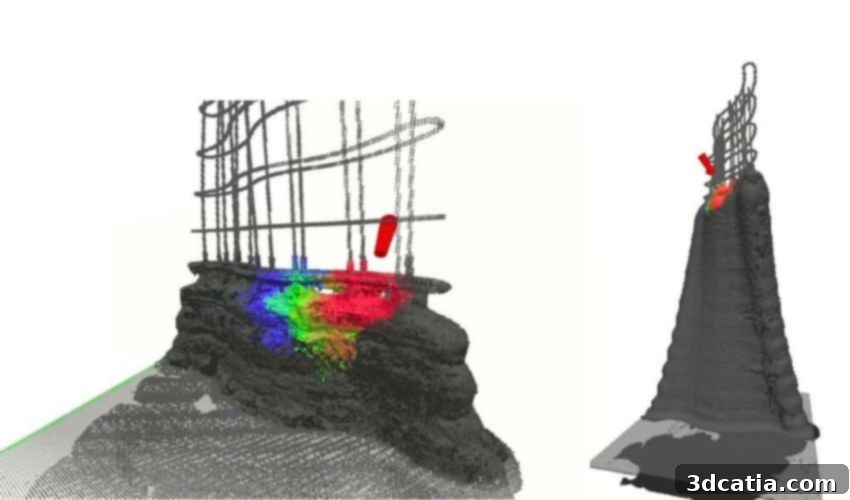
While the spray-based concrete printing process offers numerous advantages, it also presents unique challenges. The behavior of sprayed concrete can be unpredictable, with factors such as nozzle distance, spray angle, and the concrete’s setting time influencing the outcome. Material rebound, dripping, and spreading can all affect the accuracy and quality of the printed structure. To address these challenges, Shimizu has partnered with Carnegie Mellon University’s Computational Engineering and Robotics Lab to develop a sophisticated material spray simulator.
This advanced software models the behavior of concrete as it travels through the air and forms on the surface. By simulating the printing process, engineers can test various toolpaths, spray angles, and speeds before initiating the actual printing process. This allows them to identify the most accurate and efficient printing strategy, minimizing defects and reducing material waste. Furthermore, the simulation helps ensure that the final printed geometry precisely matches the original digital design, guaranteeing the integrity and accuracy of the structure.
The ability to predict and control the behavior of sprayed concrete through simulation is crucial for optimizing the printing process and achieving consistent, high-quality results. This technology allows Shimizu to refine their printing parameters, reduce errors, and ultimately produce stronger, more durable structures.
The simulation software also helps in optimizing the concrete mixture itself. By analyzing the simulated spray patterns, engineers can fine-tune the concrete’s properties to ensure optimal adhesion, flowability, and setting time. This iterative process of simulation and material refinement leads to a concrete mixture that is perfectly suited for the spray-based printing process, maximizing its performance and reliability.
Moreover, the simulation tools can be used to train operators on the proper techniques for spray-based concrete printing. By virtually experimenting with different printing parameters and scenarios, operators can gain valuable experience and develop the skills needed to operate the system effectively. This training ensures that the technology is used safely and efficiently, maximizing its potential for real-world applications.
In essence, the integration of simulation technology is a critical component of Shimizu’s spray-based 3D printing system. It empowers engineers and operators with the knowledge and control needed to produce high-quality, structurally sound concrete components, paving the way for a new era of automated construction.
The Power of a Nine-Axis Robot for Large-Scale Construction
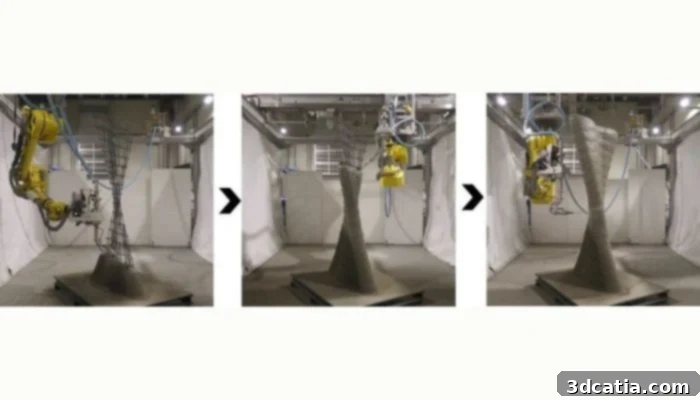
At the heart of Shimizu’s innovative printing system lies a sophisticated robotic arm integrated with a gantry system, providing an impressive nine degrees of freedom. This combination allows the robot to move and position the spray nozzle with exceptional precision and flexibility within a substantial build volume of six meters deep, four meters wide, and three meters high. The ability to reach virtually any point within this volume enables the construction of complex geometries and large-scale structures with unparalleled ease.
The seven-axis robotic arm provides the dexterity needed to navigate around obstacles and deposit concrete at precise angles, even within the confines of dense steel reinforcement cages. This is a crucial capability for creating structurally sound reinforced concrete components. The two-axis gantry further extends the robot’s reach, allowing it to cover a larger area and build even more extensive structures.
The ability to spray concrete in multiple directions, even within confined spaces, sets this system apart from other concrete printing technologies. It enables the creation of intricate designs with internal reinforcement, ensuring the structural integrity of the printed component. This is particularly important for applications in seismic regions, where buildings must be able to withstand significant forces.
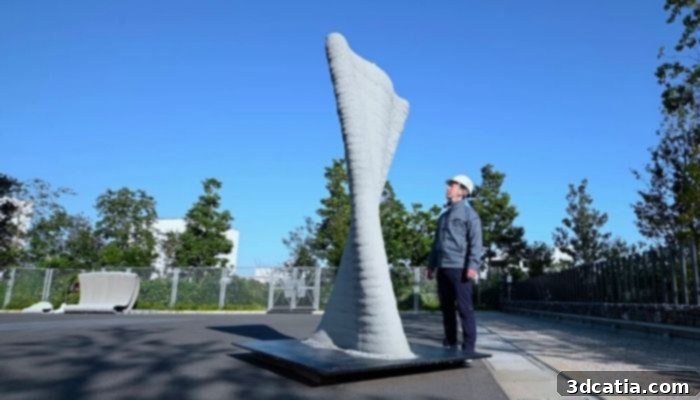
In a recent demonstration, the robotic system successfully printed a twisted concrete wall standing 2.5 meters tall, with both the top and bottom sections extending outward. This complex structure, showcasing overhanging and curved forms, was completed in just four hours, demonstrating the system’s exceptional speed and ability to handle intricate architectural designs at a realistic scale.
This demonstration underscores the potential of Shimizu’s spray-based 3D printing system to revolutionize the construction industry. By automating the process of building complex reinforced concrete structures, the system can significantly reduce labor costs and construction time, while also expanding the possibilities for architectural design.
The precision and control offered by the nine-axis robotic system also contribute to improved material efficiency. By depositing concrete only where it is needed, the system minimizes waste and reduces the overall environmental impact of construction. This is particularly important in an era where sustainability is a growing concern.
Furthermore, the robotic system can be easily adapted to different construction sites and projects. Its modular design allows for quick assembly and disassembly, making it easy to transport and deploy in various locations. This flexibility makes it a valuable tool for a wide range of construction applications, from residential buildings to infrastructure projects.
In conclusion, the combination of a seven-axis robotic arm and a two-axis gantry provides Shimizu’s spray-based 3D printing system with the power and flexibility needed to transform the construction industry. Its ability to build complex, reinforced concrete structures quickly, efficiently, and with minimal waste makes it a promising solution for addressing the challenges of an aging workforce and a growing demand for sustainable construction practices.
For Shimizu, this technology is more than just a novelty; it is a strategic response to the evolving needs of the construction industry. As Japan’s construction workforce continues to shrink, automation is becoming increasingly essential for maintaining productivity and ensuring the timely completion of projects. Spray-based 3D printing offers a viable solution by reducing manual labor requirements and empowering architects and engineers to build more complex and innovative structures with reinforced concrete.
The potential impact of this technology extends beyond Japan. As other countries face similar challenges in the construction industry, spray-based 3D printing could become a widely adopted solution for automating construction processes, improving efficiency, and reducing costs. This technology has the potential to reshape the future of construction on a global scale.
What are your thoughts on spray-based 3D printing for reinforced concrete? Share your opinions in the comments below or connect with us on our LinkedIn or Facebook pages! Stay updated on the latest 3D printing news by subscribing to our free weekly Newsletter. You can also find our videos on our YouTube channel.
*All Photo Credits: Shimizu