
Michael Hansmeyer’s Digital Grotesque: Redefining Architecture with 3D Printing and Algorithmic Design
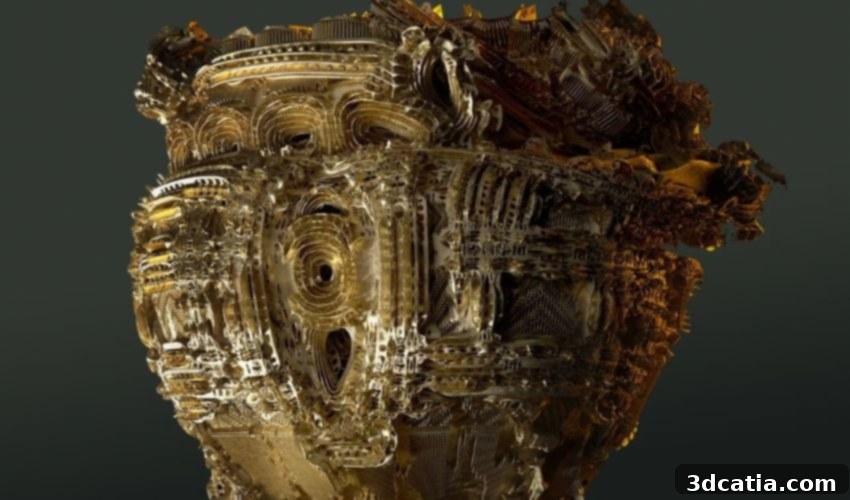
The intersection of art and technology has long been a fertile ground for innovation, and nowhere is this more evident than in the realm of additive manufacturing. A growing number of visionary artists and architects are now harnessing the power of 3D printing to bring their most ambitious and complex designs to life. Trailblazers such as Julia Körner, known for her intricate 3D-printed installations in Venice’s Palazzo Gritti, and Peter Lang, whose futuristic works push the boundaries of form, have already demonstrated the immense potential of this technology. Now, architect and programmer Michael Hansmeyer joins this distinguished list, captivating the world with his latest creations: “Digital Grotesque I” and “Digital Grotesque II.” These installations are not merely static sculptures; they are profound expressions of architecture born from sophisticated algorithms, designed to challenge conventional notions of form and classification.
Hansmeyer’s overarching objective with “Digital Grotesque” is to forge an architecture that, in his own words, “defies classification and reductionism.” This ambitious goal stems from a desire to move beyond rigid architectural categories and embrace a fluidity of design that only computational methods can truly unlock. By leveraging algorithms as a primary design tool, Hansmeyer explores an architectural language that is simultaneously alien and familiar, pushing viewers to reconsider what architecture can be. These works stand as a testament to the power of generative design, where intricate patterns and structures emerge from a set of rules, resulting in forms that are both highly complex and deeply resonant.
The Fusion of Algorithm and Form: Exploring Michael Hansmeyer’s Unique Vision
Michael Hansmeyer’s extensive portfolio already features a diverse array of 3D-printed artworks, showcasing his consistent exploration of algorithmic design. Beyond the renowned “Digital Grotesque I” and “II,” his earlier creations include compelling pieces such as “The Magic Flute,” “White Tower,” and “Maquarnas.” Each of these projects represents a step in his journey to merge digital precision with physical artistry, demonstrating a unique ability to translate complex computational data into tangible, awe-inspiring structures. His background as both an architect and a programmer provides him with a rare skillset, allowing him to not only envision intricate digital forms but also to understand the engineering and material science necessary to bring them into the physical world. This interdisciplinary approach is central to his artistic identity, bridging the often-separate worlds of theoretical computation and practical construction.
What sets “Digital Grotesque” apart and makes it particularly noteworthy is its profound duality: the forms generated by the algorithms are simultaneously synthetic and organic. This paradoxical nature gives the artworks an appearance that is both expected, in its adherence to underlying digital logic, and utterly unexpected, in its intricate and unpredictable details. While algorithms are often associated with deterministic outcomes, Hansmeyer’s application of them results in a surprising, almost emergent, beauty. This is largely facilitated by the chosen manufacturing method: 3D printing. Traditional fabrication techniques would struggle to reproduce the millions of individual, unique facets and complex curvilinear forms that define “Digital Grotesque.” Additive manufacturing, however, thrives on complexity, making it the indispensable tool for realizing Hansmeyer’s vision of an architecture that defies easy categorization and celebrates the boundless possibilities of computational design.
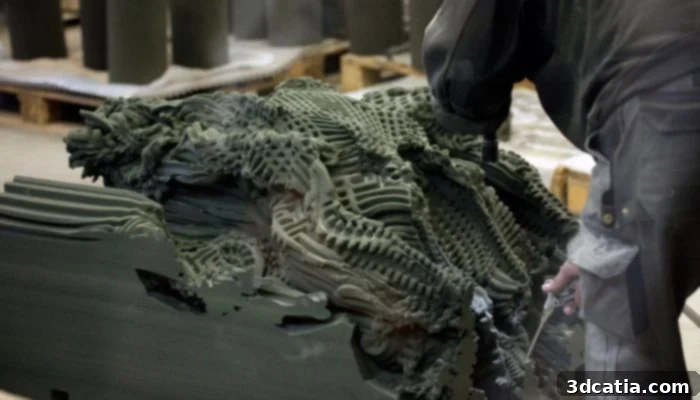
Photo Credits: Michael Hansmeyer
Additive Manufacturing: The Enabler of Digital Grotesque’s Intricate Beauty
The realization of “Digital Grotesque” in its astonishing complexity is solely attributable to the capabilities of 3D printing technology. The entire structure is meticulously crafted from sandstone, a material chosen for its unique properties and aesthetic qualities. The installations boast an incredibly intricate geometry, composed of millions of tiny, distinct facets that together create a seamless, flowing form. This level of detail and interwoven complexity would be impossible to achieve through conventional carving or molding techniques, highlighting the transformative power of additive manufacturing in contemporary art and architecture.
Hansmeyer’s decision to employ sand printing technology was a strategic one, based on its exceptional suitability for large-scale architectural components. Sand printing offers several crucial advantages: it can produce remarkably large-format elements, with some printers capable of creating parts up to eight cubic meters in size with impressive resolution and accuracy. This capacity for large-scale production was vital for “Digital Grotesque,” which stands at a substantial height and base area. Furthermore, sand printing proves to be cost-effective, particularly when dealing with elaborate embellishments and free-form geometries. Unlike traditional methods that would incur significant additional costs for intricate details, 3D printing integrates complexity into the fabrication process without escalating material or labor expenses for each unique facet. This economic efficiency, combined with high precision and speed, made sand 3D printing the ideal choice for realizing Hansmeyer’s vision.
The Sandstone 3D Printing Process: Precision and Scale
The colossal scale and intricate detail of “Digital Grotesque” were made possible by a specialized 3D printer from the renowned company voxeljet. Although the artist has not disclosed the specific model, the printer boasts an impressive build volume of 4 x 2 x 1 meters, providing ample space for fabricating large segments of the installation. The printing process utilized a binder jetting technique, where a liquid binding agent is selectively applied to a bed of sand (specifically, silicate sand) layer by layer. With each layer printed at a fine height of 0.3 mm, the resulting artwork achieves a remarkable resolution of up to 300 dpi. This level of precision is critical for capturing the millions of unique features that define “Digital Grotesque’s” signature style.
The efficiency of this industrial 3D printing method is truly astounding. The entire “Digital Grotesque” artwork, despite its monumental size and complexity, was completely printed in a mere two days using sand and binder. This rapid production time for such a large and detailed object underscores the advancements in industrial additive manufacturing. Sand, a material that has been a fundamental building block for centuries in the construction of iconic structures like churches and temples, is perfectly suited for this application. Its granular nature allows for the creation of intricate forms when bound selectively, offering both structural integrity and a unique aesthetic quality that resonates with traditional masonry while being entirely contemporary in its genesis.
Post-Processing: Enhancing Durability and Finish
Once the 3D printing phase was complete, a crucial post-processing stage was undertaken to transform the raw sand-printed object into the astonishing final artwork. The initial step involved carefully removing any unbound sand. This excess material, which merely adheres to the printed parts but is not part of the final structure, is meticulously brushed or blown away, revealing the delicate and precise forms created by the binder. This process highlights the material efficiency of sand printing, as much of the unbound sand can often be recycled for future prints, minimizing waste.
To impart an additional level of structural stability and durability, the printed sandstone was subsequently infiltrated with resin. This vital step involves saturating the porous sandstone with a liquid resin, which penetrates and seals the fine pores within the object. As the resin cures, it effectively binds the sand particles together more robustly, significantly increasing the artwork’s strength, rigidity, and resistance to environmental factors. This infiltration process is essential for large-scale outdoor installations or pieces that require substantial structural integrity. Finally, to achieve the desired aesthetic finish and provide an extra layer of protection, the 3D-printed piece was expertly sprayed. This spraying could involve a sealant, a protective coating, or a pigmented layer to enhance its visual appeal and ensure its longevity, completing the transformation from raw digital design to monumental physical art.
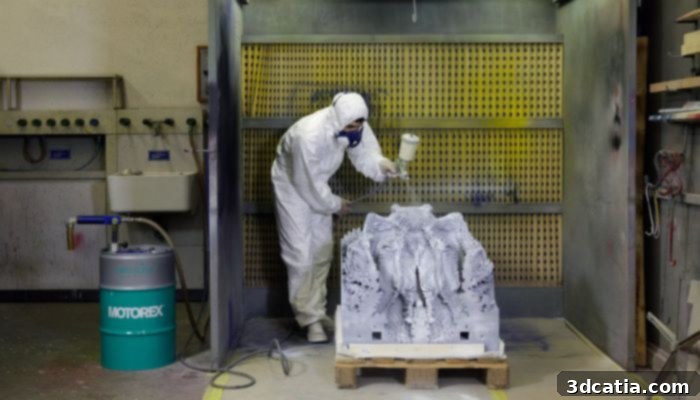
The spraying process (photo credits: Michael Hansmeyer)
Digital Grotesque: A Monumental Achievement in Algorithmic Fabrication
The completed “Digital Grotesque” installations are truly monumental, embodying a profound blend of digital ingenuity and physical presence. Each piece commands a substantial base area of six square meters and rises majestically to a height of 3.2 meters. The sheer scale is matched by its considerable weight: Hansmeyer reports it at 5.8 metric tons, which translates to a formidable 5800 kilograms. This massive bulk underscores the robustness achieved through the sand printing and resin infiltration process, making it a truly solid architectural statement.
The timeline of its creation also tells a fascinating story of modern fabrication efficiency. The initial design development phase, where Hansmeyer meticulously crafted the algorithms and refined the forms, consumed approximately a year. This extensive period highlights the intellectual rigor and computational complexity involved in generating such intricate designs. In stark contrast, the physical printing process itself was remarkably swift, taking just one month to complete. This rapid production time for a structure of this size and detail vividly illustrates the efficiency gains offered by advanced 3D printing technologies. Finally, the assembly of the printed components into the final, seamless installation took merely a single day, showcasing the precision of the digital fabrication that allowed for perfectly interlocking parts. This dramatic disparity between design time, printing time, and assembly time is a hallmark of digital manufacturing, where upfront computational effort leads to streamlined and rapid physical realization. To delve deeper into Michael Hansmeyer’s inspiring work and the full scope of “Digital Grotesque,” you can find more information by clicking HERE.
Engage with the Future of 3D Printed Art
What are your thoughts on Michael Hansmeyer’s groundbreaking “Digital Grotesque” installations and the revolutionary impact of algorithmic design combined with 3D printing? We invite you to share your insights and comments below, or connect with us on our LinkedIn, Facebook, and Twitter pages! Don’t miss out on the latest advancements and innovations in additive manufacturing – be sure to sign up for our free weekly Newsletter here, delivering the freshest 3D printing news directly to your inbox. You can also explore a wealth of informative videos on our dedicated YouTube channel. And if you’re eager to stay completely up-to-date with all the breaking news and developments from Formnext 2022, we encourage you to subscribe to our dedicated Formnext Newsletter for exclusive updates.
*Cover Photo Credits: Michael Hansmeyer