
Unlocking Potential: The Top Advantages of Pellet 3D Printing for Modern Manufacturing
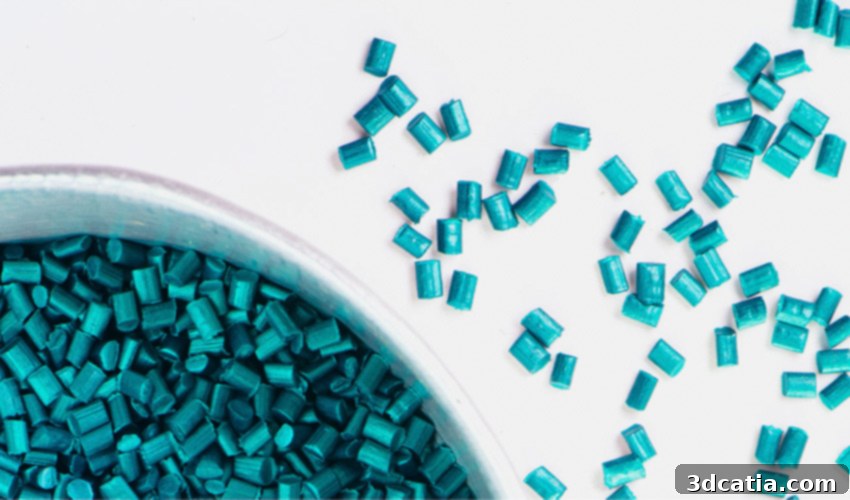
In the realm of plastic manufacturing, the term “pellets” refers to small, granular raw materials, typically in the form of cylinders or discs, composed of polymers or polymer blends. These versatile granules serve as fundamental building blocks for producing a vast array of finished plastic products across various industrial processes, including the rapidly evolving field of additive manufacturing. Specifically, within 3D printing, pellets are utilized in material extrusion technologies, a method that often draws comparisons with the more commonly known use of filaments.
Today, the conversation is shifting significantly towards the numerous benefits of integrating pellets into 3D printing workflows. Manufacturers and innovators are increasingly recognizing the strategic advantages offered by this technology. The choice between pellets and filaments extends far beyond mere material shape; it encompasses critical considerations such as the breadth of material options, the capabilities of printing machinery, suitability for diverse end-use applications, the potential for large-scale part production, operational flexibility, enhanced printing speed, and paramountly, the sustainability profile of the process. Below, we delve into the top 10 compelling reasons why pellet 3D printing is gaining substantial traction and redefining possibilities in additive manufacturing.
1. Expansive Material Selection
One of the most significant drivers behind the adoption of pellet 3D printing is the unparalleled access it provides to an extensive range of materials. While Fused Filament Fabrication (FFF) 3D printing has seen an expansion in filament availability, the spectrum of materials accessible in pellet form remains vastly superior. This disparity arises because the pelletizing process, unlike filament extrusion, transforms plastic polymers into granules with minimal alteration to their fundamental properties. This allows for direct use of industrial-grade raw polymers that might be too complex or cost-prohibitive to process into filaments.
Consequently, pellets enable the utilization of a diverse array of raw polymers, advanced thermoplastics, and even sophisticated composite materials enriched with additives like glass or carbon fibers. This capability empowers manufacturers to experiment with novel material formulations, precisely tailoring the mechanical, thermal, and aesthetic characteristics of their final products. Custom formulations become more accessible, allowing for highly specialized applications. Furthermore, since pellets are a standard raw material across other major manufacturing technologies, such as injection molding, their broad market availability further expands the choice and reduces barriers to innovation in 3D printing.
2. Enhanced Printing Flexibility
Another compelling advantage of employing pellets in 3D printing is the remarkable flexibility it offers in terms of machine compatibility and part size. This technology can be scaled across various hardware platforms, ranging from compact desktop 3D printers to sophisticated robotic arms capable of producing exceptionally large components. Robotic 3D printing, in particular, unleashes an extraordinary degree of operational flexibility, allowing for multi-axis fabrication on expansive build surfaces. This versatility facilitates the creation of medium to very large parts, catering to a wide array of industries including construction, automotive, aerospace, furniture design, and transportation.
As a direct result, pellets are optimally suited for large-format additive manufacturing (LFAM). Attempting to utilize such substantial quantities of material in filament form would present significant economic and practical disadvantages, including logistical complexities and prohibitive material costs. Moreover, pellet-based systems can accommodate extruders with significantly larger nozzle diameters, often exceeding the typical 0.8 mm limit for filament 3D printing. This capability is instrumental for producing larger parts at greatly accelerated speeds, making it an ideal choice for industrial-scale production where efficiency is paramount.
3. Significant Cost Reduction
Among the primary motivations for adopting pellet 3D printing, cost savings stand out as a pivotal factor. Given that filaments are fundamentally manufactured by processing pellets, it logically follows that the raw pellet material is substantially more economical. Estimates suggest a remarkable 65-90% reduction in material costs per kilogram when compared to pre-processed filaments. This economic advantage is further amplified by the fact that pellets are a global commodity used in myriad other manufacturing processes, such as injection molding, which fosters a larger, more competitive market and inherently drives down prices.
The financial benefits become particularly pronounced when undertaking projects that require large volumes of material or the production of sizable components, typically achievable in shorter print times than with filaments. Furthermore, the accessibility of pellets opens the door to using more cost-effective virgin materials or, crucially, recycled alternatives, thereby further lowering expenditures and vigorously supporting the principles of the circular economy. While it’s true that the initial investment in pellet-based infrastructure, often involving larger and more complex machines, can be higher, the long-term operational savings and flexibility offered allow small and medium-sized enterprises (SMEs) to increasingly develop and acquire more affordable, custom-built machines, democratizing access to this powerful technology.
4. Driving the Circular Economy
The integration of pellets into 3D printing processes plays a crucial role in advancing the circular economy through several impactful avenues. Primarily, pellets can be derived from recycled materials, offering a direct pathway to significantly reduce plastic waste and reintroduce it into the manufacturing lifecycle. Pellet 3D printers are uniquely capable of utilizing reclaimed industrial waste plastics or post-consumer recycled materials, thereby lessening the dependency on virgin raw material extraction and promoting resource efficiency.
Beyond material sourcing, users gain the ability to directly recycle printed products at the end of their lifecycle, as well as failed prints or prototypes, back into the pellet stream. This closed-loop approach renders the entire 3D printing process inherently more sustainable and substantially minimizes its environmental footprint. This direct recycling capability aligns seamlessly with the core tenets of the circular economy, where the continual reuse and reprocessing of materials are essential strategies for mitigating waste generation, conserving energy, and reducing overall ecological impact.
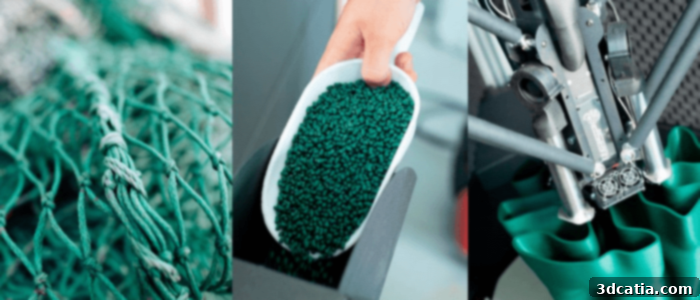
In partnership with WASP, Reflow has produced rPPGF material obtained from fishing nets, recycled and pelletized for use in 3D printing (photo credits: WASP)
5. Accelerated Production Speed
A distinctive advantage of 3D printing with pellets is the remarkable increase in production speed. This is primarily attributed to the ability of pellet extrusion systems to accommodate machines with significantly larger diameter nozzles compared to those typically employed in FFF 3D printing. A larger nozzle allows for the deposition of more material per unit of time, directly translating into faster print times and higher production throughput. This enhanced speed not only contributes to overall operational efficiency but also plays a role in reducing per-part manufacturing costs, making pellet 3D printing economically viable for certain industrial applications.
However, it is important to acknowledge a trade-off associated with this increased speed and nozzle size: the final printed parts may exhibit reduced fine detail and complexity compared to those produced with smaller nozzles. This characteristic makes pellet 3D printing particularly well-suited for applications where functional performance, structural integrity, and rapid production are prioritized over intricate aesthetic details, such as large prototypes, industrial tooling, molds, or construction components.
6. Minimized Risk of Printing Interruptions
Pellet 3D printing significantly reduces the likelihood of interruptions and common printing problems often encountered with traditional filaments. This enhanced reliability stems from the inherent nature of the direct extrusion process. Unlike filament-based systems where material is fed from spools that eventually run out, pellet extruders can be continuously fed from large hoppers. This eliminates the need for frequent material replacement mid-print, which is a common cause of failure or pauses in filament-based systems.
Furthermore, the granular form of pellets is intrinsically less prone to physical issues such as twisting, tangling, or deformation, which are typical challenges with coiled filaments. These filament-specific problems can lead to blockages or jams within the extruder, causing print failures and wasted material. The robust design of pellet extrusion systems is engineered to manage larger volumes and maintain a consistent, uninterrupted flow of material, thereby fostering a smoother, more dependable, and more reliable printing process. It is crucial, however, to ensure that the chosen pellets are physically and chemically compatible with the specific 3D printer and extrusion system being utilized, as proper material-machine matching is key to achieving optimal results.
7. Advanced Multi-Material and Multicolor Capabilities
Expanding on the advantage of broad material choice, pellet 3D printing offers sophisticated capabilities for multi-material and multicolor fabrication within a single print. This is achieved by allowing the direct mixing of multiple different materials within the machine’s print head. While careful consideration of printing temperatures and the specific characteristics of each material is necessary, and selecting an appropriate printer is paramount, this capability opens up vast possibilities for producing components with hybrid properties or integrated functionalities.
Beyond material mixing, the granular nature of pellets also facilitates the easy introduction of color additives. This means manufacturers can create multicolored parts or parts with distinct color zones within a single print job, enhancing aesthetic appeal and functional differentiation. The ability to combine varied materials and colors concurrently allows for the production of highly customized parts that possess unique mechanical, thermal, or visual properties, offering unprecedented design freedom and functional integration.
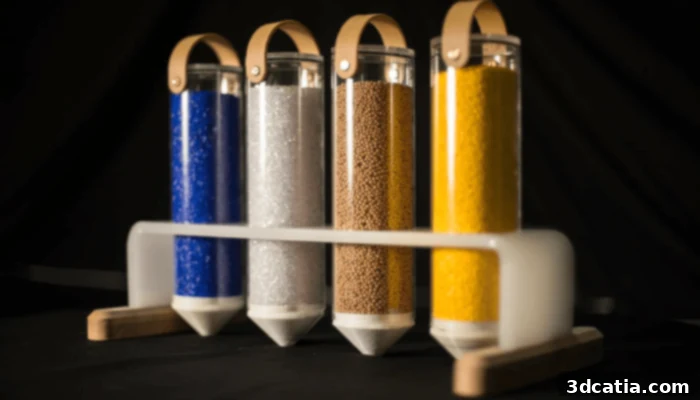
The use of pellets in 3D printing allows for a wide choice of materials, colors and greater printing flexibility (photo credits: Pollen)
8. Superior Properties of Final Parts
A significant advantage when working with granular plastic materials is the exceptional quality and consistency of the final part properties. Pellets, being closer to the raw polymer state, enable the printed objects to retain the inherent chemical and physical characteristics of the starting material. This stands in contrast to filaments, where the filament manufacturing process itself—involving additional heating, extrusion, and cooling steps—can introduce thermal stresses, alter molecular structures, and potentially compromise the original properties of the polymer before it even reaches the 3D printer. The subsequent 3D printing process for filaments can further degrade these properties, resulting in final products that differ significantly from the intended material performance.
By utilizing pellets in 3D printing, manufacturers can achieve parts with chemical and physical properties that are remarkably consistent with those obtained through established industrial processes like injection molding. This makes pellet 3D printed parts suitable for more demanding applications where material integrity and predictable performance are critical, allowing for functional prototypes and end-use parts that closely mimic traditionally manufactured components.
9. Streamlined Production Workflows
As previously highlighted, plastic pellets are a ubiquitous raw material utilized across a multitude of manufacturing technologies. This widespread adoption simplifies the overall production workflow by enabling companies to employ the same foundational material for diverse processes, ranging from additive manufacturing to conventional techniques like injection molding. This singular material approach offers substantial benefits, particularly for organizations that operate with multiple production technologies, allowing for optimized raw material management, significantly reduced logistics costs, and a more streamlined, efficient supply chain.
For instance, the strategic use of pellets facilitates a rapid and seamless transition from the prototyping phase to mass production. During product development, pellets allow engineers to quickly test and validate material properties through 3D printing, creating functional prototypes with identical or very similar material characteristics to the final product. Once validated, the design can then swiftly move to high-volume production using injection molding, utilizing the very same pellet material. This continuity ensures consistency, reduces development cycles, and minimizes risks associated with material property variations across different manufacturing stages.
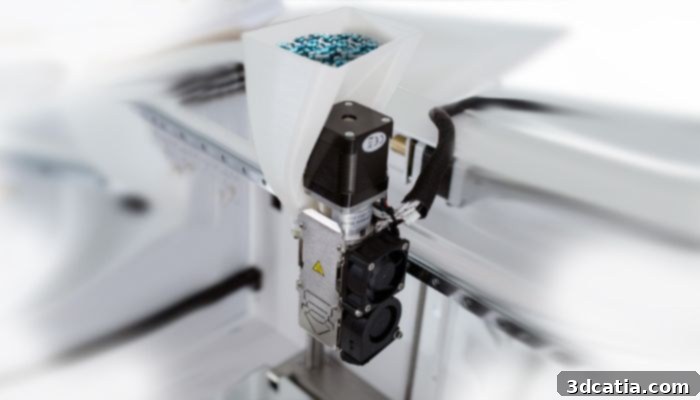
Pellet 3D printing solutions on the market are on the rise, with LFAM solutions as well as smaller format ones (photo credits: Tumaker)
10. A Dynamically Expanding Market
The confluence of benefits outlined above – including substantial cost savings, reduced production times, enhanced flexibility, and strong sustainability credentials – is increasingly compelling more users and industries to embrace pellet 3D printing. While it currently holds a smaller market share compared to the more established filament extrusion 3D printing, the pellet 3D printing market is experiencing robust growth, evidenced by a continuously expanding and diversifying array of solutions available from manufacturers.
Despite its burgeoning potential, current limitations to widespread adoption primarily include the relatively high capital cost of the machines, which tend to be larger and more complex than filament printers, and in some applications, a perceived lower accuracy of prints, particularly for very fine details. However, innovation in this sector is fervent. Companies and startups are actively developing more affordable and compact pellet 3D printing solutions, alongside specialized pellets optimized specifically for additive manufacturing, and adaptable extruders that can be retrofitted to existing machinery. Crucially, the inherent capability to utilize recycled materials and foster a truly circular economy provides a powerful and timely impetus for further technological advancement, propelling pellet 3D printing towards a more sustainable and economically efficient future of production.
Are you leveraging the power of pellets for your 3D printing projects? We’d love to hear about your experiences and insights! Share your thoughts in a comment below or connect with us on our LinkedIn, Facebook, and Twitter pages. Don’t miss out on the latest advancements and news in additive manufacturing—sign up for our free weekly newsletter here to get updates delivered straight to your inbox! You can also explore all our informative videos on our YouTube channel.