

HP Jet Fusion 3D 4210: Powering Industrial-Scale Additive Manufacturing with Unprecedented Cost Efficiency and Advanced Materials
HP continues to solidify its position at the forefront of the additive manufacturing revolution with the exciting announcement of its latest industrial 3D printer: the HP Jet Fusion 3D 4210. This pivotal release is not merely an incremental update but a significant leap forward, accompanied by the introduction of three innovative new materials designed to broaden the scope and efficiency of 3D printing applications. Engineered specifically for high-volume, industrial-scale production, the HP Jet Fusion 3D 4210 is meticulously crafted to deliver substantial reductions in operating costs while simultaneously boosting production throughput. HP proudly highlights that this cutting-edge system can achieve an astonishing 65% cost saving per piece when compared to competing additive manufacturing technologies, marking a critical milestone in making mass customization and agile manufacturing more accessible than ever before.
The HP Jet Fusion 3D 4210 Solution: Redefining Industrial 3D Printing
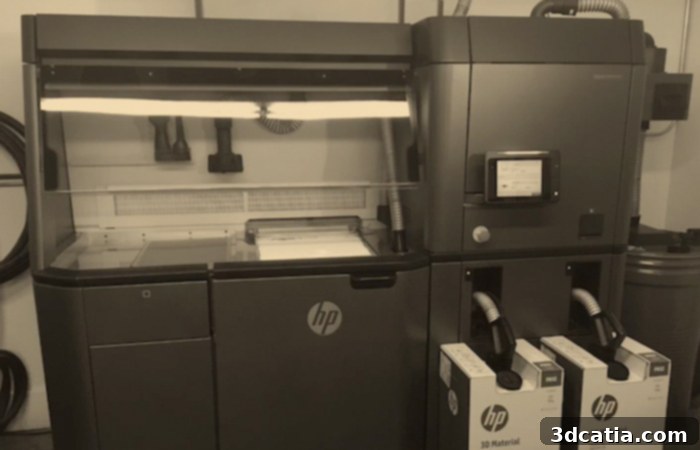
The HP Jet Fusion 3D 4210 represents the pinnacle of HP’s Multi Jet Fusion (MJF) technology, building upon the strong foundations laid by its predecessors, the Jet Fusion 3200 and 4200 3D printers. Multi Jet Fusion, a revolutionary thermal inkjet array technology, was introduced a few months prior and has since been transforming the landscape of industrial prototyping and production. HP’s strategic emphasis with the 4210 solution is unequivocally on lowering the cost of production, a factor that has historically been a significant barrier to the widespread adoption of additive manufacturing for mass-produced parts. This focus on economic viability is a game-changer, promising to unlock new opportunities for industries seeking to leverage the speed, design freedom, and personalized production capabilities of 3D printing.
Roman Pastor, General Manager of HP’s 3D Printing branch, articulated the company’s vision, stating, “The new 4210 3D printing solution enables our customers to produce mass-produced parts using Multi Jet Fusion technology at 65% lower cost per part than other processes, and to fully benefit from economies of scale. HP Jet Fusion systems have now reached a technological and economic influx that combines the speed, quality and flexibility needed to accelerate the digital industrial revolution of the manufacturing sector.” This powerful statement underscores HP’s commitment to not just developing advanced machinery but to fundamentally reshaping manufacturing paradigms. The 65% cost reduction is not just a number; it signifies a tipping point where additive manufacturing becomes a compelling alternative to traditional methods for even higher volume production runs, allowing businesses to truly capitalize on economies of scale that were once out of reach for 3D printing.
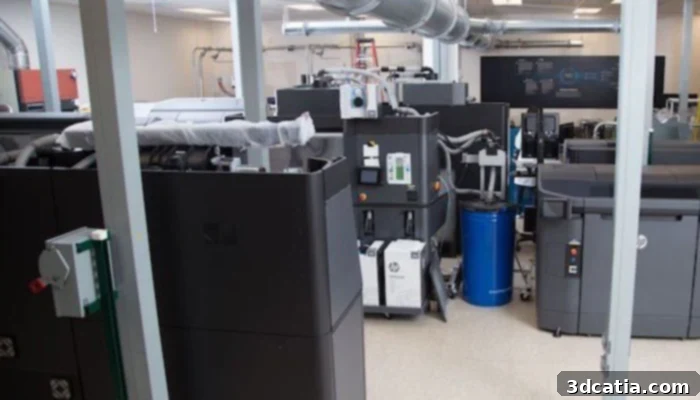
Enhanced Efficiency and Uninterrupted Operation
Beyond the impressive cost savings, the HP Jet Fusion 3D 4210 also incorporates a suite of significant hardware and software upgrades meticulously designed to enhance operational efficiencies and bolster reliability. These advancements are crucial for pushing the boundaries of what is achievable in industrial settings, paving the way for sustained, long-term, 24/7 operation. Such continuous production capabilities are indispensable for manufacturers aiming to meet demanding production schedules and maximize machine utilization, ensuring that downtime is minimized and output is consistently high. The software enhancements provide more precise control over the printing process, enabling predictive maintenance, optimized job scheduling, and improved error detection, all contributing to a more robust and autonomous production workflow.
Furthermore, HP recognizes that efficient post-processing is as vital as the printing itself. To address this, a new post-treatment station has been developed and is planned for release. This station is specifically engineered to handle larger volumes of materials and finished parts, effectively streamlining the crucial final stages of the additive manufacturing process. Post-processing has historically been a bottleneck in many 3D printing workflows, adding time and labor costs. By introducing a dedicated, high-capacity post-treatment solution, HP is further optimizing the entire production chain, ensuring that the enhanced speed and volume capabilities of the 4210 printer are not undermined by subsequent processing steps. This holistic approach to system design, from printing to finishing, underscores HP’s commitment to providing a truly integrated and efficient industrial additive manufacturing solution.
Expanding Possibilities with New Advanced Materials
A critical component of this major printing announcement is the introduction of three new materials, each engineered to unlock new applications and expand the versatility of HP’s Multi Jet Fusion technology. The availability of a diverse and robust material portfolio is fundamental for addressing the complex and varied needs of industrial manufacturing across different sectors. These materials are not just additions; they represent carefully developed formulations designed to meet specific performance requirements, offering designers and engineers greater freedom and capability.
HP 3D High Reusability PA 11
The first of these groundbreaking materials is HP 3D High Reusability PA 11. This polyamide is specifically formulated to create high-quality, durable, yet remarkably inexpensive parts. Its properties make it an ideal choice for applications where both strength and cost-effectiveness are paramount. PA 11 is renowned for its exceptional mechanical performance, offering high impact resistance and impressive ductility, meaning it can withstand significant deformation without fracturing. These characteristics are particularly valuable in the creation of personalized prostheses, where durability and flexibility are crucial for user comfort and longevity. Similarly, in the sports equipment industry, PA 11 can be used to produce components that absorb impact effectively while remaining lightweight and robust, enhancing both performance and safety. Its suitability for manufacturing custom soles further exemplifies its utility in applications requiring flexibility, resilience, and direct skin contact compatibility. The material’s high reusability also translates to less waste and further cost savings, aligning perfectly with the sustainable manufacturing practices increasingly sought after by industries worldwide.
HP 3D High Reusability PA 12 Glass Beads
HP is also set to release its PA 12 loaded with glass beads, a material engineered for solutions demanding significantly higher rigidity and dimensional stability. By incorporating glass beads into the PA 12 matrix, the material gains enhanced stiffness, strength, and improved thermal characteristics, making it perfect for applications where structural integrity and minimal deformation are critical. This material will prove invaluable in the creation of robust molds and specialized tools that require exceptional precision and durability. Beyond traditional tooling, PA 12 Glass Beads can be utilized for manufacturing fixtures, jigs, and structural components that need to withstand substantial loads without yielding. Its high rigidity also makes it suitable for producing durable prototypes that closely mimic the mechanical properties of injection-molded parts, thereby accelerating product development cycles and reducing iteration costs.
HP 3D High Reusability Polypropylene
Finally, HP is launching its highly anticipated polypropylene material. Polypropylene (PP) is celebrated in traditional manufacturing for its exceptional balance of durability, low cost, and versatile properties, and HP’s 3D printing version brings these advantages to additive manufacturing. This material offers greater flexibility than many other common 3D printing plastics, coupled with excellent chemical resistance, making it suitable for a wide array of industrial applications. Furthermore, HP’s polypropylene is inherently light and waterproof, expanding its utility into areas where environmental exposure or weight considerations are crucial. This combination of properties makes it ideal for automotive interior components, fluid tanks, containers, and functional prototypes that require chemical inertness or moisture resistance. Its flexibility makes it perfect for living hinges and components that require repeated bending, while its chemical resistance ensures longevity in harsh industrial environments. The introduction of polypropylene further solidifies HP’s commitment to providing materials that cater to the diverse needs of the modern manufacturing sector, enabling the production of parts that would traditionally be injection molded.
A significant advantage of all three newly announced materials is their complete compatibility with existing HP Multi Jet Fusion printing systems. This ensures that current HP customers can immediately benefit from these advanced materials without needing to upgrade their hardware, offering a seamless integration and immediate expansion of their manufacturing capabilities. This backward compatibility demonstrates HP’s foresight in designing a scalable and future-proof additive manufacturing ecosystem.
HP’s Vision and the Future of Additive Manufacturing
With the introduction of the Jet Fusion 3D 4210 printer and its accompanying material portfolio, HP is not just releasing new products; it is actively shaping the future of industrial production. The company’s strategic focus on reducing costs, increasing efficiency, and expanding material options directly addresses the core challenges that have historically limited the full potential of 3D printing in mainstream manufacturing. By making additive manufacturing more economically viable and technically robust for high-volume applications, HP is accelerating the transition towards a more digital, agile, and sustainable industrial landscape. This move positions HP as a key enabler of the “digital industrial revolution,” empowering businesses to innovate faster, customize products more effectively, and respond to market demands with unprecedented flexibility. The emphasis on continuous operation and streamlined post-processing further reinforces HP’s dedication to providing end-to-end solutions that drive real-world productivity and profitability for its customers.
Are you excited for this new generation of HP 3D printers and materials? Let us know your thoughts in a comment below or connect with us on our Facebook and Twitter pages! Don’t forget to sign up for our free weekly Newsletter, with all the latest news in 3D printing delivered straight to your inbox!