
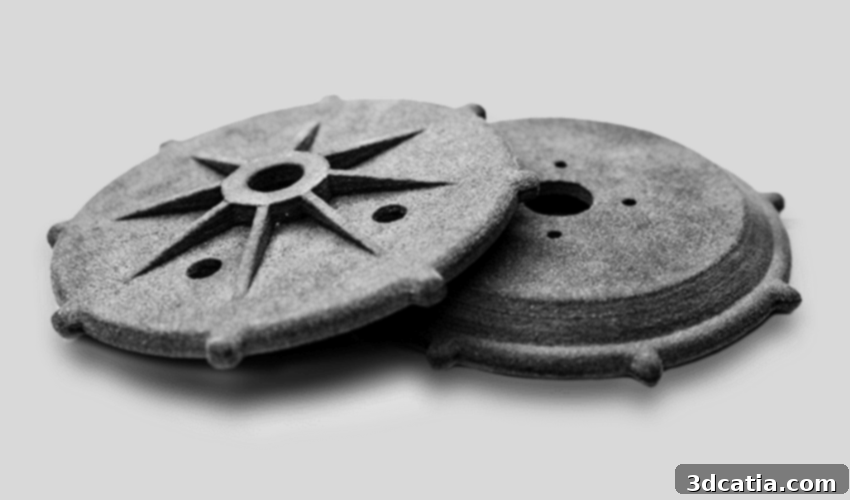
Revolutionizing Manufacturing: Impossible Objects and Owens Corning Partner for Advanced Composite 3D Printing
Earlier this week, a landmark announcement sent ripples across the additive manufacturing industry: Impossible Objects has formally entered a strategic development agreement with Owens Corning. This pivotal collaboration is specifically aimed at engineering and refining a new generation of advanced materials tailored for Impossible Objects’ groundbreaking Composite-Based Additive Manufacturing (CBAM) process. While Impossible Objects stands as a pioneering force in both 3D printers and innovative materials, Owens Corning, a global behemoth, specializes exclusively in the production of high-performance building and industrial materials. This synergistic partnership is set to unlock unprecedented potential, focusing on the creation of specialized composite materials meticulously optimized for CBAM technology. The ambitious goal is to not only achieve superior mechanical properties, leading to the production of significantly stronger parts, but also to drastically reduce manufacturing costs, outperforming many other 3D printing processes currently available in the market. This alliance represents a critical step towards mainstreaming high-performance additive manufacturing, making it more accessible and competitive for a broader range of industrial applications.
The development pipeline for these new materials includes a strong emphasis on fiberglass composites. Fiberglass composite materials inherently offer a compelling suite of advantages that are particularly impactful for 3D printed components. These benefits include remarkably higher strength-to-weight ratios when juxtaposed with conventional materials such as aluminum, significantly lower raw material costs, exceptional performance stability at elevated temperatures, and superior resistance to chemical degradation. Among these myriad advantages, the promise of low material cost holds immense strategic importance. This is especially true within the context of accelerating the broader adoption of additive manufacturing technologies across various sectors. Historically, materials utilized in 3D printing have often been priced substantially higher—sometimes by a factor of eight on a per-weight basis—compared to those employed in traditional manufacturing methodologies. This cost disparity has been a significant barrier to entry for many potential industrial users. Furthermore, the CBAM process itself introduces another layer of cost efficiency by enabling the consolidation of multiple parts into a single printed component. This design simplification inherently leads to fewer individual parts, reducing the complexity and time involved in assembly, and consequently, lowering overall manufacturing costs. The ability to integrate functionality and simplify designs via CBAM, combined with cost-effective, high-performance materials from Owens Corning, presents a formidable value proposition for the future of industrial production.
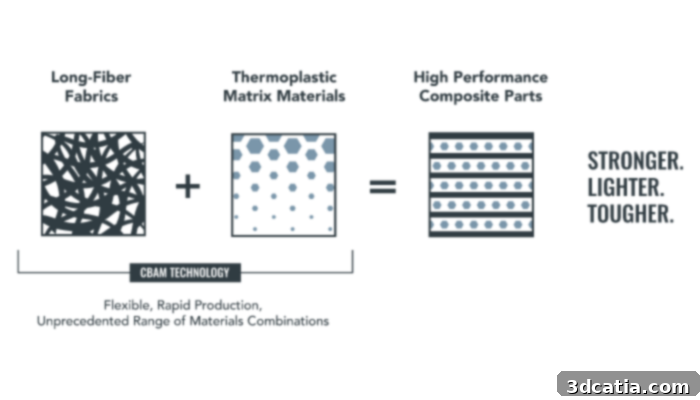
Beyond material properties, manufacturing speed stands as another paramount factor distinguishing the utility and benefits of advanced 3D printing technology. This is precisely where Impossible Objects’ proprietary CBAM technology truly shines, delivering a significant competitive edge. The CBAM process boasts the capacity to produce parts up to ten times faster than more conventional fused deposition modeling (FDM) 3D printing techniques. This exponential increase in speed is a game-changer for rapid prototyping, on-demand manufacturing, and eventually, high-volume production. Robert Swartz, the visionary chairman and founder of Impossible Objects, eloquently articulates this transformative potential: “Our CBAM process is a revolution in 3D printing, with faster speeds, better material properties and wider material selection.” He further emphasizes the critical role of this new partnership, stating, “This collaboration with Owens Corning will allow us to quickly experiment with and refine new materials to significantly lower cost and bring unprecedented options for additive manufacturing.” The versatility of the CBAM process is also a key differentiator; it is inherently compatible with an extensive array of materials. These include high-strength composites like carbon fiber and fiberglass, which can be seamlessly paired with advanced thermoplastics such as PEEK, PA 6, PA 12, various elastomerics, and most other conventional thermoplastics. This broad material compatibility means that Impossible Objects’ machines can ingeniously combine high-performance polymers like Nylon and PEEK with nonwoven materials infused with carbon fiber and fiberglass. The outcome is the production of parts that are not only remarkably stronger and lighter but also exhibit superior dimensional accuracy and exceptional temperature performance, far exceeding the capabilities of traditional 3D printing methodologies. This confluence of speed, material flexibility, and enhanced part performance positions CBAM as a truly disruptive force in modern manufacturing.
The synergy between Impossible Objects’ innovative CBAM process and Owens Corning’s robust, fully integrated glass nonwoven manufacturing capabilities is set to propel additive manufacturing into an entirely new dimension: industrial scale production. This powerful combination will enable the CBAM process to effectively amplify its output, allowing it to genuinely compete with established high-volume manufacturing methods, most notably injection molding. A significant advantage of CBAM over injection molding is its ability to eliminate the notorious long lead-times and substantial tooling costs traditionally associated with conventional molding processes. Injection molding requires expensive, custom-designed molds that can take weeks or even months to produce, creating a significant barrier for low-volume production or rapid design iterations. By circumventing these hurdles, the CBAM process not only streamlines the manufacturing pipeline but also fully enables the mass customization of parts – a capability that is difficult and costly to achieve with traditional methods. Dr. Chris Skinner, Vice President of Strategic Marketing, Composites, at Owens Corning, underscored the profound implications of this collaboration: “We have found the Impossible Objects technology and know-how potentially transformative for the conversion of some applications to composites. Because we believe it can be successful and deliver value to the market and our customers, we’ve entered into a joint agreement to support the development further.” This statement highlights Owens Corning’s foresight in recognizing CBAM’s potential to reshape the composites market. Together, Owens Corning and Impossible Objects are not merely advancing 3D printing technologies; they are actively driving a profound revolution in the global manufacturing landscape, mirroring the disruptive impacts that foundational technologies like computers and the Internet have had on the way we live, work, and innovate. This partnership signifies a decisive shift towards more agile, cost-effective, and performance-driven manufacturing paradigms.

This strategic alliance between Impossible Objects and Owens Corning marks a pivotal moment for the advanced manufacturing sector, signaling a future where high-performance, cost-effective, and rapidly produced composite parts become the norm rather than the exception. By combining Impossible Objects’ innovative additive manufacturing expertise with Owens Corning’s vast material science knowledge and industrial manufacturing prowess, the partners are set to unlock new frontiers in material development and application. The resulting materials and processes promise to accelerate the adoption of additive manufacturing across critical industries such as aerospace, automotive, defense, and consumer goods, enabling engineers and designers to create stronger, lighter, and more complex geometries than ever before, without the traditional constraints of cost or lead time. This collaboration is not just about producing parts; it’s about shaping the future of manufacturing, making it more sustainable, efficient, and responsive to market demands. The implications for product design, supply chain resilience, and economic competitiveness are immense. To delve deeper into the innovative work being done by Impossible Objects, we encourage you to visit their official website HERE. We invite you to share your thoughts on this groundbreaking partnership and its potential impact on the 3D printing industry. Let us know your perspective in a comment below or engage with us on ourFacebook,Twitter andLinkedIn pages! For the latest updates and breaking news in the world of 3D printing, be sure to sign up for our free weeklyNewsletter here, delivering essential insights straight to your inbox!