
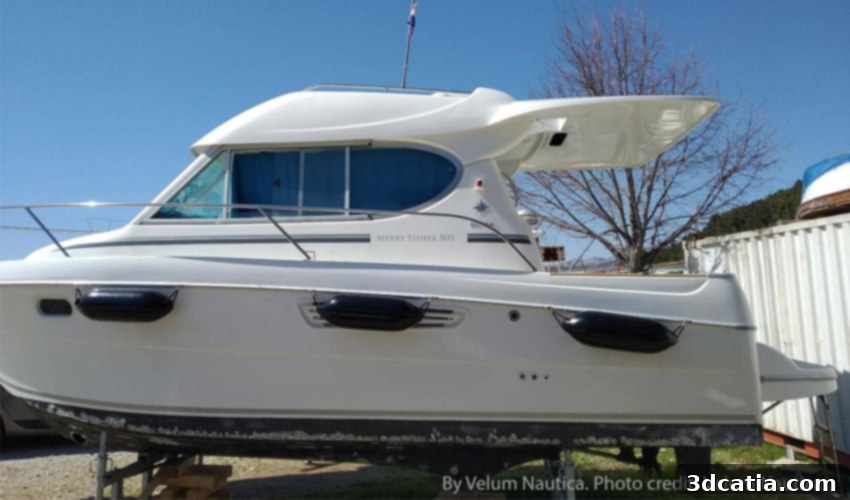
Revolutionizing Marine Repair: How Large-Format 3D Printing Transforms Stefos Yacht Services with Massivit3D and Lino3D
The maritime sector is undergoing a significant transformation, with additive manufacturing, commonly known as 3D printing, emerging as a pivotal technology. Its applications range from designing custom parts and higher-performance components to even fabricating entire boat models. This innovation is particularly impactful in countries like Greece, where tourism plays a crucial role in the economy, fueling a thriving market for boat rental, sales, and maintenance. The demand for efficient and tailored maritime services is at an all-time high, creating a fertile ground for technological adoption.
Among the key players navigating this dynamic market is Stefos Yacht Services, a reputable company dedicated to the maintenance and repair of a diverse fleet of sailing and motor yachts. Operating frequently under stringent deadlines, the company faces constant pressure to deliver swift, high-quality results. To meet these demands and enhance its operational capabilities, Stefos Yacht Services has strategically embraced a large-format 3D printing solution. This adoption has not only accelerated their manufacturing processes but also enabled them to offer more customized and efficient services to their discerning clientele. The company’s journey into advanced manufacturing is supported by Lino3D, an expert partner responsible for printing and ensuring the meticulous post-processing of parts. This collaboration allows Stefos Yacht Services to tap into a wealth of specialized knowledge, fully leveraging the extensive advantages offered by XXL 3D printing technology.
Massivit3D stands at the forefront of large-format 3D printer manufacturing, providing cutting-edge solutions characterized by exceptionally generous print volumes, often reaching impressive dimensions like 145 x 111 x 180 cm. These industrial-grade machines are specifically engineered to cater to industries that require the production of substantial parts at remarkable speeds. This capability is profoundly beneficial for the maritime industry, where rapid turnaround times are often critical, especially when vessels need to be repaired and returned to service as quickly as possible. For instance, Massivit3D’s large-format machines are adept at producing a wide array of marine components, from intricate instrument panels that integrate complex wiring to robust radar masts designed to withstand harsh marine environments. The sheer scale of Massivit3D’s build volume enables the manufacturing of these large parts in a single, continuous process, eliminating the need for complex assembly steps. This monolithic production method is crucial for marine applications, as it significantly enhances the waterproofing and structural integrity of components, thereby extending their lifespan and reliability at sea. Furthermore, by optimizing material usage and reducing the need for multiple smaller parts to be joined, Massivit3D technology helps to minimize material waste, contributing to a more sustainable and environmentally responsible manufacturing footprint.

A custom boat piece 3D printed on a Massivit machine, demonstrating the scale and detail possible.
It was precisely these compelling advantages — speed, size, and efficiency — that led Stefos Yacht Services to partner with Massivit3D for their additive manufacturing needs. Dimitris Stefos, the visionary founder and CEO of Stefos Yacht Services, recounted his initial quest for the ideal solution: “I started to look into the type of 3D printers we could use to meet our needs. We needed a solution that was large, fast and could be deployed easily.” This search led him to the expert team at Lino3D, who possessed the specialized knowledge to guide him toward the most suitable technology. Stefos elaborates, “That’s when I met the Lino3D team who advised me and directed me to a Massivit3D machine.” This strategic guidance proved invaluable. Currently, Lino3D plays a crucial role as the primary service provider, meticulously 3D printing the necessary parts for Stefos Yacht Services. Beyond mere production, Lino3D’s deep-rooted experience in shipbuilding and repair enables them to provide comprehensive post-processing services, ensuring that each part not only meets precise specifications but is also optimized for marine environments. This end-to-end support underscores the synergy between advanced additive manufacturing technology and specialized industry expertise, delivering unparalleled results for marine maintenance and customization.
The integration of additive manufacturing has dramatically expanded the capabilities of Stefos Yacht Services, enabling the Greek company to innovate across several critical areas. One significant benefit is the ability to produce highly accurate prototypes that can be physically installed on boats. This tangible approach allows end customers to visualize, interact with, and validate a proposed part much more effectively than relying solely on a two-dimensional CAD model. This direct customer engagement accelerates the design approval process, minimizes misunderstandings, and ensures the final product perfectly aligns with client expectations. Through its partnership with Lino3D, Stefos Yacht Services also excels in manufacturing complex molds and finished, end-use parts directly. Regardless of the application, the underlying technology consistently delivers substantial time and cost savings compared to traditional methods. Dimitris Stefos highlighted this transformation, stating, “Today we use glass fiber reinforced plastic with polyester resin or epoxy resin for the final parts and wood or other materials for the pre-molding. This method, in addition to the time it takes and the excessive use of materials, has its limitations.” He further emphasized the revolutionary impact of 3D printing: “The Massivit 3D printer, on the other hand, can produce any shape in any size for molding at least three times faster than before.” This stark comparison underscores additive manufacturing’s capacity to overcome the inherent constraints of conventional fabrication, offering unparalleled design freedom, material efficiency, and production speed for the maritime sector.
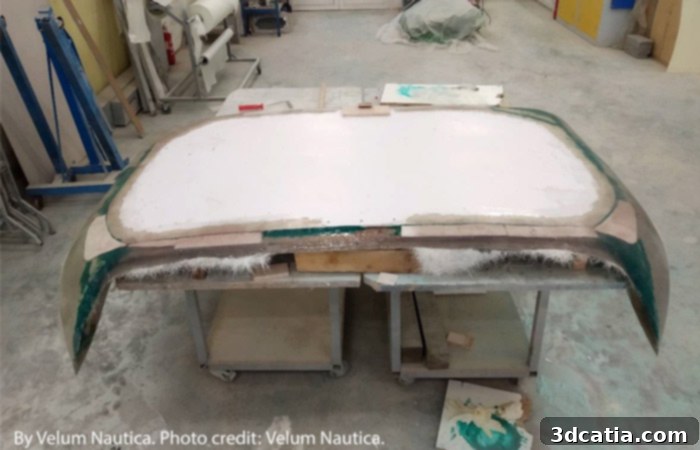
Meticulous post-processing of a large 3D printed part, essential for marine applications.
A primary and enduring challenge for the marine industry revolves around the long-term durability and resilience of parts when exposed to the relentless wear and tear of sea conditions and harsh weather. Saltwater corrosion, UV radiation, extreme temperatures, and constant mechanical stress can severely degrade components over time, leading to frequent repairs and replacements. Additive manufacturing, particularly Massivit3D’s advanced technology, presents a robust solution to this critical issue. The materials and processes used by Massivit3D are engineered to produce parts that exhibit exceptional resistance to these demanding elements. Crucially, these 3D printed components have undergone rigorous testing, with specific parts demonstrating the ability to withstand harsh marine conditions for periods exceeding two years at sea without suffering damage or significant degradation. This proven longevity and resilience are game-changers for boat owners and service providers. Furthermore, should a part eventually require replacement, 3D printing offers the invaluable advantage of rapid, on-demand reproduction. This eliminates the traditional bottleneck of having to create an expensive, time-consuming, and often environmentally impactful mold for each new part. The ability to quickly print a precise replacement reduces vessel downtime and offers significant economic and ecological benefits. As the 3D printing industry continues to evolve, the development of even more advanced and specialized materials, such as high-performance polymers, composites, and potentially bio-based alternatives, promises to further enhance the durability and sustainability of marine components.
In this spirit of innovation and forward-thinking, Stefos Yacht Services continues to strengthen its collaboration with Lino3D, relying heavily on their profound expertise to embark on increasingly complex and innovative projects. Dimitris Stefos eloquently summarizes the success of this partnership, stating, “Our collaboration continues in a friendly environment that allows me to have a panel of manufacturing solutions.” This enduring and harmonious relationship is a testament to the effectiveness of integrating advanced technology with specialized service. The boat specialist’s satisfaction and belief in the technology are so strong that Stefos Yacht Services is anticipated to take a significant leap forward in the coming months: investing in its very own Massivit 3D printer. This strategic acquisition will represent a powerful commitment to fully internalizing additive manufacturing capabilities, allowing Stefos Yacht Services to further optimize its processes, expand its service offerings, and maintain a competitive edge in the rapidly evolving marine market. It signifies a long-term vision where on-demand, custom part production becomes a core pillar of their operational strategy, ushering in an era of greater autonomy and innovation for the company.
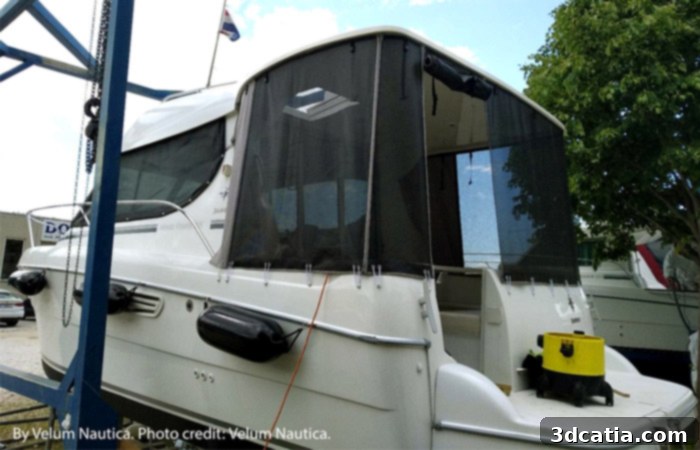
A stunning yacht hardtop roof, showcasing the quality achievable from a 3D printed mold created by Velum Nautica (photo credits: Velum Nautica).
For those keenly interested in delving deeper into these groundbreaking applications and exploring the future of additive manufacturing in the marine industry, Lino3D will be a prominent presence at Metstrade in Amsterdam. This premier international event dedicated to the marine leisure industry will take place from November 15-17. Visitors will have a unique opportunity to engage with the Lino3D team and discover more about their innovative processes and collaborative successes at the Massivit3D booth, located at 12.603. Additionally, you can gain further insights and detailed information about Lino3D’s diverse additive manufacturing solutions by visiting their official website HERE.
The adoption of additive manufacturing in boat building and repair marks a significant turning point for the marine sector, promising enhanced efficiency, customization, and durability. What are your thoughts on the transformative potential of 3D printing in this traditional industry? We invite you to share your perspectives in a comment below or join the conversation on our LinkedIn, Facebook, and Twitter pages! Don’t forget to sign up for our free weekly Newsletter here to receive the latest 3D printing news straight to your inbox! You can also find all our compelling videos and industry insights on our YouTube channel.
*Cover photo: A meticulously 3D printed mold by Velum Nautica, expertly used for crafting the elegant roof of a boat, demonstrating the precision and versatility of additive manufacturing in marine design (credits: Velum Nautica)