
Apple’s Leap into 3D Printing: Revolutionizing Apple Watch Manufacturing
The world of technology and manufacturing is abuzz with a groundbreaking development from one of its titans: Apple. Earlier this year, whispers and reports hinted at Apple’s potential venture into 3D printing for its upcoming series of Apple Watches. Initially, Ming-Chi Kuo, a highly respected analyst at TF International Securities known for his accurate predictions regarding Apple’s strategic moves, suggested that the second-generation Apple Watch Ultra would integrate certain 3D printed titanium mechanical components. However, more recent and refined intelligence from Bloomberg indicates a slightly different, yet equally significant, direction. According to their sources, Apple is currently in advanced stages of testing the production of the new Apple Watch Series 9, featuring its case made from 3D printed metal. This strategic shift is particularly noteworthy given the rapidly expanding interest and adoption of 3D printing in consumer goods across various sectors, from the creation of innovative toys and ergonomically designed sandals to intricately crafted musical instruments. The potential impact of such a fundamental manufacturing change, spearheaded by a global tech giant like Apple, extends far beyond smartwatches, signaling a major endorsement for additive manufacturing as a viable solution for mass production.
The Bloomberg report, citing anonymous sources within Apple, detailed the extensive background behind this move. These insider sources clarified that Apple’s journey into 3D printing is not a recent impulse but rather a culmination of several years of intensive research, development, and rigorous testing. The company is now reportedly on the cusp of a market launch for its next-generation Apple Watch, set to be produced using additive manufacturing techniques. Apple’s deliberate decision to transition towards 3D printing underscores a profound recognition of its superior manufacturing efficiencies. This includes a significant reduction in material waste, a cornerstone of sustainable production, leading to enhanced cost-effectiveness over time. Furthermore, additive manufacturing offers faster production speeds compared to conventional methods such as CNC machining. Beyond mere operational advantages, this paradigm shift is also poised to catalyze a reorganization of Apple’s manufacturing infrastructure. By embracing 3D printing, Apple stands to gain unprecedented control and flexibility throughout its entire production cycle, from design iteration to final assembly, potentially streamlining supply chains and accelerating product innovation. This strategic integration of advanced manufacturing processes could solidify Apple’s position as a leader not just in product design, but also in pioneering sustainable and efficient production methodologies for consumer electronics.

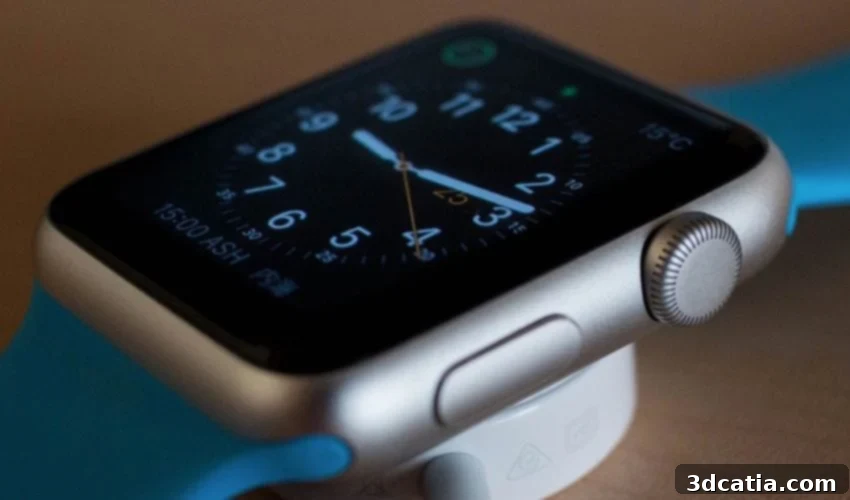
The Apple Watch Series 9 (photo credits: Apple)
The Strategic Advantages of Additive Manufacturing for Consumer Electronics
Apple’s move into 3D printing is not merely about adopting a new technology; it’s a strategic decision rooted in the intrinsic benefits additive manufacturing offers. One of the primary drivers is the drastic reduction in material consumption. Traditional subtractive manufacturing, like CNC machining, carves a product from a larger block of material, often leading to a significant amount of waste in the form of chips and scraps. In contrast, 3D printing builds objects layer by layer, adding material only where it’s needed. This ‘near-net-shape’ production minimizes waste, which translates directly into lower material costs and a reduced environmental footprint—a crucial factor for a company like Apple committed to ambitious sustainability goals.
Beyond waste reduction, additive manufacturing unlocks unparalleled design freedom. While the current focus for the Apple Watch Series 9 seems to be on the outer case, the technology’s potential for creating complex internal geometries, lightweight structures, and parts with integrated functionalities is immense. This could lead to more compact devices, improved heat dissipation, or even new ways to incorporate sensors and components in future iterations. For a company renowned for its meticulous design and engineering, the ability to iterate rapidly and produce intricate designs that would be impossible or prohibitively expensive with conventional methods presents a significant competitive edge. This flexibility also extends to the production process itself, allowing for faster prototyping and a more agile response to design changes or market demands, accelerating the journey from concept to consumer.
Binder Jetting Can Help Save Time, Money and Enable Scalability
The specific additive manufacturing method Apple has reportedly chosen is metal binder jetting, with a focus on stainless steel. Binder jetting is a highly efficient and scalable 3D printing process. It begins with the precise placement of a thin layer of powdered material – in this case, stainless steel particles – onto a build platform. Subsequently, a binding agent is selectively jetted onto this powder layer, adhering the particles together in the desired cross-section of the object. This process is repeated layer by layer, gradually building up the “green part” or unfired object. Once the printing phase is complete, the object, still fragile, undergoes post-processing. This typically involves a crucial sintering step, where the part is heated in a furnace to a temperature below its melting point. During sintering, the binder is burned off, and the metal particles fuse together, densifying the material and imparting the necessary mechanical properties. In some cases, infiltration with another metal might be used to enhance density and strength. Finally, the product would then be treated and smoothed through various surface finishing techniques to achieve Apple’s recognizable aesthetic and optimal final product quality, including polishing, grinding, or coating.
The traditional method for manufacturing a watch case out of steel involves starting with a solid block of metal. This block is then meticulously machined using computer numerical control (CNC) machines, a subtractive process that removes material until the desired shape is achieved. While CNC machining offers high precision, it inherently generates a substantial amount of material waste and can be time-consuming for complex geometries. Switching to binder jetting represents a radical departure, promising significant advantages for the Cupertino-based company. It could drastically cut the raw material needs, reducing both costs and environmental impact. More importantly, binder jetting allows for a faster and more precise production process, especially when producing multiple parts simultaneously within a single build volume. This method’s ability to produce dozens or even hundreds of objects in the same print run makes it exceptionally well-suited for high-volume manufacturing, a critical requirement for Apple’s mass-market products. The inherent scalability and efficiency of binder jetting could be a game-changer for Apple’s production lines.
The Broader Implications for Apple and the Additive Manufacturing Industry
Significantly, the Bloomberg report clarifies that Apple’s initial foray into additive manufacturing for smartwatches will be focused on the Apple Watch Series 9, rather than the Apple Watch Ultra as some earlier rumors suggested. This distinction is important, as it indicates Apple’s intent to implement 3D printing in a product with broader mass-market appeal from the outset. The Apple Watch Series 9 is most likely to be unveiled this September, aligning with Apple’s customary announcement schedule for new products, including the highly anticipated iPhone models. The tech world is keenly awaiting this potential announcement, as the launch of 3D-printed watches on such a massive scale would represent a momentous and pivotal step forward for additive manufacturing technologies, demonstrating their readiness and viability for true mass production in the consumer electronics sector. This move by Apple could serve as a powerful validation for the entire additive manufacturing industry, potentially accelerating its adoption across various other industries.
Given the extensive timeframe of Apple’s testing and the maturity of current additive manufacturing technologies, it seems highly probable that these production method tests are indeed bearing significant fruit. The successful integration of 3D printing into the manufacturing process of the Apple Watch Series 9 could set a precedent not only for future generations of smartwatches but also for a gradual expansion of this technology to a wider array of Apple products in the coming years. One could envision 3D-printed internal components for iPhones, MacBooks, or even accessories, leveraging the design freedom and material efficiency of additive manufacturing. This long-term vision highlights Apple’s commitment to pushing the boundaries of manufacturing innovation. The challenges for Apple will include maintaining stringent quality control at unprecedented scales, optimizing post-processing workflows, and securing a robust supply chain for powdered materials and binder agents. However, Apple’s track record of overcoming complex manufacturing hurdles suggests they are well-positioned to tackle these challenges.
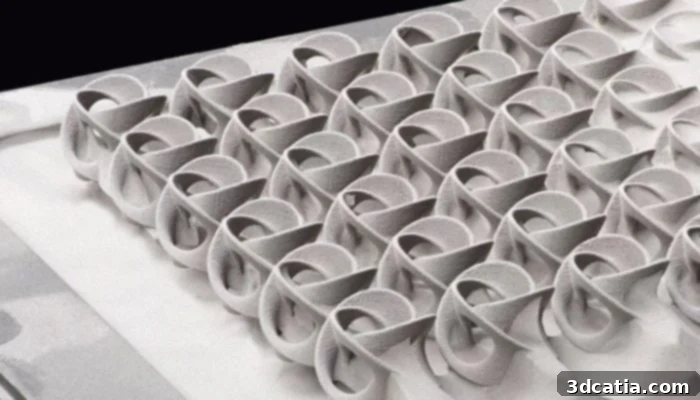
Binder jetting allows for dozens of objects to be made in the same print, making it a highly efficient production method. (photo credits: Markforged)
Ultimately, Apple’s reported venture into mass-producing 3D printed Apple Watches signifies more than just a new manufacturing technique for a single product line. It represents a potential turning point for the consumer electronics industry and for additive manufacturing as a whole. As a company renowned for setting industry standards and influencing global trends, Apple’s adoption of 3D printing could inspire countless other brands to explore and invest in these advanced technologies. This could lead to a future where products are not only more sustainably produced but also offer greater customization, innovative designs, and enhanced performance, all thanks to the transformative power of additive manufacturing. The upcoming September announcement is eagerly awaited, promising to shed more light on the specifics of this exciting new chapter in Apple’s manufacturing journey and its profound implications for the future of tech. This strategic move cements Apple’s position not just as a design leader, but as a pioneer in integrating cutting-edge manufacturing processes into the heart of mainstream consumer technology.
What do you think about Apple making such a significant move towards 3D printing its watches? Share your thoughts and predictions in the comments section below or engage with us on our social media channels: LinkedIn, Facebook, and Twitter! Don’t forget to subscribe to our free weekly Newsletter here to get the latest 3D printing news delivered straight to your inbox. You can also explore all our insightful videos on our YouTube channel for more in-depth content.
*Cover Photo Credits: Apple