

Beyond STL: Virginia Tech’s Source Form Redefines 3D Printing with Crowdsourced Photogrammetry
The landscape of additive manufacturing is continuously evolving, with researchers constantly pushing the boundaries of what’s possible. From the prestigious Virginia Tech Institute of Creativity, Arts and Technology (ICAT), a team of visionary researchers has recently unveiled a truly groundbreaking innovation: their brand new SLA 3D printer, aptly named Source Form. At first glance, Source Form might appear to be just another Stereolithography (SLA) machine, a well-established technology renowned for its high-resolution and intricate details. However, beneath its familiar exterior lies a revolutionary capability that promises to fundamentally alter how we approach 3D printing. Source Form is engineered to produce physical objects without the traditional prerequisite of an STL file, a standard format that has long been the cornerstone of the 3D printing workflow. Instead, this pioneering device creates three-dimensional objects by intelligently assembling and interpreting a multitude of images through a sophisticated process known as photogrammetry. Its operational brilliance is rooted in the utilization of vast amounts of downloaded data, primarily crowdsourced images. The underlying principle is elegantly simple yet powerfully effective: the more images that are gathered and processed, the greater the accuracy and detail the 3D printer can achieve, leading to a continuously improving output over time.
For decades, the STL (STereoLithography) format has reigned supreme as one of the most widely adopted and fundamental file types in the 3D printing industry. This ubiquitous format is crucial because it describes the surface geometry of a 3D part using a tessellated representation of triangular facets. Once an STL file is generated, it serves as the digital blueprint for the physical object. The next critical step in the conventional 3D printing pipeline involves a slicer software, which meticulously cuts the 3D model into hundreds, if not thousands, of horizontal layers. These individual layer instructions are then meticulously translated into G-code, a language understood by the 3D printer, dictating every movement of its print head and every curing action. These successive stages – from precise STL file creation to accurate slicing – are absolutely foundational to a successful 3D printing process. Consequently, investing time in ensuring the quality and integrity of an STL file is paramount, as it directly impacts printability and final part accuracy, thereby saving considerable time and resources in the long run. However, with the advent of the Source Form 3D printer from these innovative American researchers, users may soon be able to circumvent these often-complex and time-consuming initial design and file preparation steps, potentially saving even more precious time. The groundbreaking capabilities of this machine were recently showcased and lauded at the prestigious ACM SIGGRAPH 2019 conference held in Los Angeles, drawing significant attention from the additive manufacturing community.
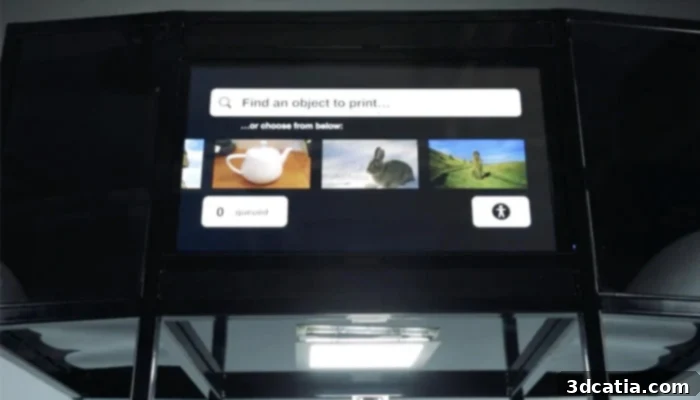
The operational methodology of the Source Form 3D printer is remarkably intuitive and stands in stark contrast to traditional CAD-centric workflows. To initiate the 3D printing of an object using Source Form, the process begins simply: users must first input the name or a descriptive text of the desired object into the machine’s interface. Upon receiving this textual query, the machine springs into action, performing an initial, comprehensive image search across vast online databases. It then presents the recovered content to the user, who, at this critical juncture, provides feedback by commenting on the accuracy and relevance of the retrieved images. This user feedback loop is not merely a validation step; it’s a crucial, iterative learning mechanism that enables the printer to continuously refine and enhance its search algorithms and understanding for future queries. Following this crucial validation and refinement phase, the Source Form undertakes a more targeted inverted image search. This advanced search leverages the initially identified relevant images to scour the internet for even more comprehensive and diverse visual data of the same object. Therefore, the strength and ultimate precision of the Source Form system are directly correlated with the sheer volume and quality of photographic content available online. As the researchers eloquently explain: “When Source Form is asked to print the Statue of Liberty today and then print again 6 months from now, the later result will be more accurate and detailed than the previous version. As people continue to take pictures of the monument and upload them to social media, blogs and photo sharing sites, the database of images grows in quantity and quality.” This statement underscores the dynamic, self-improving nature of Source Form, positioning it not just as a printer, but as a system that evolves and gains intelligence as the global digital visual library expands, enabling it to generate increasingly refined and lifelike 3D models with each passing day.
Building upon the rich visual data acquired through its intelligent search mechanisms, the Source Form’s sophisticated internal algorithms then embark on the complex task of constructing a comprehensive 3D mesh reconstruction. This mesh is not static; it undergoes a meticulous and gradual processing and refinement phase, meticulously transforming disparate image data points into a coherent and printable digital model. During this critical stage, the system performs a series of vital operations to ensure the physical printability and structural integrity of the final object. This includes intelligently thickening surfaces to create robust, printable features that can withstand the printing process and subsequent handling, while simultaneously identifying and eliminating minute features that are simply too small or delicate to be accurately reproduced by the printer. These unprintable elements could otherwise lead to failures or imperfections in the final print. Once this intricate digital preparation is meticulously completed, the system takes the refined 3D model, which is represented in a voxel-based geometry, and ingeniously splits it into a series of bitmap images, each representing a distinct layer of the object. These precisely generated bitmap images, akin to digital slices, are then sequentially transmitted to the 3D printer, guiding the layer-by-layer fabrication process. For the physical creation of these sophisticated models, the Virginia Tech team made a deliberate and well-considered choice, opting for Mask Spray Tank Photopolymerization (MPVP) technology. MPVP is a form of stereolithography that utilizes a mask to cure entire layers simultaneously, offering significant advantages. This technology was preferred over alternatives such as powder bed fusion or material jetting due to its inherent capabilities for delivering exceptional high-quality resolution, producing parts with superior surface finishes, and its relative accessibility in terms of operational complexity and material costs, making it an ideal choice for rendering the fine details derived from photogrammetric data.
As with many groundbreaking technological advancements, the exact timeline for the Source Form’s market availability remains a subject of anticipation. The research team has not yet announced when this revolutionary 3D printer will be commercially accessible or identified the initial cohort of customers who will have the privilege of benefiting from its unique capabilities. However, the implications of such a technology are profound and far-reaching. Imagine a world where anyone, regardless of their CAD design expertise, can simply describe an object and have it materialize into a physical form. This could democratize 3D printing on an unprecedented scale, transforming rapid prototyping, educational tools, artistic expression, and even personalized manufacturing. From preserving historical artifacts by recreating models from archival photographs to allowing hobbyists to effortlessly print objects based on internet images, the potential applications are vast and exciting. The continuous improvement of printed models as more photographic data becomes available also introduces a fascinating concept of ‘living’ digital archives that are always getting better. We are committed to keeping our readers fully informed of any updates regarding Source Form’s development and market debut as soon as information becomes available. In the interim, for those eager to delve deeper into the technical specifics and ongoing progress of this remarkable project, we encourage you to consult the Institute’s official project website, which can be accessed HERE. This platform provides a comprehensive overview of the research, methodology, and the brilliant minds behind this transformative innovation.
The unveiling of Source Form represents a significant leap forward in additive manufacturing, challenging the traditional paradigms and opening new avenues for creativity and accessibility. Its ability to bypass the complexities of conventional 3D modeling software and STL file generation, instead leveraging the power of crowdsourced photographic data and advanced photogrammetry, positions it as a truly disruptive technology. We believe this innovation could empower a wider audience to engage with 3D printing, fostering a new era of digital fabrication where ideas can transition from concept to physical reality with unprecedented ease. We are incredibly excited to see how Source Form will shape the future of this dynamic industry. What are your initial thoughts on Source Form and its potential to revolutionize 3D printing? Do you envision specific applications where this STL-free approach would be particularly advantageous? We invite you to share your insights, opinions, and predictions by leaving a comment on our Facebook and Twitter pages! Furthermore, to ensure you never miss out on the latest advancements, breaking news, and insightful analyses from the world of additive manufacturing, don’t forget to sign up for our free weekly Newsletter, delivering all the essential updates directly to your inbox!