
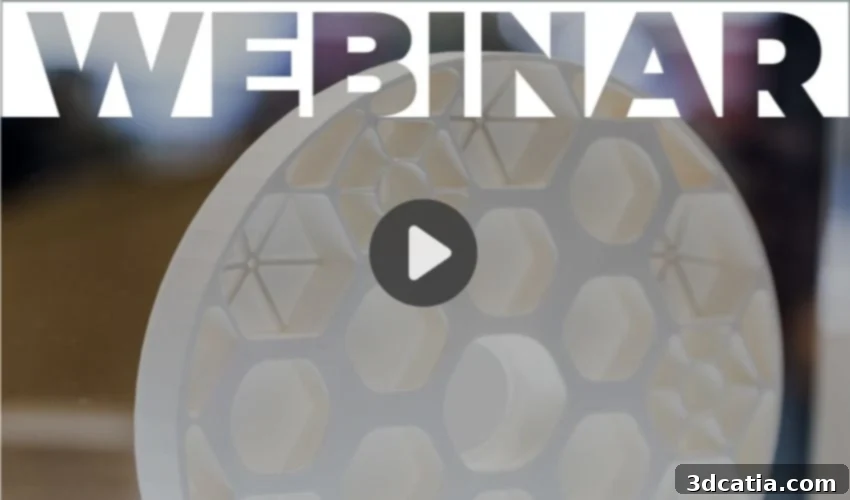
Mastering Large-Scale Technical Ceramics: Insights from the Laser-Based Additive Manufacturing Webinar
On March 6th, 3Dnatives hosted an unparalleled webinar event, bringing together leading experts from **Bosch Advanced Ceramics** and **3DCeram**. This illuminating session delved deep into the transformative capabilities of laser-based ceramic additive manufacturing, specifically focusing on its potential for producing large-scale, high-performance ceramic components in series production. The webinar served as a crucial platform for industry professionals to explore how this cutting-edge technology is reshaping the landscape of advanced manufacturing, offering solutions for precision, efficiency, and scalability in challenging industrial environments.
Attendees gained invaluable insights into the intricate technological requirements essential for 3D printing high-precision ceramic parts. The discussion spanned a broad spectrum of critical sectors, including **aerospace**, **semiconductor**, **medical**, **textile**, and **electronics** industries, highlighting the diverse applications where advanced ceramics are proving indispensable. Our expert speakers meticulously guided the audience through the entire additive manufacturing workflow, from initial design concepts to the meticulous production of final, highly functional components. They candidly addressed the prevalent challenges associated with manufacturing complex, large ceramic parts, simultaneously presenting innovative solutions that ensure unparalleled precision and operational efficiency. This comprehensive approach underscored the readiness of ceramic additive manufacturing to meet rigorous industrial demands.
Beyond theoretical discussions, the webinar illuminated the practical efficacy of ceramic 3D printing through compelling, real-life case studies. These examples emphatically demonstrated that ceramic additive manufacturing has evolved far beyond its traditional role in rapid prototyping. It is now firmly established as a viable, reliable, and indeed essential solution for robust series production across various industrial verticals. Representatives from Bosch Advanced Ceramics and 3DCeram provided a detailed exploration of how their pioneering “top-down technology” is instrumental in enabling the efficient and cost-effective production of large-scale, superior-quality ceramic parts. This methodology offers significant advantages in achieving critical material properties and geometric complexities required for demanding industrial applications.
The rapid advancements in **laser-based ceramic additive manufacturing** are fundamentally changing how engineers and manufacturers approach design and production. This technology allows for the creation of intricate geometries and internal structures previously unattainable with conventional ceramic manufacturing methods. The ability to precisely control the laser’s interaction with ceramic slurries or powders ensures exceptional material density, minimal porosity, and superior surface finish, which are critical for high-performance applications. Furthermore, the inherent flexibility of 3D printing means that custom ceramic parts can be produced on demand, reducing lead times and facilitating rapid iteration in product development cycles. This flexibility is vital in fast-paced industries where quick adaptation to new designs and functionalities is a competitive advantage.
When discussing **key technological requirements** for printing high-precision ceramic parts, several factors stand out. Firstly, the selection and preparation of ceramic materials are paramount. High-quality ceramic powders or slurries, often tailored for specific additive manufacturing processes, are crucial for achieving desired mechanical, thermal, and electrical properties in the final component. These materials must maintain purity and consistency to avoid defects. Secondly, the precision and stability of the laser system are vital for accurate layer-by-layer consolidation. Advanced calibration and feedback systems are employed to ensure consistent energy delivery and material solidification, which directly impacts the structural integrity and dimensional accuracy of the printed part. Thirdly, sophisticated software for design optimization and process control plays a significant role. This includes topology optimization tools to create lightweight yet robust designs and simulation software to predict material behavior during printing and post-processing, such as sintering, which is critical for densification and achieving final part dimensions without warping or cracking.
The impact of **advanced ceramic additive manufacturing** is particularly pronounced in industries demanding extreme performance. In **aerospace**, lightweight ceramic components offer excellent strength-to-weight ratios and superior thermal stability, making them ideal for high-temperature engine parts, thermal protection systems, and structural elements where traditional metals would fail. The **semiconductor industry** relies heavily on ultra-pure, high-precision ceramic parts for critical process equipment, where resistance to corrosive chemicals, high dielectric strength, and exceptional dimensional stability are non-negotiable for manufacturing microchips. **Medical applications** benefit immensely from the biocompatibility and excellent mechanical properties of ceramics for custom implants, surgical instruments, and prosthetic devices. The ability to create patient-specific geometries significantly enhances treatment outcomes and quality of life. Even in niche areas like the **textile industry**, specialized ceramic guides and components are prized for their extreme wear resistance and smooth surfaces, ensuring longevity and consistent performance in high-speed machinery. **Electronics industries** leverage ceramics for advanced insulators, heat sinks, and sensor components due to their superior electrical insulation, thermal management properties, and ability to operate in harsh environments.
Despite its immense potential, the journey to perfecting **ceramic 3D printing** involves overcoming unique challenges. Ceramics are inherently brittle, and their processing often involves significant shrinkage during sintering, which can lead to warping, cracking, or dimensional inaccuracies if not meticulously controlled. The experts at Bosch Advanced Ceramics and 3DCeram shared their proprietary solutions for mitigating these risks. This includes advanced material formulations that precisely control shrinkage, innovative support structure designs that minimize residual stresses during printing and firing, and optimized sintering profiles that ensure uniform densification and grain growth. Furthermore, handling and processing ceramic slurries or powders require specialized cleanroom environments and precise dispensing mechanisms to prevent contamination and maintain material integrity, especially for sensitive applications like those in the semiconductor industry. Their expertise highlighted how meticulous process control, coupled with deep material science knowledge, is key to consistently producing high-quality, defect-free ceramic components that meet stringent industrial specifications.
The transition from **prototyping to series production** marks a pivotal shift for ceramic additive manufacturing. While 3D printing has long been celebrated for its ability to rapidly iterate designs and produce one-off custom parts, its viability for large-volume manufacturing was once questioned. However, with significant advancements in machine reliability, process automation, and material economics, laser-based ceramic AM is now demonstrating its capability for efficient, repeatable series production. This paradigm shift offers manufacturers unparalleled flexibility in production, enabling just-in-time manufacturing, reducing inventory costs, and facilitating agile responses to market demands. The ability to produce complex, customized parts economically in volume opens up new markets and applications that were previously inaccessible due to the limitations and high tooling costs associated with traditional ceramic manufacturing methods like injection molding or machining.
Central to the discussion was the efficacy of **top-down technology** in achieving high-quality, large-scale ceramic parts. This specific additive manufacturing approach, leveraged by companies like 3DCeram, offers distinct advantages, particularly for industrial applications demanding precision and scale. Unlike bottom-up methods where layers are built upwards and material might flow or deform under gravity before curing, top-down approaches often involve a vat of liquid ceramic resin with the build platform descending into it, or a process where the ceramic material is illuminated from above. This orientation can provide better stability for large, intricate structures, reduce the risk of part detachment during printing, and often allows for more efficient material handling and recirculation, minimizing waste. The exceptional precision achievable with top-down techniques makes them particularly suitable for complex geometries requiring tight tolerances, excellent surface finishes, and the ability to produce fine features, proving invaluable for the rigorous demands of advanced industrial ceramic applications.
This webinar was more than just an informational session; it was an extraordinary opportunity to learn directly from **industry leaders** who are at the forefront of ceramic additive manufacturing innovation. Attendees gained a comprehensive understanding of why laser-based ceramic additive manufacturing is not merely a novel concept but a proven, cutting-edge solution for industrial-scale production. The deep dives into real-world applications, technological requirements, and practical solutions provided a holistic view of the current state and future potential of this transformative technology. For anyone involved in advanced materials, engineering design, or manufacturing, the insights shared were truly indispensable. If you missed the live event, you have the chance to experience this wealth of knowledge first-hand and understand how ceramic 3D printing is poised to revolutionize various sectors.
For those eager to revisit the key discussions, delve into the detailed presentations, or catch up on what they missed, the full webinar replay is available. This is your chance to gain a deeper understanding of the possibilities that advanced ceramic additive manufacturing unlocks for a multitude of industrial sectors. Don’t miss out on this opportunity to learn from the best in the field and see how **laser-based ceramic 3D printing** is setting new benchmarks for performance and production efficiency. Simply **check out the replay below** to immerse yourself in the world of high-performance technical ceramics and discover the future of precision manufacturing.
Meet Our Esteemed Speakers
The success of this insightful webinar was greatly amplified by the expertise and invaluable contributions of our distinguished speakers, each bringing a unique perspective from the cutting edge of ceramic additive manufacturing.
Maxence Bourjol, the dynamic Sales Manager for the French-based company **3DCERAM SINTO**, brought a deep understanding of the ceramic additive manufacturing market and customer needs. A proud graduate of the prestigious engineering school of ceramics in Limoges, France, Maxence has been an integral part of 3DCERAM SINTO since 2013. His journey within the company began in the demanding production team, providing him with invaluable hands-on experience in the intricacies of ceramic part creation. This foundational knowledge proved crucial as he transitioned to the sales team, where he successfully managed the Asia-Pacific region for five years, cultivating strong relationships and expanding the company’s footprint. Now serving as the Sales Manager, Maxence continues to drive innovation and adoption of 3DCERAM’s cutting-edge solutions for **large-scale technical ceramics**. His close collaboration with Wuhan 3DCERAM China since 2016 has been pivotal in building robust partnerships with Chinese customers, resulting in the installation of over 30 machines in the region. Maxence’s insights into market trends, technological demands, and global expansion strategies made his presentation exceptionally relevant for all attendees interested in the commercialization and industrial application of advanced ceramic 3D printing, especially for **series production**.
Johannes Noll, a distinguished Development Engineer at the headquarters of **Bosch Advanced Ceramics** in Germany, shared his profound technical expertise. Johannes is a recognized specialist in the additive manufacturing of technical ceramics, with a particular focus on their application across a wide array of demanding industries, including medical, semiconductor, textile, and electronics sectors. His extensive experience encompasses the entire ceramic process chain, from the initial design and material selection to the complex post-processing steps that lead to the final product. Johannes’s comprehensive understanding of material science, process optimization, and quality assurance in ceramic production enriched the discussion significantly, particularly regarding **high-performance ceramics**. His contributions highlighted the rigorous research and development efforts undertaken at Bosch Advanced Ceramics to push the boundaries of what’s possible with industrial ceramic components. Attendees benefited immensely from his practical knowledge of overcoming manufacturing hurdles and his insights into developing robust, reliable ceramic solutions for critical industrial challenges, underscoring Bosch’s commitment to innovation in advanced materials and **laser-based ceramic additive manufacturing**.
Madeleine Prior served as the insightful moderator and English Content Specialist at **3Dnatives**, the leading international online media platform dedicated to 3D printing and additive manufacturing. As a key member of the 3Dnatives editorial team, Madeleine is responsible for defining and curating content for its extensive English-speaking audience. Her role involves meticulously tracking the latest developments, innovations, and implications within the rapidly evolving additive manufacturing sector, ensuring that readers receive timely, accurate, and impactful news. Madeleine’s expertise in articulating complex technical concepts into accessible and engaging content made the webinar fluid and easy to follow. Her contributions helped to bridge the gap between highly technical discussions and the diverse audience, ensuring that the webinar’s profound insights into **laser-based ceramic additive manufacturing** were clearly communicated and understood. Through her work, Madeleine helps shape the global narrative around 3D printing, making the advancements in this field accessible to a broader professional community and fostering deeper engagement with **advanced ceramic solutions**.
Did you have the opportunity to attend this groundbreaking webinar? Or perhaps you’re just discovering the immense potential of **laser-based ceramic additive manufacturing** and are eager to learn more? We are keen to hear your thoughts and insights! Why are you particularly interested in this advanced field? What specific applications or challenges do you foresee being addressed by this technology? Let us know your perspectives in a comment below. You can also join the conversation and connect with us on our vibrant social media platforms: find us on LinkedIn, Facebook, and Twitter. Don’t miss out on the latest advancements and breaking news in the additive manufacturing world – be sure to sign up for our free weekly Newsletter here, delivering the most relevant 3D printing news straight to your inbox! Additionally, for a deeper dive into video content and expert interviews, you can explore all our engaging videos on our dedicated YouTube channel. Your engagement helps us continue to provide valuable content and foster a thriving community around advanced manufacturing technologies and the future of **high-performance technical ceramics**.