
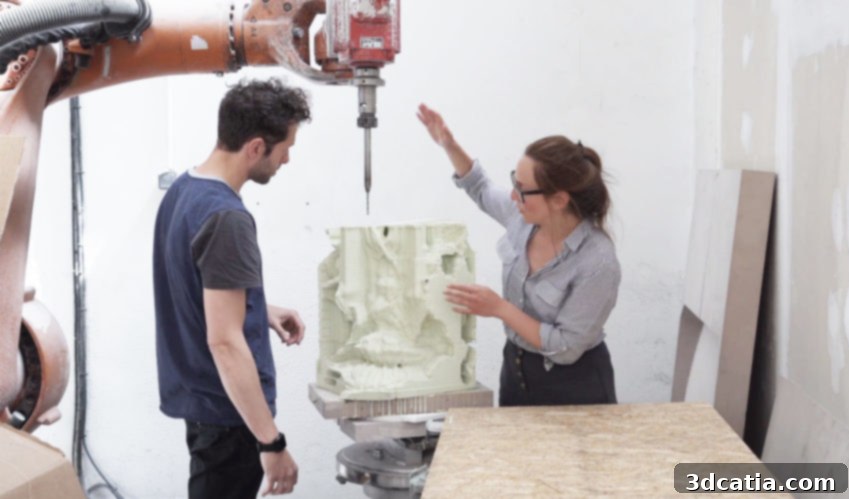
Factum Arte: Revolutionizing Cultural Heritage Conservation and Art Creation with Advanced 3D Technologies
Factum Arte stands at the forefront of cultural artefact conservation, pioneering the integration of advanced digital technologies, particularly various methods of additive manufacturing. Established in 2001 by visionary artists Adam Lowe, Manuel Franquelo, and Fernando Garcia-Guereta, the company has grown into a globally recognized entity with strategically located facilities in Madrid, Milan, and London. Their core mission revolves around the meticulous recording, preservation, and thoughtful reproduction of the world’s most vulnerable and significant cultural heritage sites and objects.
A cornerstone of Factum Arte’s methodology involves the use of non-contact high-definition 3D scanners. These sophisticated devices enable them to capture intricate details of endangered sites and precious artefacts without causing any physical impact, ensuring the integrity of the originals. The resulting high-resolution 3D data serves as the foundation for digital models, which are then transformed into tangible replicas using a diverse array of 3D printing technologies. These faithful reproductions play a crucial role in promoting accessibility to cultural heritage, allowing wider audiences to engage with masterpieces that might otherwise be too fragile or geographically remote to experience firsthand. Simultaneously, this approach supports the ongoing monitoring and maintenance of the original items’ present condition, offering an invaluable tool for conservationists.
The fidelity of Factum Arte’s reproductions is so exceptional that it has sparked considerable debate within the art world, with some critics controversially accusing their works of being forgeries. This contention highlights the unprecedented level of detail and material truth achieved through their innovative processes, blurring traditional lines between original and copy. Beyond mere replication, their work opens up profound philosophical questions about authenticity, originality, and the role of technology in cultural preservation in the 21st century. Factum Arte believes that these high-fidelity facsimiles offer a unique way to understand and appreciate the original works, providing new avenues for research, education, and public engagement that traditional conservation methods alone cannot achieve.
While their groundbreaking 3D printed reproductions garner significant attention, Factum Arte’s influence extends far beyond mere replication. The company is also renowned for collaborating on numerous notable original art projects, many of which are similarly underpinned by sophisticated 3D technologies. They have partnered with celebrated contemporary artists such as Anish Kapoor and Grayson Perry, pushing the boundaries of artistic creation and material exploration. The diverse nature of these artistic endeavors necessitates a flexible and broad technological toolkit. Consequently, Factum Arte employs a comprehensive suite of 3D printing technologies tailored to specific project requirements, including Stereolithography (SLA), Fused Filament Fabrication (FFF), Selective Laser Sintering (SLS), specialized cement printing, and Canon Production Printing’s unique Elevated Printing Technology. This versatile approach allows them to select the most appropriate method to achieve the desired aesthetic and structural properties for each unique challenge.
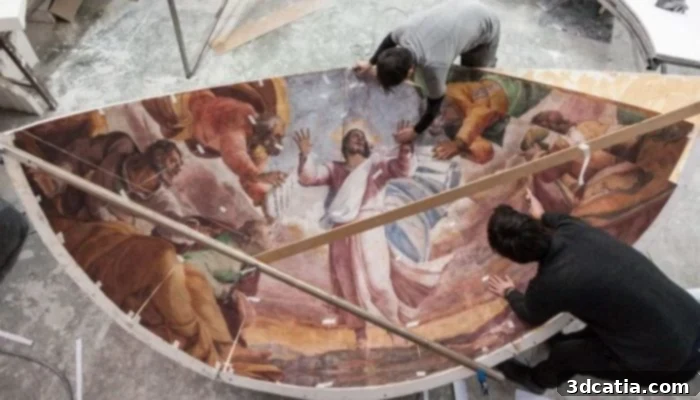
Factum Arte assembling 3D printed parts for the reproduction of Michelangelo and Sebastiano’s Borgherini Chapel in London (Credit: Factum Arte)
Fused Filament Fabrication (FFF) / Fused Deposition Modeling (FDM)
Within Factum Arte’s versatile arsenal of additive manufacturing techniques, Fused Filament Fabrication (FFF), more commonly known as Fused Deposition Modeling (FDM), serves as a fundamental technology for a range of critical applications. This method involves extruding a thermoplastic filament through a heated nozzle, depositing it layer by layer to build a three-dimensional object. While FFF is generally known for producing models with a slightly lower resolution compared to other 3D printing methods, its speed, cost-effectiveness, and ability to use a wide variety of materials make it indispensable for certain stages of Factum Arte’s projects. It is primarily utilized for the rapid production of preliminary models, which are crucial for conceptualization and design refinement, allowing artists and conservators to quickly visualize and evaluate forms before committing to higher-resolution, more time-intensive processes.
Furthermore, FFF technology is extensively employed in the creation of intricate mould forms. These moulds are essential for traditional casting techniques, enabling the production of final artefacts in materials like bronze, resin, or plaster, which may not be directly 3D printable with current technologies. The precision with which FFF can create these mould patterns ensures that the final cast objects retain the exact geometries and details captured by their initial 3D scans. Additionally, Factum Arte leverages FFF for manufacturing various mechanical parts, such as custom component housings, jigs, and fixtures, which are vital for their complex machinery and project setups. These robust and functional parts ensure the smooth operation of their specialized workshops and on-site installations.
To facilitate these diverse applications, Factum Arte’s workshops are equipped with advanced in-house FFF machines. These machines boast impressive build volumes, capable of fabricating objects up to 500 mm³, providing significant flexibility for their projects. This capacity means that 3D models can often be produced as a single, coherent piece. For larger, more ambitious undertakings, the technology allows for the fabrication of multiple individual sections that are later meticulously joined to create a final, grander form. This modular approach is particularly beneficial when dealing with reproductions of large architectural elements or extensive artworks, demonstrating FFF’s adaptability and efficiency in Factum Arte’s innovative workflow.
Stereolithography (SLA)
Stereolithography (SLA) holds a preeminent position among Factum Arte’s additive manufacturing methods, frequently being their go-to choice for high-precision 3D printing. SLA technology operates by curing liquid photopolymer resin layer by layer using an ultraviolet (UV) laser. This process allows for the creation of incredibly fine details and exceptionally smooth surface finishes, making it ideal for applications where aesthetic accuracy and intricate fidelity are paramount. At Factum Arte, SLA is deployed across a wide spectrum of projects to manufacture a diverse range of parts, from highly detailed miniature models used for initial design studies to components requiring complex geometries and a flawless exterior for final presentation.
The distinct capabilities of SLA mean that while smaller preliminary models can be efficiently fabricated in-house, Factum Arte often prepares larger, more ambitious parts within their workshops before collaborating with external manufacturers, such as industry leader Materialise. This strategic partnership leverages Materialise’s extensive capacity and specialized expertise in large-scale SLA printing, ensuring that even monumental objects can be produced with the same exacting standards of quality and precision. The inherent advantage of SLA machines lies in their ability to print significantly larger objects than many other additive manufacturing methods, all while rigorously maintaining an unparalleled level of surface resolution. This exceptional quality is particularly critical in the production of highly detailed smaller models, where every minute textural nuance and subtle curve must be rendered with absolute accuracy to capture the essence of the original artefact or artistic vision.
A compelling illustration of SLA’s transformative power in cultural heritage reproduction is Factum Arte’s rematerialization of Gianbattista Piranesi’s etching of an Isis tripod. Piranesi, an 18th-century Italian artist, architect, and antiquarian, was renowned for his etchings of ancient Roman ruins and fantastical prisons. His depictions, though often based on real structures, were imbued with a dramatic and sometimes imaginary flair. To bring one of his two-dimensional visions into three-dimensional reality, Factum Arte embarked on a meticulous multi-stage process. First, the team created a precise 3D digital model of the tripod, carefully interpreting Piranesi’s intricate lines and shading into a volumetric form. This digital model was then prototyped by Materialise using an advanced SLA printer. The resulting SLA print, while highly accurate, served as a foundational prototype to which intricate details, textures, and subtle imperfections were meticulously added by hand, combining digital precision with traditional craftsmanship. This enhanced prototype was then utilized to create a durable silicon mould, from which the final tripod was cast. The magnificent finished piece, a testament to the seamless integration of historical art, cutting-edge technology, and artisanal skill, was proudly exhibited in 2010, offering a unique tactile experience of Piranesi’s imaginative world.
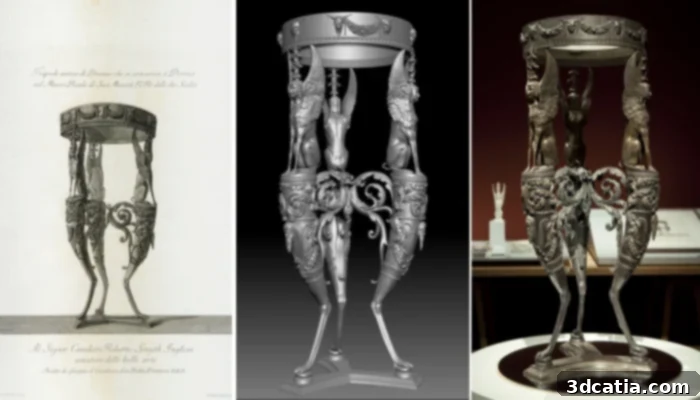
Credit: Factum Arte
Selective Laser Sintering (SLS)
Selective Laser Sintering (SLS) is another cornerstone 3D printing technology extensively employed by Factum Arte, particularly when the end-use application demands superior mechanical properties and environmental resilience. Unlike resin-based SLA or filament-based FFF, SLS utilizes a high-powered laser to selectively fuse powdered material, typically nylon, polyamide, or other engineering plastics, into a solid structure, layer by layer. This powder-bed fusion process eliminates the need for support structures, as the unfused powder naturally supports the object during printing, allowing for complex geometries and internal channels that are difficult to achieve with other methods. The resulting parts are renowned for their excellent strength-to-weight ratio, isotropic mechanical properties (meaning strength is consistent in all directions), and exceptional durability.
Factum Arte strategically deploys SLS for the manufacture of end-use parts because SLS components inherently tend to be more stable and remarkably resistant to UV light and other environmental factors compared to those produced by many other 3D printing technologies. This makes SLS an ideal choice for creating objects intended for exhibition, outdoor display, or functional applications where longevity and material integrity are paramount. For these very reasons, SLS is also a preferred method for manufacturing robust mechanical components, serving effectively in both rapid prototyping scenarios where functional testing is required, and in final end-use applications within Factum Arte’s intricate machinery or artistic installations. Its ability to produce parts that can withstand significant stress and environmental exposure ensures that both the artistic creations and the tools that bring them to life are built to last.
A compelling demonstration of SLS’s capabilities and Factum Arte’s collaborative spirit came to fruition in 2018 through a partnership with London-based artist Shezad Dawood. This collaboration aimed to produce a striking statue titled On Becoming Virtual Octopi, which drew profound inspiration from a Hellenistic piece housed within the esteemed Barakat collection. The artistic vision behind this project was to explore the intersection of ancient history, mythical creatures, and contemporary digital transformation. To translate this complex concept into a tangible form, Factum Arte’s skilled expert, Irene Gaumé, meticulously prepared a highly detailed 3D model. This digital masterpiece was then additively manufactured using an advanced SLS printer, creating a precise and robust core structure. Following the SLS printing, the piece underwent further artisanal refinement. It was expertly cast in composite resin, adding weight, durability, and a tactile quality. The final touch involved coating the entire statue with polychromatic paint, carefully applied to evoke a sense of the ancient while embracing a contemporary aesthetic, resulting in a work that seamlessly blends historical inspiration with cutting-edge manufacturing and artistic finishing.
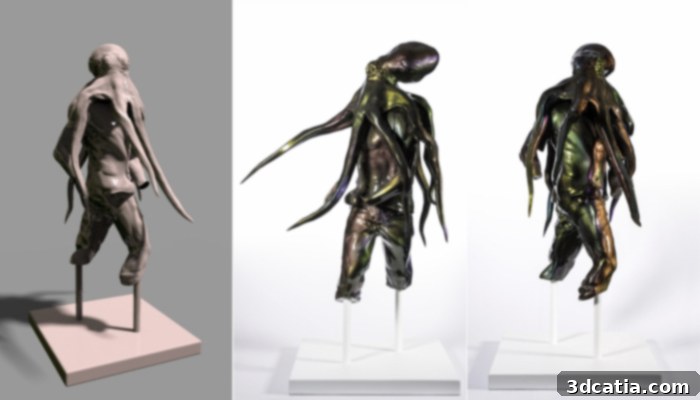
Credit: Irene Gaumé (left) and Eduardo López Rodríguez (right) for Factum Arte
Elevated Printing Technology
Factum Arte’s commitment to capturing the complete essence of cultural artefacts extends beyond mere shape and form to encompass the subtlest surface textures. For this specialized requirement, they employ Canon Production Printing’s (CPP) elevated printing technology, a groundbreaking method for 3D printing objects with incredibly fine surface textures, such as paintings and other “2.5D” objects. This term “2.5D” refers to objects that possess a relief or tactile dimension beyond a flat, two-dimensional image, but do not have the full volumetric depth of a traditional 3D object. Examples include the brushstrokes on a canvas, the subtle texture of paper, or the minute details of an engraved surface.
While CPP elevated printers conceptually function in a similar manner to conventional flat-bed printers used for 2D image reproduction, their operational principle diverges significantly. Instead of merely depositing a single layer of ink, these advanced machines are engineered to deposit multiple, successive layers of ink onto a surface. This iterative layering process gradually builds up the surface texture, creating high-resolution 3D surfaces that accurately replicate the topography of the original. This technology allows for the creation of incredibly faithful facsimiles of paintings, not just in color and tone, but also in the tangible texture of the paint, including impasto and other surface undulations. This capability is revolutionary for art conservation and appreciation, as it provides scholars and the public with a physical copy that can be touched and studied, offering an immersive experience of the artwork’s materiality that is impossible with standard photographic reproductions.
A powerful illustration of this technology’s potential is its application in producing a stunning facsimile of Rembrandt’s iconic Portrait of an Old Man. The photos below vividly demonstrate CPP’s elevated printing technology in action, showing how layers of ink are precisely built up to recreate every wrinkle, every brushstroke, and the subtle luminosity of the original painting. This level of detail allows for a profound re-engagement with masterworks, enabling closer examination of an artist’s technique without risking damage to the original. Such reproductions are invaluable for educational purposes, for exhibitions that require sensitive handling of original works, and for making priceless art accessible to a global audience in a tactile and meaningful way, truly bringing the past into the present with unparalleled fidelity.
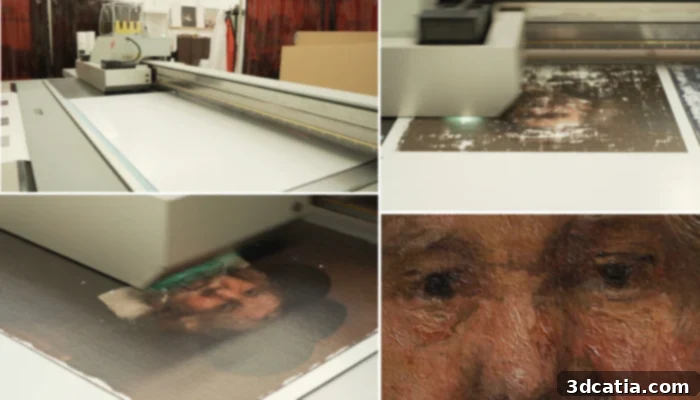
Recreation of Rembrandt’s Portrait of an Old Man using Elevated Printing (Credit: Óscar Parasiego for Factum Foundation and Canon Production Printing)
Cement Printing
In an ongoing quest to explore unconventional materials and push the boundaries of artistic expression, Factum Arte embarked on a visionary collaboration with the celebrated artist Anish Kapoor. This partnership aimed to investigate entirely new methods of generating sculptural forms, leading to the groundbreaking development and construction of a specialized 3D cement printer. This innovative machine was engineered to print directly from CAD (Computer-Aided Design) files, allowing for unprecedented control over the architectural and organic shapes created from cement. This initiative underscores Factum Arte’s dedication not only to conservation but also to facilitating contemporary artistic innovation.
The year 2009 marked a significant milestone, as the very first sculptures using this unique cement printing technique were brought to life. These pioneering works represented a fusion of digital precision and the raw, expressive qualities of cement. Later, these remarkable sculptures were unveiled to the public at London’s prestigious Royal Academy, sparking considerable interest and critical acclaim within the art world. The fundamental concept driving this ambitious project was to harness the “live properties” of different cement mixes. By experimenting with varying compositions and consistencies of cement, the collaborators sought to combine the artist’s deliberate intention and precise digital design with an element of chance and material spontaneity. This approach allowed the physical characteristics of the cement – its flow, texture, and setting behavior – to contribute organically to the final form, resulting in sculptures that embody both controlled design and natural evolution. The resulting artworks are a testament to the powerful synergy between advanced digital fabrication and traditional material artistry, opening new avenues for large-scale sculptural creation and challenging conventional notions of form and process.
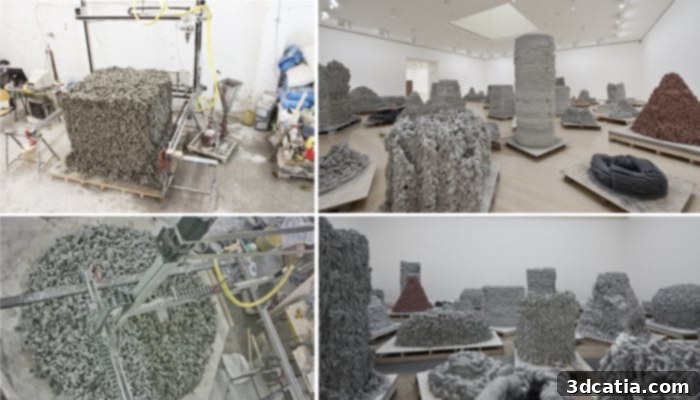
Left: Sculptures being printed by a cement printer (Credit: Factum Arte). Right: Sculptures being exhibited (Credit: Anish Kapoor)
Factum Arte’s pioneering work undeniably redefines the landscape of cultural heritage conservation and contemporary art production. Through their mastery of diverse 3D technologies, from high-definition scanning to an array of additive manufacturing processes, they have established a new paradigm for interacting with and understanding our shared artistic legacy. Their commitment to blending cutting-edge digital tools with traditional craftsmanship ensures that each reproduction or new creation is not merely a copy but a meticulously crafted object, imbued with the spirit and detail of its original or conceptual design.
The ethical and philosophical questions raised by their hyper-accurate facsimiles—are they facsimiles or forgeries?—are precisely what make Factum Arte’s work so compelling and vital. Rather than devaluing originals, these reproductions often enhance appreciation by providing unparalleled access and new avenues for scholarly study and public engagement. They serve as essential tools for preserving endangered cultural artefacts, making them resilient against environmental degradation, conflict, and the passage of time. By ensuring that these irreplaceable treasures can be experienced by future generations, Factum Arte is not just preserving objects; they are safeguarding the narratives, histories, and artistic ingenuity embedded within them.
What do you think about these incredible 3D printed artworks and reproductions? Do you believe Factum Arte’s creations are revolutionary facsimiles that extend the life and reach of cultural heritage, or do they challenge the very notion of originality in a way that approaches forgery? We invite you to share your thoughts in a comment below or join the discussion on our Facebook and Twitter pages! Don’t miss out on the latest advancements and news in the world of 3D printing; sign up for our free weekly Newsletter here and get it delivered straight to your inbox!