
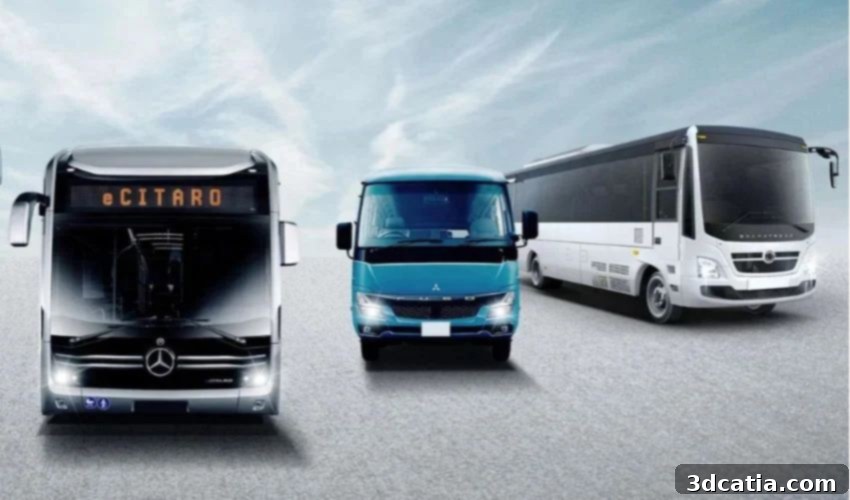
Daimler Truck & Buses: Pioneering Automotive Innovation with Advanced 3D Printing Solutions
Additive manufacturing (AM) has rapidly evolved from a niche technology to a cornerstone of modern production across various industries, notably in the automotive and transportation sectors. This transformative technology is reshaping how vehicles are designed, developed, and manufactured. Many leading automotive manufacturers have already deeply integrated 3D printing into their corporate strategies, leveraging its unique capabilities to drive innovation and efficiency. The railway industry, too, is increasingly adopting 3D-printed parts, moving beyond simple prototyping to encompass individual components, specialized tools, complex systems, and even mass production of specific elements. For forward-thinking companies, additive manufacturing has proven to be a true game-changer, facilitating flexible, demand-driven production cycles and enabling unprecedented levels of innovation. However, some enterprises still approach 3D printing with reservations, yet to fully unlock its immense potential.
Daimler Truck & Buses stands out as a prime example of a company that has not only recognized but actively embraced the profound benefits of additive manufacturing. It has seamlessly woven 3D printing into the fabric of its core strategy, establishing it as a fundamental pillar for implementing a future-oriented digital business model. In an insightful interview, Daniela Rehm, Head of Product Management and Marketing for Additive Manufacturing, and Ralf Anderhofstadt, Head of the AMS 3D Printing Technology Center and Consulting Unit, share their compelling journey. They detail the milestones achieved, the strategies employed to integrate 3D printing within Daimler Truck & Buses, and their ambitious goals for the continued advancement of this cutting-edge technology.
3DN: Can you introduce yourselves and explain your work at Daimler Truck & Buses?
Daniela: My name is Daniela Rehm, and I am deeply involved in the world of additive manufacturing at Daimler Buses. Within our dedicated 3D printing technology center, my primary responsibility is to lead the product management and marketing activities for all additive manufacturing initiatives. Additionally, in our consulting unit, I play a crucial role in coordinating key account management, overseeing central sales activities to ensure that our innovative solutions reach our internal and external stakeholders effectively. Our work focuses on demonstrating the tangible value and strategic importance of 3D printing for our bus divisions.
Ralf: I am Ralf Anderhofstadt, and I have the privilege of managing our advanced 3D printing technology center. Furthermore, I lead our external consulting unit, known as AMS – Additive Manufacturing Solutions Daimler Truck. In this comprehensive role, my dedicated team and I are tasked with spearheading all aspects related to additive manufacturing, both within Daimler Truck & Buses and for external collaborations. Our overarching mission is to cultivate this dynamic technology into a robust, digital, and forward-looking business model that defines the future of manufacturing. Beyond my responsibilities at Daimler, I am also the author of two editions of the influential book “Disruptive 3D Printing,” and I actively contribute to numerous expert committees, including serving on the advisory board of the prestigious 3D Printing Association. These engagements allow me to contribute to the broader industry development while bringing external insights back to Daimler.

Ralf Anderhofstadt, Head of the AMS 3D Printing Technology Center and Consulting Unit (left) and Daniela Rehm, Head of Product Management and Marketing for 3D Printing (right).
3DN: How and why is Daimler Truck & Buses using 3D printing?
Ralf: Our journey with 3D printing at Daimler Truck & Buses is quite extensive, spanning many years, if not decades, of successful implementation. Initially, the primary focus was on its invaluable role in rapid prototyping and design verification, allowing our engineers to quickly iterate and refine concepts. However, a significant shift occurred in 2015 with the launch of the cross-functional “CSP 3D Printing” project. This marked a pivotal moment, as we began to seriously explore the transition of 3D printing from mere prototyping to full-fledged series production. This project served as the catalyst, signaling the start of integrating the first 3D-printed parts into our spare parts catalog and subsequently into our series production lines. This strategic move unlocked unprecedented potential for our company, offering new avenues for innovation, cost reduction, and supply chain optimization. Over the past few years, we have meticulously worked through numerous necessary adaptations, developed rigorous technical and quality approval processes, and conducted countless product tests and inspections. Today, we are deeply involved in advanced 3D digital printing, continuously pushing the boundaries of its application.
Daniela: As a global leader in the automotive industry, Daimler Truck & Buses maintains a constant vigilance on market trends and technological advancements. As Ralf highlighted, additive manufacturing emerged as a key technology in 2015, identified as crucial for maintaining our company’s future competitiveness and agility. Building on this recognition, 2016 saw the formal establishment of 3D printing as a dedicated project. This initial phase was dedicated to a fundamental examination of the technology’s full potential and its added value across our diverse operations. We quickly realized positive impacts in terms of both monetary savings and significant process efficiencies. This early success solidified additive manufacturing’s position as a strategic pillar in our long-term vision, central to our efforts to create a more resilient and innovative production ecosystem.
Regarding the specific technologies we employ, we have moved beyond simple applications. In addition to robust powder-bed processes, our portfolio now encompasses a comprehensive range of printing technologies. This diverse capability allows us to fully guarantee the stringent quality requirements demanded by our mass-produced components. While plastic components currently represent our largest advantage, we are also heavily invested in exploring and developing applications in the metal and silicone sectors. In particular, we foresee immense potential in the metal additive manufacturing arena in the near future. This potential is being effectively exploited, thanks in no small part to our internally developed metal material, which offers superior properties tailored to our specific needs.
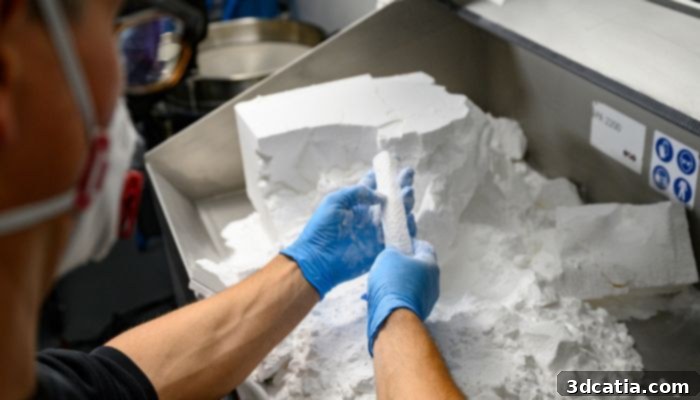
Daimler Truck & Buses uses various 3D printing processes for comprehensive manufacturing solutions.
3DN: How did you integrate 3D printing sustainably, what were the key milestones and what has changed since you started using 3D printing in your business?
Daniela: Integrating industrial additive manufacturing sustainably is a complex endeavor, and we quickly identified that mental barriers, often stemming from a lack of knowledge or apprehension due to negative past experiences with new technologies, posed the biggest obstacles. To overcome these, it was paramount for us to adopt a holistic, global view of the technology from the very beginning. We actively involved all relevant specialist departments in the initial project phases. This collaborative approach was crucial in fostering a long-term, comprehensive understanding across the organization. As the initial positive effects and tangible benefits of using the technology became evident – whether through faster prototyping, custom tooling, or small-batch production – it not only laid robust foundations for trust and confidence in 3D printing but also gradually cultivated strong, enduring partnerships based on shared success.
Ralf: Indeed, our commitment to rigorous standards was evident when we produced our first officially approved replacement parts back in 2017. The fundamental requirements for these parts, which remain unchanged today for all serial parts produced via 3D printing, were and are absolute reproducibility and adherence to the highest quality standards. Since 2017, the potential we’ve been able to realize has expanded considerably. This growth is multifaceted, driven partly by the continuous development of innovative new materials that meet our stringent performance criteria. Crucially, it’s also thanks to the approval of diverse 3D printing processes facilitated by our carefully implemented 3D printing license management system. A significant milestone is our highly successful digital warehouse, a secure repository where several thousand digital twins of our products are stored. These digital blueprints enable immediate “on-demand” production, revolutionizing our supply chain and manufacturing agility.
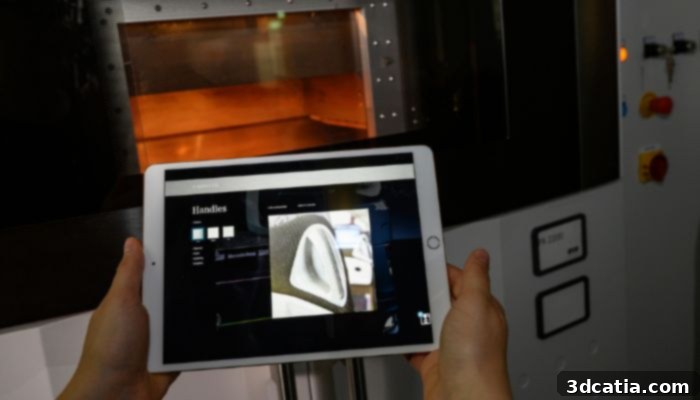
Digital twins enable on-demand production, right where the final part is needed.
3DN: What are the requirements for on-demand production?
Ralf: After making the strategic decision to create a robust 3D printing license management system, it became exceptionally important, particularly in the context of decentralized production, to ensure that parts could be implemented on certified 3D printers, utilizing approved systems, and following rigorously qualified processes. Our innovative mobile 3D printing units are a critical component of this strategy, allowing us the flexibility to print parts directly at the point of sale or production, significantly reducing lead times and logistical complexities. Beyond these internal capabilities, we maintain close collaborations with our external organization and work hand-in-hand with specialized logistics and printing service providers. This expansive network is vital for continuously developing and scaling our decentralized 3D printing business, maximizing its substantial economic and ecological benefits. This distributed approach allows us to respond to customer needs with unparalleled speed and efficiency, while also minimizing our environmental footprint through reduced transportation.
3DN: What are some of the projects you’ve completed using additive manufacturing?
Daniela: We’ve embarked on several truly exciting and impactful projects leveraging additive manufacturing in the past. One significant milestone was certainly the implementation of components in series production, specifically the additive manufacturing of the cockpit control panel for eight coaches. This project showcased our capabilities, as we successfully manufactured these complex components within a few weeks, adhering to all stringent quality requirements and navigating the necessary approval processes. This achievement was crucial as it guaranteed timely vehicle delivery, demonstrating the real-world impact and reliability of our 3D printing capabilities for critical parts. Another monumental success was the launch of the 3D printing license stores, which Ralf mentioned earlier, in June 2022. Since their inception, our customers have gained unparalleled flexibility: they can either purchase physical spare parts as usual or, more innovatively, obtain the 3D print data sets of the required components, enabling them to produce these parts directly at their point of use, significantly streamlining maintenance and repair operations.
Ralf: Yes, the projects Daniela highlighted are indeed some of our most impactful achievements. While I could easily list many more groundbreaking initiatives, if I were to single out one, it would undeniably be the official launch of our external consultancy unit, AMS – Additive Manufacturing Solutions Daimler Truck. This moment was truly momentous for us, marking a new chapter as we began receiving direct requests from external companies eager to jointly pilot industrial 3D printing solutions. It validated our expertise and the value we could offer beyond our internal operations. Today, we collaborate with a diverse range of companies, guiding them in realizing the vast potential of additive manufacturing across their respective industries. This unit not only extends our influence but also fosters a broader adoption of this transformative technology, creating a synergistic ecosystem of innovation.
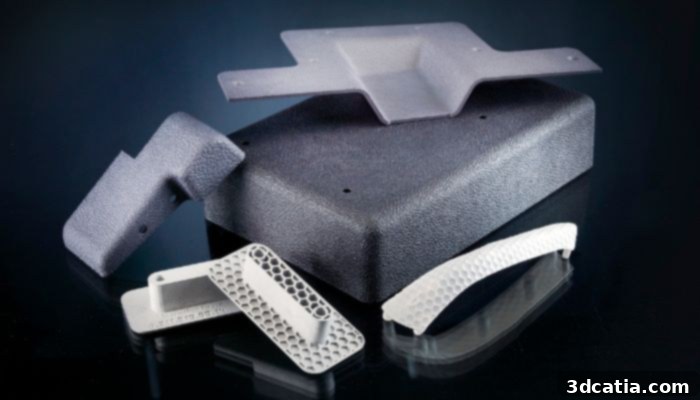
Prototypes, spare parts and production parts are designed using 3D printing at Daimler Truck & Buses.
3DN: Any last words for our readers?
Daniela: It has become clear to many that additive manufacturing is not merely a tool for more efficient product development and rapid prototyping, but is destined to secure a prominent and indispensable place, particularly in series production. The digital potential inherent in additive manufacturing will undoubtedly usher in exciting and profound changes across the entire transportation industry. Capabilities such as decentralized production – the ability to manufacture components directly at the point of need or sale – have a truly disruptive effect on established logistics concepts and traditional component sourcing possibilities. This paradigm shift offers unprecedented agility and resilience in supply chains. The 3D printing market is in a constant state of dynamic evolution, making every day in this field exciting and rewarding. It’s a joy to observe these developments, and even more so, to be an active part of shaping them.
Ralf: While we acknowledge that certain technical challenges persist – such as ensuring consistent quality across different 3D printers or navigating complex intellectual property issues – the most significant hurdle remains the mindset and open-mindedness of the individuals involved with 3D printing. Unfortunately, there is often a prevalent perception or image of 3D printing that does not accurately reflect its current reality and advanced capabilities. This frequently leads to erroneous patterns of reasoning, causing this truly transformative technology of the future to be perceived from an overly narrow or outdated perspective. Overcoming this ingrained perception and actively broadening our collective perspective is a major challenge, yet it simultaneously unlocks enormous, untapped business potential. I am incredibly proud to be part of a fantastic team that is driving the subject of additive manufacturing forward, both within our company and across the wider industry. I sincerely hope that other companies will also find the courage to adopt a global and visionary approach to this technology. Only then will we truly begin to uncover and realize its unimaginable potential.
To learn more about the pioneering work of Daimler Truck & Buses, you can find additional information HERE. What are your thoughts on Daimler Truck & Buses’ innovative use of 3D printing? Share your insights with us in a comment below or connect with us on our LinkedIn, Facebook, and Twitter pages! For those interested in exploring more automotive 3D printing applications, click here. And don’t miss out on the latest 3D printing news – sign up for our free weekly Newsletter here, delivered straight to your inbox! You can also discover all our engaging videos on our YouTube channel.
*All Photo Credits: Daimler Truck & Buses