
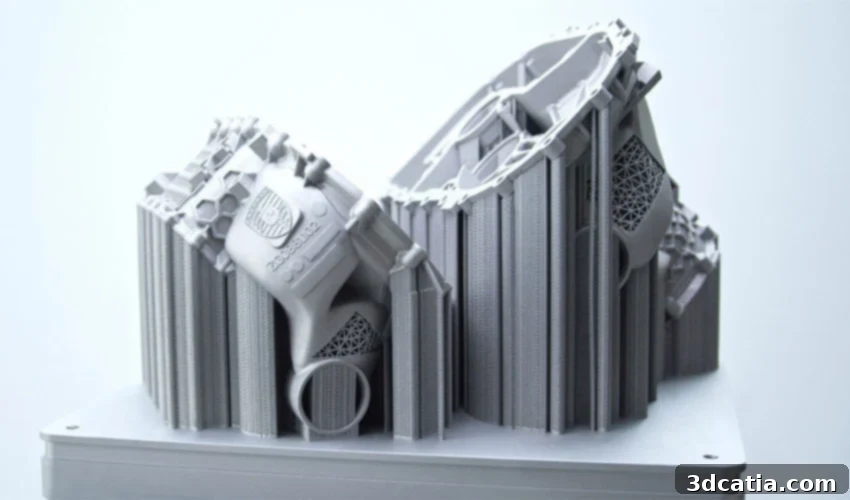
Porsche Pioneers Electric Vehicle Innovation with Advanced 3D Printed Drive Housing
In a groundbreaking move, luxury sports car manufacturer Porsche has unveiled its innovative, fully integrated housing for an electric engine, a testament to the immense potential of additive metal manufacturing. This pioneering development was made possible through the utilization of SLM Solutions’ cutting-edge machine, the NXG XII 600, marking a significant milestone in the automotive industry’s embrace of advanced manufacturing techniques. Still in its prototype phase, this revolutionary component promises to redefine performance benchmarks. Initial evaluations reveal that the 3D printed housing is substantially lighter than its conventionally manufactured counterparts, contributing to an approximate 10% reduction in the overall weight of the entire drive system. Beyond weight savings, the additive manufacturing process has also enabled a remarkable doubling of rigidity in areas subjected to high stress, thereby enhancing durability and performance. Having successfully navigated all rigorous quality and resistance tests, this prototype stands as compelling evidence that additive manufacturing is not merely a niche technology but a transformative force with a bright and expansive future within the automotive sector, particularly for high-performance electric vehicles.
Porsche’s engagement with 3D technologies is not a recent endeavor; the German automaker has been leveraging these advanced tools since the 1980s. Initially, their focus was predominantly on rapid prototyping, a phase critical for accelerating design cycles and iterating on concepts efficiently. However, as the market evolved and additive manufacturing technologies matured, Porsche’s application of 3D printing expanded significantly. Today, the company utilizes 3D printing for manufacturers across three strategic pillars: driving product innovation, optimizing process innovation, and exploring new business models. This forward-thinking approach has already yielded impressive results, such as the recent introduction of 3D-printed pistons for its acclaimed GT cars. These advanced pistons are not only significantly lighter but also ingeniously incorporate internal cooling ducts, directly contributing to reduced operating temperatures and subsequently higher engine efficiency. Given this impressive track record of embracing additive manufacturing for performance enhancements, it comes as no surprise that their latest innovation—a sophisticated, electrically powered drive housing—was conceptualized and brought to life using the very same state-of-the-art approach, underscoring Porsche’s commitment to pushing the boundaries of automotive engineering.
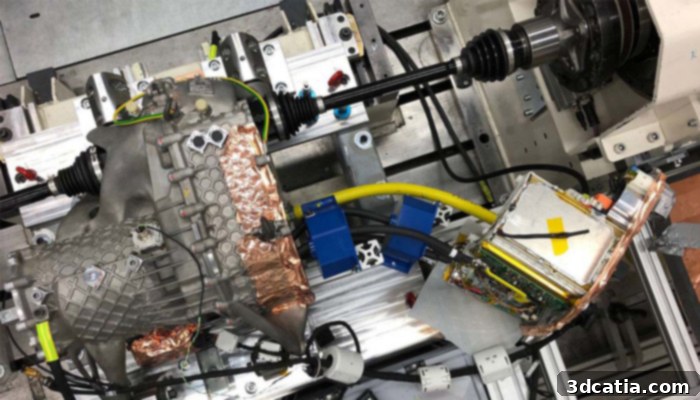
Porsche utilizes additive manufacturing to accelerate its prototyping and innovation phases, showcasing its commitment to advanced engineering (photo credit: Porsche AG)
Revolutionizing Electric Drivetrains: The Lighter and More Efficient 3D Printed Housing
The innovative electric drive housing, crafted from a high-performance metal alloy, represents a significant leap forward in integrated automotive design. This advanced component ingeniously incorporates a two-speed gearbox, specifically engineered for deployment on the front axle of a high-performance sports car. A primary objective behind its development was to consolidate as many distinct features and components as possible into a single, cohesive unit, thereby drastically reducing the number of individual parts and simplifying the assembly process. This holistic design philosophy is eloquently articulated by Falk Heilfort, project manager in the Powertrain Advance Development department at the Porsche Development Center in Weissach: “Our goal was to develop an electric drive with the immense potential of additive manufacturing, simultaneously integrating as many functions and parts as possible within the drive housing itself. This approach not only facilitates significant weight savings but also allows for an optimized structural design, pushing the boundaries of what is achievable in electric powertrain engineering.” This strategy not only streamlines manufacturing but also enhances the overall integrity and performance of the electric drive system.
To achieve such a highly integrated and optimized design, the project teams rigorously applied topological optimization methods. This sophisticated computational design approach allowed engineers to strategically integrate various crucial components, such as bearings, heat exchangers, and other critical elements, in the most efficient and spatially effective manner possible. Through advanced simulation, specialized software was able to precisely calculate the diverse loads and their intricate trajectories acting upon the part. This data-driven analysis then guided the optimization of the final component’s geometry, ensuring maximum performance with minimal material usage. The direct outcome of this advanced engineering process was the innovative conception of intricate honeycomb structures within the housing. These ingenious internal geometries are directly responsible for a staggering 40% reduction in the weight of the housing itself, contributing significantly to the overall 10% weight reduction of the entire electric drive system. Moreover, despite their incredibly thin walls, which measure just 1.5 millimeters, these honeycomb structures are instrumental in achieving a remarkable 100% increase in rigidity between the electric motor and the gearbox. This enhanced rigidity is crucial for improved power transfer, reduced vibrations, and ultimately, a more responsive and durable electric powertrain, showcasing the profound impact of combining additive manufacturing with intelligent design methodologies.
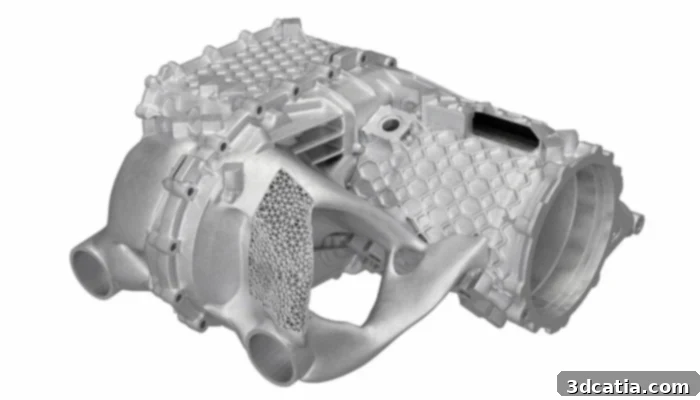
Topology optimization facilitated the creation of highly efficient, lighter lattice structures, crucial for enhanced performance (photo credit: Porsche AG)
Accelerated Production: Porsche Leverages SLM Solutions’ NXG XII 600 for Industrial-Scale 3D Printing
For the realization of this complex and high-performance electric drive housing, Porsche strategically opted to utilize SLM Solutions’ state-of-the-art NXG XII 600 machine. This cutting-edge industrial additive manufacturing system operates on the principles of laser powder bed fusion technology, a method renowned for its precision and ability to produce dense, functional metal parts. What sets the NXG XII 600 apart is its impressive array of 12 powerful 1,000-watt lasers, which work simultaneously to melt and fuse metal powder layer by layer. This multi-laser configuration dramatically boosts printing speed and efficiency, making it one of the fastest machines in its class. Porsche has highlighted that this advanced machine can reduce manufacturing time by an astonishing 90% compared to traditional methods. Specifically, the entire electric drive housing can be 3D printed in an unprecedented timeframe of just 21 hours. Furthermore, the highly integrated design achieved through additive manufacturing contributes to a significant simplification of the subsequent assembly process, eliminating approximately 40 discrete assembly steps. This efficiency translates into an estimated reduction in overall production time of about 20 minutes per unit, underscoring the potential for substantial cost savings and faster time-to-market for future electric vehicle components.
The partnership between Porsche and SLM Solutions exemplifies a synergy between innovation and advanced manufacturing. Ralf Frohwerk, Commercial Director of SLM Solutions, expressed the significance of this collaboration: “We are exceptionally glad and proud to cooperate with highly innovative companies like Porsche. The NXG XII 600 achieves unmatched levels of performance and functional improvements of key automotive parts, while simultaneously delivering cost productivity that enables the broad adoption of Additive Manufacturing technology for true series production. We are thrilled to take this significant step towards the full industrialization of metal Additive Manufacturing for Porsche applications.” This statement not only celebrates the technical achievements but also emphasizes the strategic intent to transition from prototyping to large-scale, industrial series production, a critical hurdle for any advanced manufacturing technology aiming for widespread adoption in the automotive industry. The ability of the NXG XII 600 to provide both high performance and cost-effectiveness positions it as a key enabler for Porsche’s future electric mobility initiatives, promising to transform how complex components are designed, produced, and integrated into high-performance vehicles.
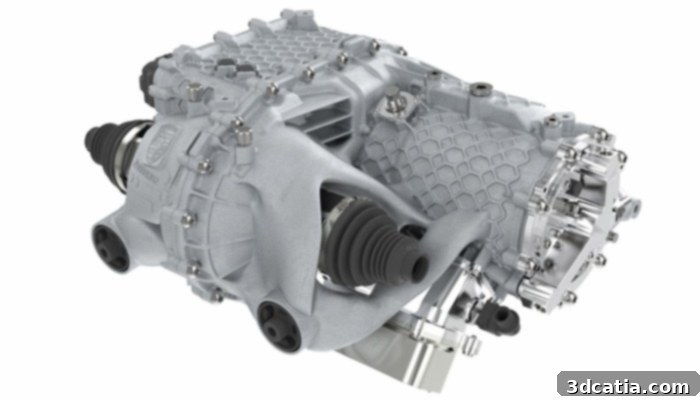
The intricate details and lightweight design of the 3D printed electric drive housing (photo credit: Porsche AG)
The Road Ahead: Scaling Additive Manufacturing for Porsche’s Electric Future
The unveiling of Porsche’s 3D printed electric engine housing represents more than just a technological triumph; it signals a profound shift in the automotive manufacturing paradigm. The crucial question that now emerges for Porsche, aligning with the strategic directions of many leading car manufacturers today, is whether these advanced 3D technologies can be effectively scaled for genuine mass production. While the benefits in terms of lightweighting, integration, and performance are undeniable, transitioning from high-value, low-volume prototypes to high-volume manufacturing presents a unique set of challenges related to cost, speed, material consistency, and post-processing. However, the impressive production time of 21 hours for this complex part on the NXG XII 600 suggests that metal additive manufacturing is rapidly approaching the thresholds required for broader industrial application, especially for specialized components in high-performance vehicles. As the technology continues to mature, we can anticipate further reductions in production costs and increased throughput, paving the way for 3D printed components to become standard in future electric vehicles.
The implications for Porsche are significant. This development underscores their leadership in embracing cutting-edge engineering to enhance their electric vehicle portfolio. By integrating key components like the gearbox directly into the housing, they are not only reducing weight and improving rigidity but also creating opportunities for more compact and efficient powertrains. This holistic approach to design and manufacturing could lead to electric sports cars with superior handling, increased range, and enhanced overall driving dynamics. For the broader automotive industry, Porsche’s success with this electric drive housing serves as a powerful case study, demonstrating the tangible benefits and potential of additive manufacturing to innovate beyond traditional constraints. It encourages other manufacturers to invest further in research and development, fostering a competitive environment that will accelerate the adoption of these technologies across the sector. The era of lightweight, custom-engineered, and high-performance components produced through additive manufacturing is rapidly approaching, promising a future where electric vehicles are not only more sustainable but also more exhilarating to drive.
We invite you to share your thoughts on this exciting development and the future of 3D printing in the automotive industry. Let us know what you think in a comment below or join the conversation on our Facebook and Twitter pages! Stay informed about the latest advancements in additive manufacturing by signing up for our free weekly Newsletter here, delivering the most relevant 3D printing news straight to your inbox!