

Revolutionizing Bone Repair: The Promise of 3D Printed Biodegradable Zinc Scaffolds for Enhanced Osteogenesis
Bone defects represent a significant global health challenge, stemming from a myriad of causes including congenital conditions, traumatic accidents, tumor resections, and degenerative diseases. The intricate nature of bone tissue and its essential role in structural support, movement, and protection necessitates highly effective and innovative treatment approaches. Traditional methods often involve bone grafts (autograft, allograft) or synthetic implants, each with inherent limitations such as donor site morbidity, risk of immune rejection, or issues like stress shielding and the need for secondary surgeries. In pursuit of superior solutions, a groundbreaking collaboration between leading Chinese experts from Beihang University, Renji Hospital, Shanghai Jiao Tong University, Tsinghua University, and Peking University has emerged. This consortium is diligently working on developing advanced 3D-printed biodegradable zinc scaffolds, specifically engineered to address large bone defects and promote natural bone regeneration. This ambitious project receives crucial industrial support from Bright Laser Technologies (BLT), a prominent Chinese company known for its state-of-the-art 3D printing machines and systems, underscoring the vital interplay between academic research and technological manufacturing capabilities in driving medical innovation.
The development of these 3D-printed, porous zinc structures signifies a monumental leap forward in orthopedic regenerative medicine. They offer an innovative and highly promising approach to repairing complex bone defects by actively facilitating and guiding new bone formation, a process known as osteogenesis. However, the journey to harnessing zinc’s potential as a biomaterial has not been without its hurdles. A significant challenge historically associated with zinc-based implants has been their rapid degradation rate within the physiological environment, which could lead to an excessive release of zinc ions and localized toxicity, potentially impeding healing rather than promoting it. Recognizing this critical barrier, the research team has dedicated extensive efforts to meticulously optimize several key aspects of the scaffold design: the precise composition of the zinc alloy, the intricate structure of its surface, and the critical pore geometry of the scaffolds. This multi-faceted optimization strategy aims to achieve a controlled degradation profile that aligns perfectly with the natural pace of bone healing, mitigating toxicity concerns while maximizing therapeutic efficacy.
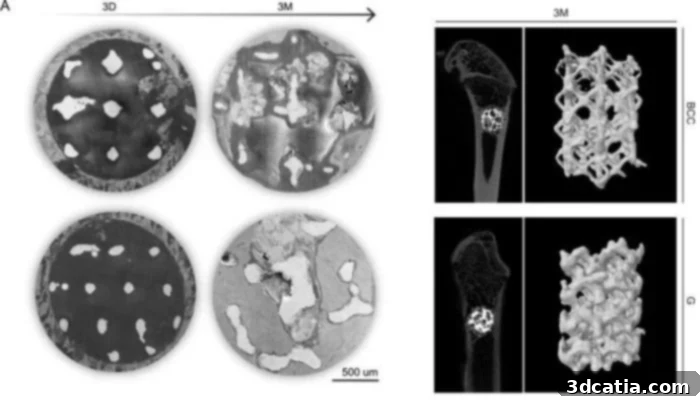
The degradation behavior of the 3D printed zinc scaffolds in rat femur after three days and three months (image credits: Li, S., Yang, H., Qu, X. et al. Multiscale architecture design of 3D printed biodegradable Zn-based porous scaffolds for immunomodulatory osteogenesis.Nat Commun 15, 3131, 2024.)
Over the past three years, the dedicated team of researchers has made remarkable strides in developing novel, biodegradable zinc alloys specifically tailored for additive manufacturing. Their focus has been on Zn-Li alloys, where the addition of lithium (Li) plays a crucial role in enhancing the material’s properties. These advanced Zn-Li alloys, particularly those with an optimized composition of approximately 0.8% lithium by weight, demonstrate an exceptional combination of mechanical properties. They offer a superior balance between strength, crucial for providing immediate structural support to the defect site, and plasticity, which allows the implant to withstand physiological loads without premature failure. Crucially, the lithium content also significantly influences the corrosion behavior, enabling a more controlled and predictable degradation rate. The fabrication of these intricate frameworks relies on BLT’s cutting-edge Laser Powder Bed Fusion (L-PBF) system. L-PBF, a sophisticated additive manufacturing technology, is instrumental in achieving the precise designs and complex, patient-specific porous structures required for effective bone regeneration. This technology allows for unparalleled control over the scaffold’s internal architecture, porosity, and interconnectivity, all of which are vital for cell infiltration, nutrient transport, and vascularization within the healing bone.
Beyond the foundational material science and advanced manufacturing techniques, the researchers recognized that the surface properties of the scaffold are equally critical for successful bone regeneration. Therefore, following the 3D printing process, a series of meticulous surface treatments were performed to further optimize the scaffold’s interaction with biological tissues. These treatments included ultrasonic cleaning, acid etching, and electrochemical polishing. Ultrasonic treatment effectively cleans the scaffold surface and can induce micro-scale modifications. Acid etching is employed to create a targeted micro-patterning of the surface, increasing its roughness and surface area in a controlled manner, which is known to significantly enhance cell adhesion and spreading. Electrochemical polishing, on the other hand, allows for fine-tuning of the surface topography, removing any undesired surface irregularities and achieving the optimal surface characteristics. The synergistic effect of these treatments results in a surface that not only promotes robust cell attachment and proliferation – key steps in the osteogenic process – but also critically influences the surrounding biological environment, paving the way for enhanced bone healing.
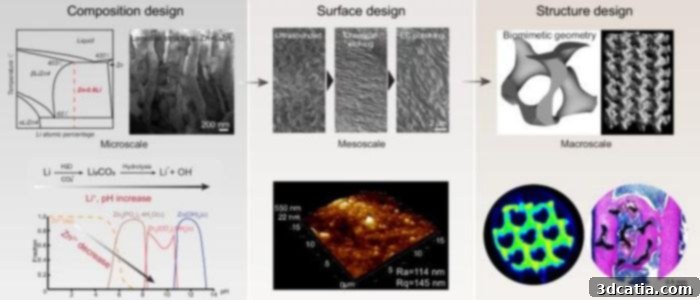
The design of 3D-printed, biodegradable and porous zinc-based scaffolds (image credits: Li, S., Yang, H., Qu, X. et al. Multiscale architecture design of 3D printed biodegradable zinc-based porous scaffolds for immunomodulatory osteogenesis. Nat Commun 15, 3131, 2024)
A particularly groundbreaking aspect of this research lies in the scaffold’s ability to promote favorable interaction with macrophages – a type of white blood cell crucial to the immune system. These specialized surface structures are designed to modulate the immune response, guiding it towards a pro-healing phenotype rather than an inflammatory one. By influencing how the immune system reacts to the implant, the scaffold can effectively improve the overall biological environment, fostering immunomodulatory osteogenesis. This means the body’s own defense mechanisms are not only tolerant of the implant but actively contribute to its integration and the regeneration of new bone. Furthermore, the meticulously designed 3D-printed zinc scaffold exhibits a highly controlled degradation profile within the body. This controlled degradation is precisely calibrated to match the pace of new bone formation, ensuring that the scaffold provides mechanical support during the initial healing phase and then gradually resorbs as native bone tissue replaces it. This property is paramount, as it ensures that zinc ions are released at a safe, therapeutic rate, avoiding any localized toxicity and creating an optimal, dynamic microenvironment for the regeneration and seamless integration of the implant with the host tissue.
The cumulative impact of these advanced features – innovative Zn-Li alloy composition, precise 3D printing, and sophisticated surface engineering – leads to a remarkably efficient improvement in bone regeneration compared to many conventional implant technologies. The synergistic structural and chemical properties of these scaffolds actively promote new bone formation, accelerating the healing process and improving clinical outcomes. The strategic utilization of 3D printing technology for producing these Zn-Li scaffolds unlocks immense potential, allowing for unprecedented control over the precise structure, pore size, and porosity of the implants. This level of customization is absolutely crucial for optimizing the scaffold’s ability to support cell infiltration, vascularization, and nutrient exchange, all of which are indispensable for robust bone regeneration. The ability to design patient-specific implants that perfectly match the defect geometry and biological requirements represents a significant step towards personalized medicine in orthopedics. This research not only offers a viable solution for large bone defects but also lays a strong foundation for future advancements in biodegradable metallic implants. You can delve deeper into the comprehensive findings of this seminal research by accessing the full scientific paper HERE.
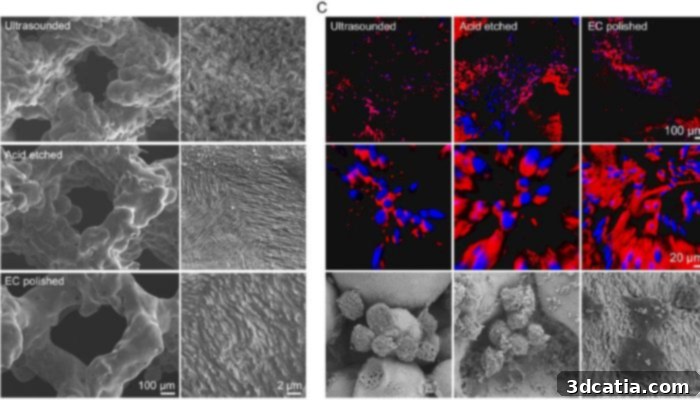
Surface morphology and properties of Zn-0.8Li scaffold after ultrasonic treatment, acid etching and electrochemical (EC) polishing (image credits: Li, S., Yang, H., Qu, X. et al. Multiscale architecture design of 3D printed biodegradable Zn-based porous scaffolds for immunomodulatory osteogenesis.Nat Commun 15, 3131, 2024.)
This pioneering research into 3D-printed zinc scaffolds for bone regeneration marks a significant milestone in medical additive manufacturing and biomaterials science. The collaborative efforts of these esteemed Chinese institutions, supported by BLT’s advanced technology, demonstrate a powerful paradigm for addressing complex medical challenges. The focus on biodegradable, immunomodulatory materials with controlled degradation capabilities represents the future of orthopedic implants, promising to enhance patient recovery and reduce the need for repeat surgeries. As clinical trials and further development progress, these intelligent scaffolds could soon become a standard of care for patients suffering from various bone defects, profoundly improving their quality of life. We are excited to see the continued impact of such innovations.
What are your thoughts on the groundbreaking potential of 3D-printed zinc scaffolds for revolutionizing bone regeneration and repair? We invite you to share your insights and engage in the discussion by leaving a comment below, or connecting with us on our LinkedIn, Facebook, and Twitter pages! Don’t forget to sign up for our free weekly newsletter here to receive the very latest 3D printing news and innovations delivered straight to your inbox! You can also explore all our informative videos and cutting-edge content on our YouTube channel.