
Mastering the Finish: Essential Trends and Automation in 3D Printing Post-Processing
The world of additive manufacturing, commonly known as 3D printing, is constantly evolving, with innovations emerging at every stage of the production process. While much attention is often given to the printers themselves and the materials they use, the crucial phase of post-processing frequently determines the ultimate success, quality, and functionality of a 3D-printed part. Recognizing this vital aspect, PostProcess Technologies, a leader in automated post-processing solutions, recently released its inaugural annual study on post-processing trends in 3D printing. Conducted in collaboration with the esteemed Society of Manufacturing Engineers (SME), this comprehensive report sheds light on the prevailing practices, significant hurdles, and future directions faced by users across diverse industries.
The study’s findings underscore a widespread challenge within the additive manufacturing community: a substantial 66% of participants reported encountering at least two significant barriers with their existing post-processing solutions. These obstacles primarily revolve around critical factors such as the time investment required, the consistency and quality of the finished parts, and the resources (both human and material) demanded by these processes. This revelation highlights a pressing need for more efficient and effective post-processing strategies to unlock the full potential of 3D printing.
The Critical Role of Post-Processing in Additive Manufacturing
Within the intricate 3D printing workflow, post-processing steps are far from mere afterthoughts; they are often indispensable for transforming raw printed objects into high-quality, functional components. These processes are fundamental in imparting the desired final surface finish, achieving accurate colors, enhancing mechanical properties like strength and durability, and ensuring dimensional accuracy. Without proper post-processing, many 3D-printed parts would fail to meet the rigorous standards required for their intended applications, whether in aerospace, medical, automotive, or consumer goods sectors. This critical phase directly influences a part’s aesthetics, performance, and overall utility.
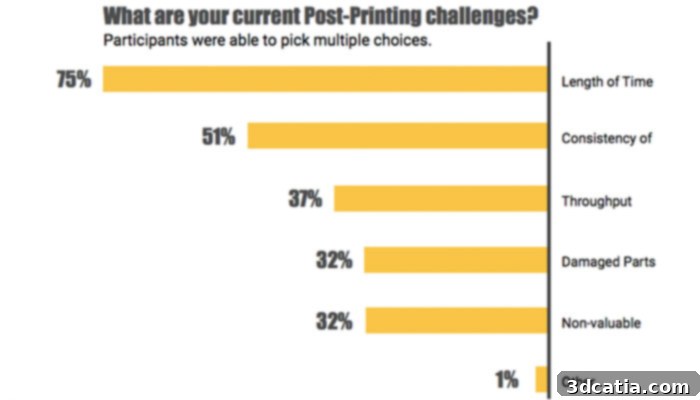
In recent months and years, the industry has witnessed a concerted push towards automating post-processing wherever possible. This drive is fueled by a clear objective: to significantly minimize the time commitment and dramatically optimize the efficiency of these labor-intensive stages. Pioneering companies have even introduced innovative machines featuring integrated post-processing capabilities, such as those from Velox and DyeMansion, designed specifically to streamline workflows and provide users with substantial time savings. The PostProcess study starkly validates this industry focus, revealing that for a striking 75% of participants, the sheer duration of the post-processing phase stands out as the primary impediment. The overwhelming consensus is that, across the board, current post-processing methods are simply “too time-consuming,” creating bottlenecks in an otherwise rapidly accelerating production technology.
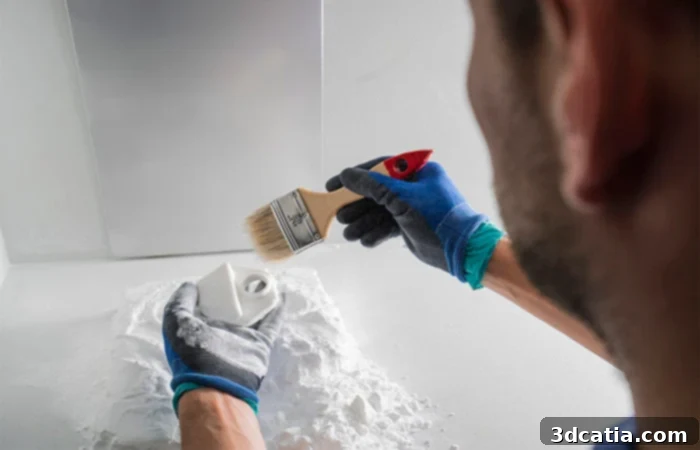
The 3D post-printing process varies significantly depending on the 3D printing technology utilized | Credits: Beamler
Navigating Complexity: The Challenge of Multiple 3D Printing Technologies
The challenge of lengthy post-processing is further exacerbated when organizations leverage multiple 3D printing technologies within their operations. The study indicates a diverse adoption of technologies: 50% of respondents employ two to three different additive manufacturing methods, while an additional 33% utilize four or more. This multi-technology approach, while offering flexibility in material choice and part characteristics, inherently complicates the post-processing landscape. It stands to reason that the greater the number of technologies involved, the more numerous and intricate the post-processing challenges become. This complexity arises directly from the fact that each additive manufacturing method necessitates distinct and often specialized post-processing techniques.
Consider, for example, the widely used Laser Powder Bed Fusion (L-PBF) technology for metal printing. Parts produced via L-PBF typically require extensive support structures to manage thermal stresses and overhangs during the printing process. Consequently, the meticulous removal of these supports is a highly recommended, often critical, and frequently time-consuming step. In contrast, Selective Laser Sintering (SLS) technology, which utilizes a powder bed as its own support, generally does not require external support structures, eliminating this particular post-processing hurdle. The report clearly highlights this divergence, revealing that for half of the study’s participants (50%), the removal of printing supports and media is identified as the single most time-intensive post-processing step. This disparity underscores the need for versatile and adaptable post-processing solutions that can handle the varied demands of different printing technologies.
Key Post-Treatment Techniques and Their Significance
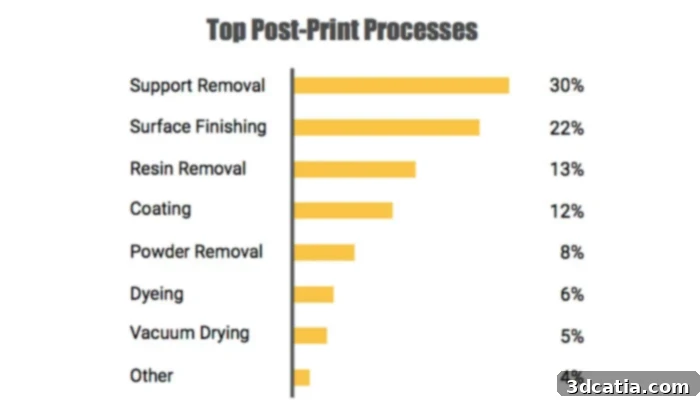
When delving into the specifics of post-treatment, several techniques are routinely employed to prepare 3D-printed parts for their final use. The most commonly cited category of post-processing involves various forms of material removal. This includes the crucial task of support removal, identified by 30% of users as a primary technique. Beyond supports, the removal of excess resin (13%) in processes like SLA or DLP, and the meticulous de-powdering of parts (8%) from technologies such as SLS or MJF, are also essential. These removal steps are often manual, labor-intensive, and critical for achieving the correct part geometry and functionality. Inadequate removal can lead to compromised part performance or aesthetic flaws.
Another significant aspect of post-processing is surface finishing, a technique employed by 22% of users. While often considered optional, surface finishing is vital for applications demanding a higher level of detail, enhanced aesthetic appeal, or improved functional characteristics such as reduced friction, increased biocompatibility, or better sealing. Techniques range from manual sanding and polishing to automated methods like tumbling, chemical vapor smoothing, and advanced coating applications. The goal is to smooth rough surfaces, remove layer lines, and achieve a desired tactile and visual quality. Last month, we highlighted companies like 3DNextech, a startup that has developed innovative automatic and professional finishing solutions, showcasing the industry’s continuous drive for more efficient and higher-quality finishing processes that move beyond traditional manual labor.
Beyond removal and surface finishing, other critical post-processing steps include curing (especially for photopolymer resins to achieve final mechanical properties), heat treatment for metal parts to relieve internal stresses and improve strength, and dyeing or coloring processes to achieve specific aesthetic requirements. Each of these steps contributes significantly to the final part quality and adherence to design specifications, reinforcing the diverse and complex nature of the post-processing landscape.
Credits: PostProcess Technologies
Addressing the Core Challenges in 3D Printing Post-Processing
The PostProcess study meticulously details the primary challenges that hinder the widespread adoption and scaling of additive manufacturing. As previously emphasized, the most significant obstacle remains the sheer amount of time required to process a 3D-printed part from its raw state to a finished product. This time burden impacts lead times, overall production efficiency, and ultimately, the return on investment for companies investing in additive manufacturing technologies. Manual post-processing, while offering flexibility, is inherently slow and resource-intensive, often becoming the bottleneck in high-volume production scenarios.
Following time, a critical challenge identified by 51% of respondents is consistency. Achieving uniform quality and repeatable results across batches of 3D-printed parts, especially with manual post-processing, is notoriously difficult. Variations in technique, human error, and subjective judgment can lead to inconsistencies in surface finish, dimensional accuracy, and mechanical properties. For many, this lack of consistency acts as a significant deterrent, preventing them from investing in new additive manufacturing technologies. The concern is valid: adopting a new printing method often implies an entirely new set of post-processing techniques, potentially requiring additional resources (material, human expertise, specialized equipment) and further complicating the quest for reliable, repeatable output. The need for robust quality control and adherence to strict specifications makes consistency a non-negotiable requirement, particularly in regulated industries.
Finally, for 37% of participants, yield capacity emerges as a considerable difficulty. Inefficient or slow post-processing directly limits the number of usable parts that can be produced within a given timeframe, thereby impacting the overall productivity and efficiency of the entire additive manufacturing workflow. If post-processing cannot keep pace with the speed of printing, the benefits of rapid prototyping and on-demand manufacturing are diminished. Overcoming these challenges—time, consistency, and yield capacity—is paramount for the additive manufacturing industry to transition from specialized prototyping to mainstream industrial production, enabling greater scalability and economic viability.
Credits: PostProcess Technologies
The Future is Automated: Driving Efficiency and Productivity
The compelling data from PostProcess Technologies’ study makes one thing abundantly clear: the widespread adoption of solutions that automate post-processing in 3D printing is not just an advantage, but a necessity. By streamlining these crucial steps, automation provides users with invaluable additional time that can be reallocated to other high-value activities, such as design optimization, material development, or process innovation. The benefits extend beyond mere time savings; automated systems can deliver unparalleled consistency, reduce human error, enhance worker safety by minimizing exposure to hazardous materials, and significantly boost overall throughput and yield capacity. This translates directly into lower operational costs, improved part quality, and accelerated production cycles, making additive manufacturing a more competitive option for mass customization and serial production.
As highlighted in our previous expert advice on optimizing post-treatment for 3D printing, industry leaders consistently emphasize the transformative potential of automation. Their insights often converge on the idea that smart, automated post-processing is the missing link for additive manufacturing to reach its full industrial potential. We are already witnessing an encouraging surge in the availability and sophistication of automated solutions within the additive manufacturing market, ranging from robotic support removal systems to advanced chemical finishing units and integrated digital workflows. This trend towards greater automation is not just a technological curiosity; it is a fundamental shift that is reshaping the efficiency, reliability, and economic viability of 3D printing across all sectors. We eagerly anticipate and hope that this critical trend will continue to accelerate, driving additive manufacturing into a new era of industrial productivity and excellence.
For a more in-depth understanding of these critical insights and trends, the complete study on post-processing trends is available HERE. Dive into the full report to explore the data, methodologies, and detailed recommendations that can help your organization master the post-processing challenges.
Do you agree with the comprehensive trends and challenges presented in this pivotal study from PostProcess Technologies? We invite you to share your perspectives and experiences in a comment below. Alternatively, engage with our community and let us know your thoughts on our Facebook and Twitter pages. Your feedback helps us understand if this detailed overview was useful and resonates with your own industry observations. Don’t forget to sign up for our free weekly Newsletter, ensuring you receive all the latest news, expert analysis, and critical developments in 3D printing delivered directly to your inbox!