

DIY Tesla Cybertruck: 3D Printing Your Own Futuristic Pickup Model at Home
The anticipation for the Tesla Cybertruck has been immense since its unveiling, capturing the imaginations of automotive enthusiasts and tech innovators alike. While the full-sized, angular electric pickup truck isn’t expected to hit roads en masse until 2021 (with initial deliveries primarily in North America), one ingenious designer couldn’t wait. Roger Kappler embarked on an exciting do-it-yourself project, leveraging the power of 3D printing to create his very own miniature Tesla Cybertruck model. This initiative perfectly encapsulates the spirit of the maker community: taking a concept and bringing it to life with accessible technology.
Kappler’s journey began with an existing 3D model file found on Thingiverse, a popular online repository for 3D printable designs. Recognizing the limitations of standard desktop 3D printers in handling a single, large object, he ingeniously sliced the original file into multiple manageable pieces. This strategic segmentation allowed for printing directly at home using common consumer-grade machines, making the project achievable for many other enthusiasts. The process of printing the entire body of the truck took approximately 24 hours, a testament to both the complexity of the design and the capabilities of modern 3D printing technology. What makes Kappler’s creation truly stand out, however, is his meticulous attention to detail, including the integration of LEDs powered by discreetly hidden batteries in the trunk, adding an authentic, illuminated touch to the miniature marvel.
The Vision Behind the Cybertruck: Tesla’s Bold Pickup Entry
To truly appreciate Roger Kappler’s 3D printed model, it’s essential to understand the groundbreaking vehicle it emulates. The Tesla Cybertruck, officially introduced in November of last year, marks a significant departure for the electric vehicle manufacturer. It is Tesla’s first foray into the highly competitive pickup truck market, and true to form, it arrived with a design that defied convention and sparked global discussion. Measuring an imposing 6 meters long and 1.9 meters high, the Cybertruck’s sheer scale is matched only by its profoundly futuristic and almost brutalist aesthetic. Its angular, stainless steel exoskeleton and distinctive lines make it an unmistakable presence, whether on a showroom floor or, eventually, on the highway.
Beyond its striking appearance, the Cybertruck promises formidable performance, a hallmark of the Tesla brand. It is slated to be available in three distinct electric powertrain configurations, catering to a range of needs and preferences. The most powerful iteration, featuring a tri-motor all-wheel-drive setup, boasts an impressive top speed of 209 km/h (130 mph) and an astounding estimated range of over 800 km (500 miles) on a single charge. This combination of speed, range, and Tesla’s signature electric torque positions the Cybertruck not just as an innovative pickup, but as a potential game-changer in the utility vehicle segment. With initial deliveries planned for 2021, particularly focusing on the North American market where pickup trucks are immensely popular, the anticipation is palpable. For those eager to get their hands on a piece of this future, Roger Kappler’s detailed 3D printed model offers a perfectly “well thought-out B plan,” providing a tangible representation of the truck long before its official release.
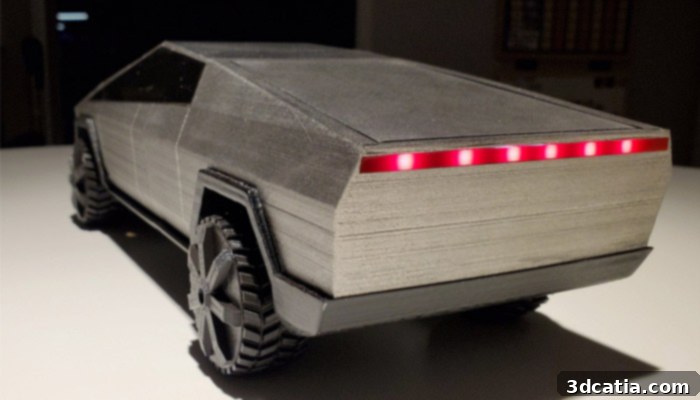
Credits: Roger Kappler – A closer look at the meticulously crafted 3D printed Tesla Cybertruck model.
Bringing a Digital Design to Life: The 3D Printing and Post-Processing Journey
Roger Kappler’s project is a brilliant example of how 3D printing empowers individuals to realize complex designs. He meticulously printed the entire body of the miniature Cybertruck using a white plastic filament, a common and versatile material in desktop 3D printing, likely PLA (Polylactic Acid) or ABS (Acrylonitrile Butadiene Styrene). The choice of white plastic is often strategic, providing a neutral base for subsequent painting. While Kappler didn’t specify the exact 3D printer he used, the nature of the project strongly suggests a Fused Deposition Modeling (FDM) desktop machine, which are widely accessible and popular among hobbyists for their ease of use and affordability. These printers build objects layer by layer by extruding melted plastic filament, a process that can be time-consuming for detailed models, explaining the 24-hour printing duration.
The journey from raw 3D print to a polished model involves significant post-processing, a crucial step that often distinguishes a good project from an exceptional one. After the printing was complete, Kappler dedicated himself to sanding the plastic pieces. This critical step smooths out the visible layer lines inherent in FDM printing, creating a much more refined surface. Following sanding, the model was painted in a striking silver finish, carefully chosen to precisely match the distinctive metallic sheen of the Tesla Cybertruck announced by the manufacturer. This attention to color accuracy greatly enhances the realism of the miniature. The creative process didn’t stop there. An additional 15 hours were invested in crafting the finer details of the model. This included fabricating the windows and headlights using precisely cut acrylic sheets, a material known for its clarity and workability. Furthermore, the electronic components – specifically the batteries required to power the integrated LEDs – were cleverly concealed within the trunk, ensuring a clean and authentic appearance without visible wires or bulky power sources. In total, Roger Kappler estimates the cost of all materials and accessories (excluding the 3D printer itself, which is often a one-time investment for hobbyists) to be a remarkably affordable $50, making this an accessible and rewarding DIY endeavor for many.
The Art of Replication: Achieving Astonishing Realism Through 3D Printing
The final result of Roger Kappler’s dedicated work is nothing short of amazing. His 3D printed Cybertruck model is strikingly similar to the full-sized concept, capturing the vehicle’s unique proportions and audacious design elements with remarkable accuracy. This achievement underscores the incredible precision that can be attained with modern desktop 3D printing when combined with skillful post-processing. The true scale and distinctiveness of the Cybertruck’s design become even more apparent when Kappler’s miniature model is placed alongside other conventional car models he owns. Its angular, monolithic form stands in stark contrast to the smoother, more traditional curves of other vehicles, highlighting just how revolutionary Tesla’s design choice truly is. This side-by-side comparison vividly illustrates the Cybertruck’s distinctive presence, even in a scaled-down form.
For those inspired by Roger Kappler’s impressive project and eager to embark on their own 3D printing adventure, the original 3D file that served as his starting point is readily available on Thingiverse. This platform fosters a vibrant community of designers and makers who share their creations, allowing others to learn, modify, and replicate. The accessibility of such files, coupled with the increasing affordability and user-friendliness of 3D printers, has democratized the ability to bring digital designs into the physical world. Whether you’re a seasoned 3D printing veteran or a curious newcomer, the opportunity to print and customize your own Tesla Cybertruck model is an exciting prospect. Don’t hesitate to get started and experience the satisfaction of creating a tangible piece of automotive future with your own hands!
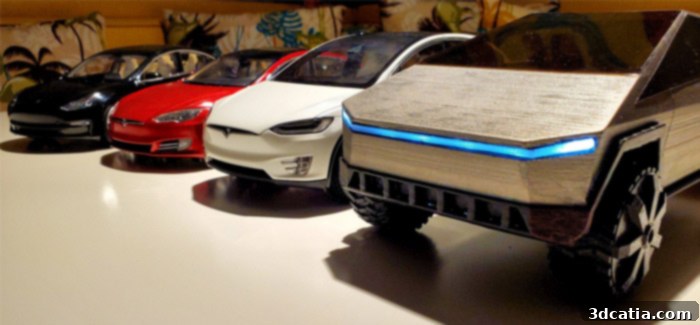
The pickup truck is much larger than the other models of the brand, emphasizing the Cybertruck’s unique proportions | Credits: Roger Kappler
The Broader Impact: 3D Printing and Automotive Enthusiasm
Roger Kappler’s Cybertruck model is more than just a personal project; it’s a shining example of the growing synergy between 3D printing technology and automotive enthusiasm. This accessible manufacturing method allows fans to engage with their favorite vehicles in entirely new ways, moving beyond simply collecting die-cast models. From replicating rare concept cars that never made it to production to creating custom accessories for existing vehicles, 3D printing offers a creative outlet for unparalleled personalization and detailed reproduction. It’s a testament to the maker movement, where digital blueprints transform into physical objects, empowering individuals to become creators rather than just consumers.
Moreover, such projects serve as excellent educational tools, demystifying the design and manufacturing processes. They encourage problem-solving, attention to detail, and patience, as individuals navigate challenges like slicing complex models, optimizing print settings, and mastering post-processing techniques. The global community platforms like Thingiverse, MyMiniFactory, and Cults3D further amplify this impact, acting as hubs for sharing knowledge, iterating on designs, and inspiring countless others to pick up a 3D printer. Whether it’s to decorate a desk, prototype an idea, or simply enjoy the tactile experience of building something from scratch, 3D printing has opened up new frontiers for hobbyists and professionals alike, continually pushing the boundaries of what’s possible in customization and rapid prototyping.
What do you think of Tesla’s Cybertruck, both the real vehicle and Roger Kappler’s impressive 3D printed model? We’d love to hear your thoughts and experiences with similar projects! Share your comments below or engage with us on our Facebook and Twitter pages. And to ensure you stay ahead with all the latest developments in the rapidly evolving world of 3D printing, remember to sign up for our free weekly Newsletter, delivering cutting-edge news and insights straight to your inbox!