
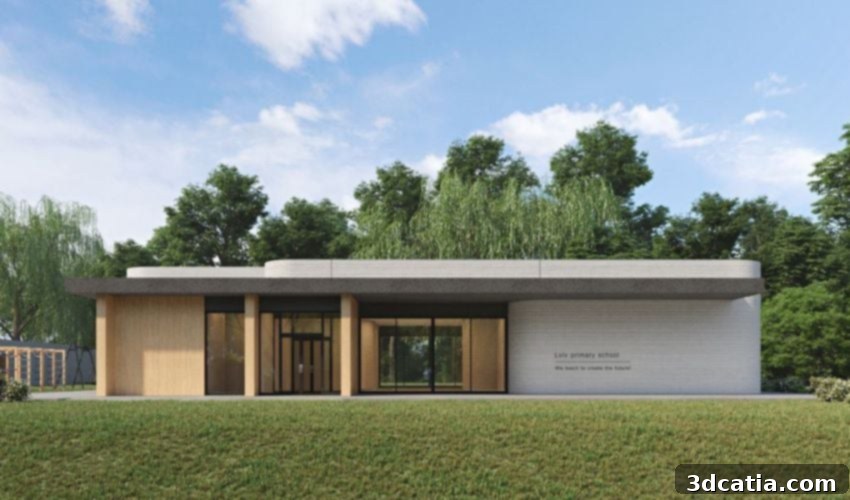
Revolutionizing Reconstruction: Europe’s First 3D-Printed School in Ukraine Signals a New Era for Additive Construction
The landscape of global construction is undergoing a profound transformation, driven by the innovative advancements in additive manufacturing, widely recognized as 3D printing. This cutting-edge technology is no longer confined to prototyping or small-scale industrial applications; its role in the construction sector is rapidly expanding, offering unparalleled benefits that traditional building methods often struggle to match. As industries worldwide seek more efficient, sustainable, and adaptable solutions, 3D construction printing emerges as a pivotal force, promising to reshape how we envision and erect structures. From creating highly intricate architectural designs to significantly reducing project timelines and operational costs, the advantages are compelling, fostering a growing specialization and adoption of 3D printing technologies within the demanding construction industry.
Recent achievements underscore the burgeoning potential of additive construction. Notably, Heidelberg, Germany, celebrated a significant milestone with the completion of Europe’s largest 3D-printed building, a testament to the technology’s capability to scale. This impressive feat joins a growing portfolio of diverse projects, including the rapid fabrication of residential houses, elegant pavilions, robust bridges, and essential medical facilities. Each project not only highlights the versatility of 3D construction but also sparks immense excitement for its future applications, particularly in contexts demanding rapid and resilient infrastructure development. Among these groundbreaking initiatives, one project stands out for its profound humanitarian significance and innovative approach: the collaborative effort between the non-profit foundation Team4UA and the Danish 3DCP Group to construct Europe’s inaugural 3D-printed school in Ukraine.
Addressing Urgent Needs: 3D Printing in Post-Conflict Reconstruction
Ukraine currently faces an unprecedented challenge in rebuilding its critical infrastructure following the devastating impact of Russia’s invasion. The conflict has left an indelible mark on the nation’s educational system, with the Ukrainian Ministry of Education and Science reporting that over 2,000 schools have been damaged or completely destroyed. A stark 277 of these educational institutions require complete demolition, leaving countless children without safe and accessible learning environments. In response to this pressing crisis, the country has prioritized the rapid reconstruction of educational facilities for its population, recognizing the immense potential that advanced 3D construction printing technology offers in accelerating this vital process. The historic city of Lviv, situated in the western region of Ukraine, has been chosen as the site for this pioneering project, leveraging the capabilities of the BOD2 printer from the renowned Danish manufacturer COBOD to bring this vision to fruition.
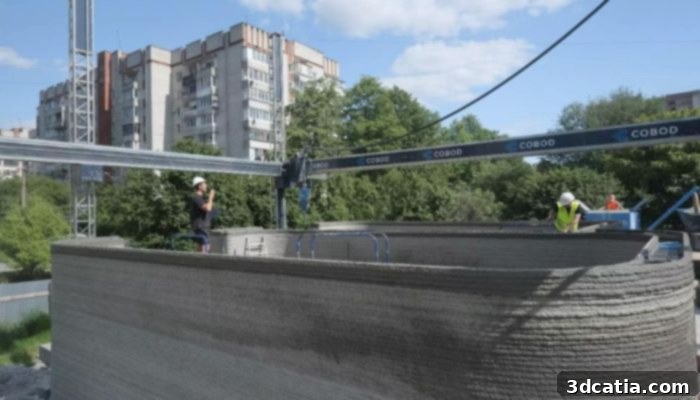
The school’s printing is done with COBOD’s BOD2 printer (Image: COBOD)
Rebuilding Futures: The School’s Innovative Design and Rapid Construction
The 3D printing-based school construction project in Lviv embodies a crucial dual objective: to ensure uninterrupted access to education for children profoundly affected by the devastating war in Ukraine, and to establish an inclusive, welcoming space for internally displaced children now residing in Lviv. The widespread destruction of schools and other vital educational facilities has severely curtailed valuable learning opportunities for the younger generation, posing significant long-term risks to their future prospects and the overall developmental trajectory of the country. By embracing such innovative construction solutions, this critical issue can be addressed with remarkable swiftness, efficiency, and speed. The project’s rapid advancement is clearly demonstrated by the substantial progress made in just three to four days of printing, during which approximately half of the entire construction printing process has already been completed. This unprecedented pace highlights the transformative potential of additive construction in crisis response.
Jean-Christophe Bonis, the visionary founder and chairman of the humanitarian foundation Team4UA, elaborated on the facility’s design and purpose. He explained that the new school building is specifically designed to cater to elementary students and is being strategically constructed on the premises of an existing school, maximizing resource utilization and integration within the community. Spanning an area of 370 square meters, this thoughtfully designed single-story building is being meticulously planned to provide a safe, comfortable, and highly pleasant learning environment, fostering an atmosphere conducive to educational growth and well-being for its young occupants. A key priority for the construction team has been the commitment to sustainability and local economic revitalization, evidenced by the decision to use predominantly locally sourced building materials. A remarkable 90% of all materials required for the school’s construction are produced within Ukraine, significantly reducing transportation costs and environmental impact. Even the specialized concrete mixture essential for 3D printing has been procured locally, leading to substantial cost savings and further bolstering the domestic economy. This strategic approach not only contributes directly to the revival of Ukraine’s industrial base but also establishes a robust foundation for continued economic development and self-reliance in the future.
The technological backbone of this inspiring project is provided by COBOD, whose advanced BOD2 printer is instrumental in its rapid execution. Henrik Lund-Nielsen, the Founder and Managing Director of COBOD, expressed profound pride in his company’s contribution: “We are proud to have delivered the technology that makes this project possible. The proud people of Ukraine deserve all the support we can provide, and I am happy we have been able to donate all what we have been doing in this project for free. Out of the respect for the impressive fighting will Ukraine has shown on behalf of all of the rest of Europe and the rest of the democratic world, this is the least we could do.” This sentiment underscores the global solidarity and commitment to aiding Ukraine’s recovery efforts. The collaboration demonstrates how private enterprise and humanitarian organizations can converge to deliver impactful solutions in times of crisis. To delve deeper into the specifics of this project and its ongoing progress, further information is available by clicking HERE.
Beyond the Classroom: The Broader Impact of Additive Construction in Humanitarian Efforts
The 3D-printed school in Lviv is more than just a building; it is a powerful symbol of resilience, innovation, and international cooperation in the face of adversity. This project serves as a compelling model for future humanitarian and post-conflict reconstruction initiatives globally, demonstrating the immense potential of 3D construction printing to deliver rapid, cost-effective, and sustainable infrastructure solutions. In regions affected by natural disasters, conflicts, or housing shortages, the ability to quickly erect safe and durable structures, from emergency shelters to permanent community buildings, can significantly accelerate recovery and improve living conditions. The efficiency of the COBOD BOD2 printer, completing half the school in just a few days, highlights how this technology can drastically cut down construction timelines compared to conventional methods, a critical advantage when time is of the essence.
Furthermore, the project’s emphasis on local sourcing aligns perfectly with sustainable development goals, promoting local economies, reducing the carbon footprint associated with material transport, and empowering local workforces with new skills in additive manufacturing. This approach ensures that reconstruction efforts are not just about rebuilding physical structures but also about fostering long-term economic stability and community self-sufficiency. As 3D printing technology continues to evolve, we can anticipate even more sophisticated applications, including the use of diverse materials, the construction of larger and more complex structures, and further integration with smart building systems. The Lviv school project is a clear indication that additive manufacturing is poised to play an increasingly vital role in creating a more resilient, accessible, and sustainable built environment for communities around the world.
Conclusion: A Blueprint for a Better Tomorrow
The construction of Europe’s first 3D-printed school in Lviv, Ukraine, stands as a beacon of hope and a powerful testament to the transformative capabilities of additive manufacturing. It underscores how innovation, coupled with unwavering humanitarian spirit, can address some of the most pressing global challenges, from providing essential educational facilities to fostering economic recovery in war-torn regions. This project is not merely about erecting a building; it’s about rebuilding lives, restoring hope, and demonstrating that cutting-edge technology can be harnessed for profound social good. As the world watches Ukraine rebuild, this initiative provides a compelling blueprint for rapid, sustainable, and impactful reconstruction, showcasing the future of construction printing as a cornerstone for a better, more resilient tomorrow.
What do you think of taking inspiration from termites to 3D print more energy-efficient buildings, or how this project can inspire similar initiatives? Let us know your thoughts in a comment below or connect with us on our LinkedIn, Facebook, and Twitter pages! Don’t forget to sign up for our free weekly Newsletter here to get the latest 3D printing news delivered straight to your inbox! You can also find all our engaging videos and content on our YouTube channel.
*Cover photo credit: Balbek Bureau