

Revolutionizing Space Exploration: The Transformative Impact of 3D Printing
Space, the ultimate frontier of human endeavor, is witnessing a profound transformation thanks to the advent of additive manufacturing, commonly known as 3D printing. This innovative technology is rapidly becoming an indispensable tool in our expansion beyond Earth, enabling groundbreaking advancements from the production of critical rocket components to the fabrication of essential items in the harsh vacuum and microgravity of orbit. Aerospace companies and pioneering space agencies like NASA and ESA are increasingly integrating 3D printed parts into their missions, captivated by its unparalleled ability to significantly reduce costs, optimize complex designs for superior performance, and facilitate on-demand manufacturing in environments that are otherwise prohibitive for traditional production methods. Beyond immediate applications, researchers are actively exploring futuristic possibilities such as printing nutritious food and even biological tissues, which are crucial for sustaining human life during ambitious, long-duration deep-space missions to the Moon and Mars.
The impact of 3D printing is particularly evident in the highly demanding field of rocket development. Additive manufacturing offers unparalleled freedom in design, allowing engineers to create intricate geometries and internal structures that optimize performance, reduce weight, and enhance fuel efficiency for propulsion systems. While the capabilities of 3D printing in rocket and spacecraft construction have been extensively covered in previous discussions, this article will delve into some of the other equally fascinating and critical applications of additive manufacturing that are propelling humanity further into the cosmos.
In-Space Manufacturing: Building Beyond Earth
3D Printing in Zero Gravity: Paving the Way for Orbital Factories
Achieving efficient 3D printing directly in space represents a monumental goal for various space organizations. The ability to manufacture items on-site would unlock a myriad of possibilities, from repairing equipment and creating custom tools to constructing large structures, thereby significantly reducing reliance on costly and time-consuming resupply missions from Earth. However, the unique and extreme conditions of space – particularly microgravity and the near-perfect vacuum – pose significant challenges for conventional 3D printing technologies. These factors can affect material flow, heat dissipation, and overall print stability. To address these hurdles, researchers at the University of Glasgow have made remarkable progress in developing solutions for advanced 3D printing in zero-gravity environments. Dr. Gilles Bailet, a leading figure from the University, has dedicated years to perfecting a prototype space 3D printer capable of fabricating devices directly in orbit. This includes critical components like reflectors, communication antennas, and even medicines. The printer is designed to process granular material efficiently under the prevailing space conditions, circumventing many of the issues faced by Earth-bound printers. Dr. Bailet envisions this technology as a foundational step towards establishing genuine space factories, ushering in an era of unprecedented self-sufficiency for orbital and deep-space missions. Following extensive testing in a series of successful test flights in November 2024, the potential of this innovative printer is now closer to becoming a reality.
First 3D-Printed Metal Part Aboard The ISS: A New Era for Orbital Manufacturing
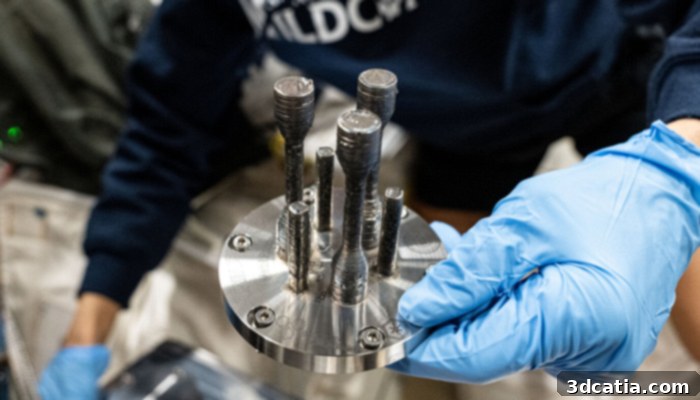
A significant leap forward in in-space manufacturing occurred in early 2024 when a specialized metal 3D printer was launched into space for critical orbital manufacturing tests. This groundbreaking printer, a collaborative design by Airbus and the European Space Agency (ESA), was transported to the International Space Station (ISS) as part of the Cygnus NG-20 resupply mission. After several months dedicated to precise calibration and fine-tuning in the microgravity environment, the team successfully 3D printed the very first metal part in orbit. This achievement marks an extraordinary milestone in the history of space manufacturing, demonstrating the feasibility of fabricating durable metal components away from Earth. The printing process utilized the Directed Energy Deposition (DED) technique, where a high-power laser precisely melts stainless steel wire at extreme temperatures, reaching up to 1,200°C. The result of this pioneering experiment was an array of metal components measuring approximately 9 x 5 cm. This remarkable success underscores the immense potential of 3D printing for producing tools, spare parts, and structural elements directly in space. It not only opens the door to on-demand production, significantly reducing launch mass and logistics, but also promises to optimize resource utilization and enhance the autonomy of future space exploration endeavors, making long-duration missions more sustainable and self-reliant.
NASA Tests Laser Beam Welding for In-Space Construction and Repair
Laser beam welding, a specialized form of directed energy deposition, is a versatile technology widely employed for high-precision repairs and the creation of new parts from scratch on Earth. Its potential applications in space are even more transformative, offering solutions for constructing vast habitats in low Earth orbit, fabricating robust spacecraft structures to ensure astronaut safety, and performing critical in-situ repairs. Recognizing this potential, NASA undertook a comprehensive two-year research project to assess the viability of laser beam welding in the unique conditions of space. In the fall of 2024, NASA proudly announced the mission’s resounding success, detailing the outcomes of this collaborative effort between NASA’s Marshall Space Flight Center and Ohio State University. The primary objective of the project was to gain a deep understanding of the physical processes involved in welding on the lunar surface, a critical capability for future lunar bases. The team meticulously investigated how laser beam welding performs in a combined environment of vacuum and reduced gravity, mimicking lunar conditions. During a series of specialized test flights, they successfully completed an impressive 69 out of 70 welds, gathering invaluable data through an extensive network of sensors. By thoroughly understanding how laser beam welding operates and behaves in such an unforgiving environment, NASA aims to significantly expand in-space manufacturing and repair capabilities, paving the way for more ambitious and sustainable human presence beyond Earth.
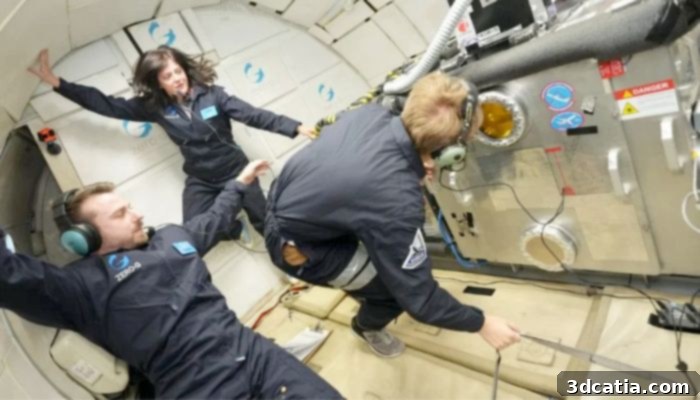
The team monitors laser beam welding in a vacuum chamber during a Boeing 727 parabolic flight. From left, Andrew O’Connor, Marshall materials scientist and NASA technical lead for the project; Louise Littles, Marshall materials scientist; and Aaron Brimmer, OSU graduate student. Photo Credits: Tasha Dixon
Berkeley Researchers Send a 3D Printer Into Space to Validate Microgravity Printing
On June 8, 2024, a team of pioneering researchers from the University of California, Berkeley, achieved a significant milestone by sending their microgravity 3D printer into space for its inaugural test flight. This mission, part of the Virgin Galactic 07 initiative, saw the SpaceCAL printer embark on a suborbital journey aboard the VSS Unity spacecraft. During a brief but crucial 140-second window in suborbital space, the printer autonomously produced and post-processed a total of four distinct test parts, including miniature space shuttles and figurines, utilizing PEGDA liquid plastic. While the Berkeley researchers acknowledge that further fine-tuning and development are still required, the printer demonstrated exceptional performance under microgravity conditions. This successful validation confirms the readiness of this specific 3D printing technology for broader integration into space travel applications. With ongoing support from NASA, the Berkeley team is committed to continuing their rigorous testing and refinement of the SpaceCAL technology. Their ultimate goal is to provide astronauts with a reliable and efficient means of producing critical parts and tools during extended space missions, empowering them with unparalleled autonomy and reducing dependence on Earth-based supply chains for consumables and emergency replacements.
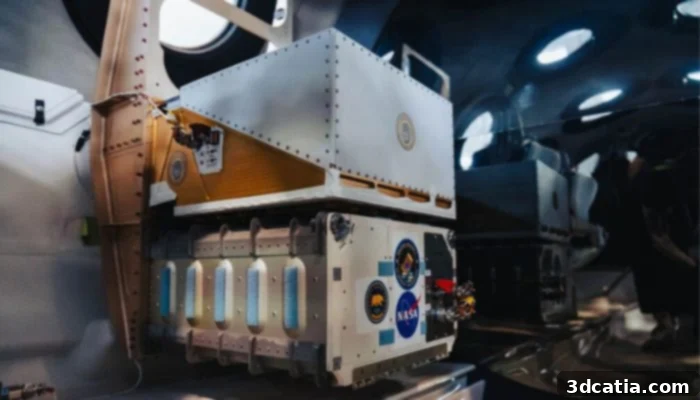
The SpaceCAL 3D printer on board the VSS Unity. (Credit: Virgin Galactic)
European Space Agency (ESA) Adopts IMPERIAL 3D Printer for Future Missions
The European Space Agency (ESA) has announced its strategic decision to integrate the IMPERIAL 3D printer into its ambitious space exploration plans. This sophisticated additive manufacturing solution was the result of a collaborative effort by OHB System AG, Azimut Space, Athlone Institute of Technology, and BEEVERYCREATIVE, specifically designed to overcome the limitations of printing parts larger than the available build volume in space. With the IMPERIAL 3D printer, ESA aims to enable the creation of larger structures, complex tools, and essential spare parts, all vital for the success and sustainability of extended space missions. The printer boasts several highly innovative features. Firstly, its intrinsic capability to print effectively in microgravity conditions—a near-zero gravity environment—sets it apart from conventional terrestrial printers. Secondly, it incorporates a unique conveyor-belt-shaped printing plate. This design allows for continuous production along a single axis, making it exceptionally well-suited for fabricating structures with significant volumes and extended lengths without being constrained by a fixed build platform. Finally, to ensure material integrity, IMPERIAL is equipped with a thermoregulated environment. This crucial feature prevents the deformation of high-performance materials such as PEEK, PEKK, and PEI, which are highly desirable for aerospace applications due to their strength and heat resistance. While the functional prototype has been successfully developed and tested on Earth, the next critical phase involves rigorous experimentation in the microgravity environment of the International Space Station (ISS) or ESA’s forthcoming Space Rider, validating its readiness for operational deployment in space.
3D Printing Electronic Circuits Directly Onto Spacecraft for Enhanced Functionality
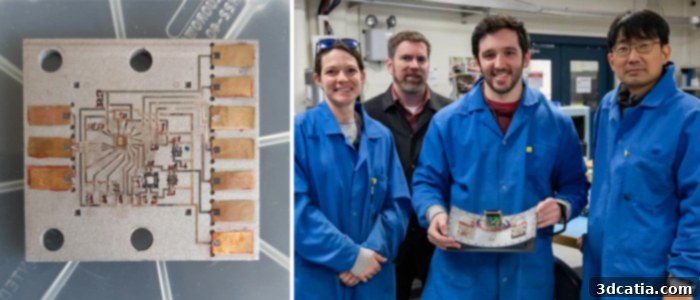
A team of dedicated NASA engineers has achieved a significant technological breakthrough by successfully testing 3D printed electronic circuits during a suborbital flight launched from Wallops Flight Facility. This innovative technology empowers engineers to print sensors and intricate circuitry directly onto both the internal and external surfaces of spacecraft, dramatically optimizing available space and enhancing overall functionality. During the experimental flight, temperature and humidity sensors that were printed directly onto the cargo door and various panels of the SubTEC-9 rocket meticulously collected environmental data. This crucial data was then seamlessly transmitted back to Earth, demonstrating the robust performance of the integrated printed electronics. This innovation offers multifaceted benefits: it facilitates the integration of vital components into previously unusable or difficult-to-access areas, thereby increasing the density and efficiency of spacecraft. Furthermore, it significantly improves the accuracy and performance of antennas by allowing them to be printed directly onto curved surfaces, optimizing their aerodynamic and signal properties. The team also successfully developed circuits with ultra-thin traces, a notable advancement that reduces the reliance on bulky and heavy traditional metallic wiring. This cutting-edge technology holds immense promise for future space missions, enabling real-time monitoring of internal spacecraft temperatures, structural health, and potentially complementing AI-designed structures fabricated directly in orbit, leading to smarter, lighter, and more capable spacecraft.
Supporting Human Life Beyond Earth: Additive Manufacturing for Astronaut Wellbeing
Redwire’s BioFabrication Facility: Advancing Space Medicine
Redwire Corporation, a prominent American aerospace manufacturer, is at the forefront of accelerating space exploration by developing innovative solutions that fundamentally improve the feasibility and ease of life in space. A key aspect of this ambitious goal is the pioneering application of bioprinting in microgravity environments. For a considerable period, Redwire has been intensely focused on the creation of printed biological tissues in space. Towards the end of 2023, the company proudly announced a monumental achievement: the successful 3D printing of the first human knee meniscus directly onboard the International Space Station. John Vellinger, Executive Vice President of Redwire, emphasized the profound implications of this breakthrough, stating, “This is a groundbreaking milestone with significant implications for human health. Demonstrating the ability to successfully print complex tissue such as this meniscus is a major leap forward toward the development of a repeatable microgravity manufacturing process for reliable bioprinting at scale.” This development unequivocally highlights how additive manufacturing can revolutionize human health and medical care in space, making advanced treatments and personalized medicine far more accessible to astronauts during long-duration missions, potentially even paving the way for organ printing in the distant future.
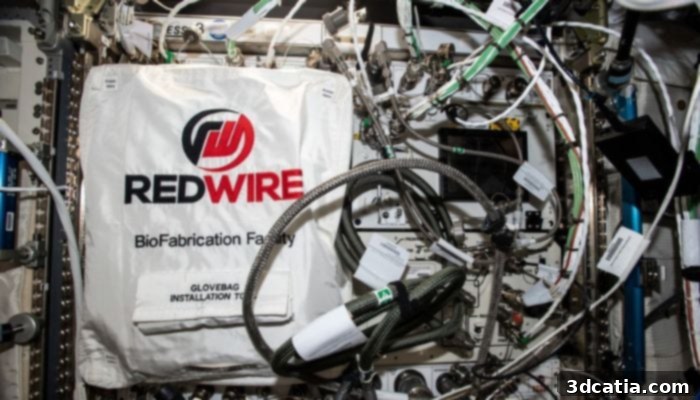
The 3D bio-printer installed on board the ISS (photo credits: Redwire Corporation)
Bioprint FirstAid: Personalized Wound Care for Astronauts
The Bioprint FirstAid experiment stands as another exemplary illustration of the transformative potential of bioprinting for medical applications in space. In 2022, ESA astronaut Matthias Maurer conducted crucial tests of this innovative device while aboard the International Space Station. Described colloquially as a “plaster/band-aid gun,” this hand-operated device is designed to produce a covering akin to a plaster or band-aid for skin wounds, utilizing a specialized bio-ink. During Maurer’s initial tests, the bio-ink consisted of fluorescent microparticles rather than actual skin cells. The long-term objective, however, is to evolve this technology to provide highly personalized and on-demand wound care for astronauts, crucial for addressing injuries in environments where medical resources are severely limited. A research paper published in 2024 provided encouraging results, showing successful proliferation of human skin cells within biogels after printing. Furthermore, the Bioprint FirstAid printer itself demonstrated remarkable suitability for space applications, characterized by its low susceptibility to failure, robust and straightforward design, complete absence of complex electronics, and maintenance-free mechanical operation. These attributes make it an ideal medical device for future human exploratory missions, whether to the Moon, Mars, or beyond, ensuring astronaut health and safety in challenging extraterrestrial environments.
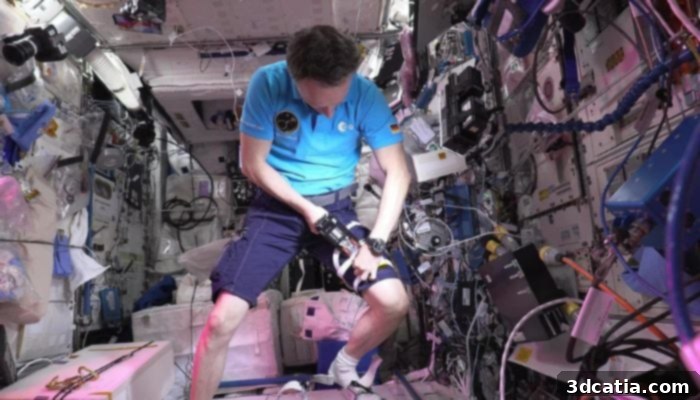
Astronaut Matthias Maurer testing the Bioprint FirstAid experiment (photo credits: ESA/NASA)
Professor Pablo de León Patents 3D Printed Spacesuits for Martian Expeditions
Professor Pablo de León, who chairs the Department of Space Studies at the University of North Dakota (UND), has secured a patent for a revolutionary 3D printing technology poised to transform astronaut preparedness for long-duration missions. This innovative system enables astronauts to independently produce entire spacesuits and create crucial replacement parts while on extended journeys, particularly with an eye towards future expeditions to Mars. Professor de León’s technology offers a multitude of benefits for space missions, significantly enhancing self-sufficiency and operational flexibility. Foremost, the capability to produce spacesuit components and other essential items directly in space drastically reduces dependence on hypothetical and costly supply chains from Earth, minimizing launch mass and logistical complexities. Moreover, the technology allows for unprecedented customization: spacesuits, gloves, and boots can be precisely tailored to each astronaut’s unique body shape and measurements, using data gathered from individual body scans. This ensures optimal fit, comfort, and performance. The system is also highly versatile, accommodating both rigid and flexible filaments. This enables the fabrication of sturdy components for areas requiring structural integrity, such as the torso, alongside softer, more pliable parts ideal for joints, ensuring maximum mobility and protection.
Beyond spacesuits, this adaptable technology lends itself to the production of a wide array of other vital objects, including robust, pressurized fluid tanks. A truly innovative aspect is the potential to synthesize the filaments required for the suits from elements found directly in Martian soil or even from extraterrestrial atmospheric gases. This groundbreaking capability allows for the exploitation of local resources, a critical factor for the long-term sustainability of extended planetary missions. Such a technology would be invaluable for programs like NASA’s Artemis, which aims to return astronauts to the Moon as a stepping stone for future human missions to Mars, laying the groundwork for permanent off-world settlements.
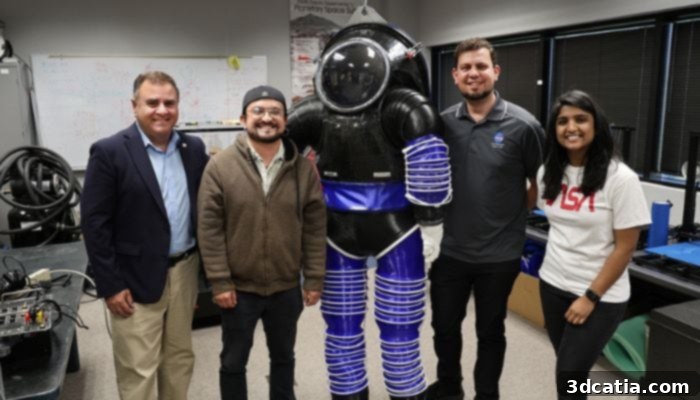
Next to the prototype 3D printed spacesuit, Pablo de León (left) poses with doctoral students David Mateus Jimenez, Jurie Visagie and Pranika Gupta. (Photo credit: Joe Banish/UND Today)
3D Printed Astronaut Meals from Recycled Plastic Waste: A Sustainable Solution
The concept of 3D printed food is remarkable, but imagine 3D printed food derived from plastic waste – a truly revolutionary idea for long-duration space missions. Addressing the critical challenge of food security in extraterrestrial environments, American, Japanese, and European space organizations have forged collaborations with the food industry to devise an ingenious solution. This involves collecting plastic waste generated onboard spacecraft, shredding it, and then introducing it into a bioreactor. Within this bioreactor, a specific type of modified bacteria is introduced. These specialized microorganisms consume the plastic, effectively transforming it into an edible biomass. This biomass can then be processed and 3D printed into a variety of recognizable and nutritious meals. The company Beehex, founded by Anjan Contractor, an engineer affiliated with NASA, has been instrumental in making this seemingly miraculous process a reality. A core objective of this project is to provide a sustainable and self-sufficient food source for astronauts, minimizing the need for extensive food provisions from Earth. Through this innovative 3D printing approach, Beehex has successfully created visually appealing and potentially palatable items such as steaks, chicken, and other meal components, demonstrating a significant step towards a closed-loop food system for future human space exploration.

Photo credit: NASA
Space Construction: Building Permanent Outposts on Other Worlds
ICON and NASA Drive 3D Construction Forward on the Moon and Mars
In a testament to the growing importance of additive construction, NASA has awarded a substantial $57.2 million contract to ICON, an innovative Austin-based company, to spearhead the development of advanced construction technologies crucial for future human missions to the Moon and Mars. This ambitious initiative falls under the umbrella of the Moon to Mars Planetary Autonomous Construction Technologies (MMPACT) project. As part of this collaborative effort, ICON will work in close partnership with NASA’s Marshall Space Flight Center to develop the groundbreaking Olympus construction system. The core objective of the Olympus project is to leverage abundant local materials – such as lunar regolith or Martian soil – for the on-site fabrication of essential infrastructure. This includes robust landing pads for spacecraft, comfortable and safe habitats for astronauts, and efficient roads to facilitate surface mobility on both the lunar and Martian landscapes. This multi-year contract, extending through 2028, significantly expands upon ICON’s previous successful work under the Small Business Innovation Research (SBIR) program. It builds on their proven expertise in applying advanced 3D printing techniques to space exploration, notably exemplified by the construction of Mars Dune Alpha, a high-fidelity simulated Martian habitat utilized for the CHAPEA analog mission on Earth. Through these forward-thinking innovations, NASA is actively seeking to accelerate the development of technologies that are absolutely essential for the sustainable, long-term exploration and eventual colonization of new extraterrestrial sites, establishing a permanent human presence beyond our home planet.
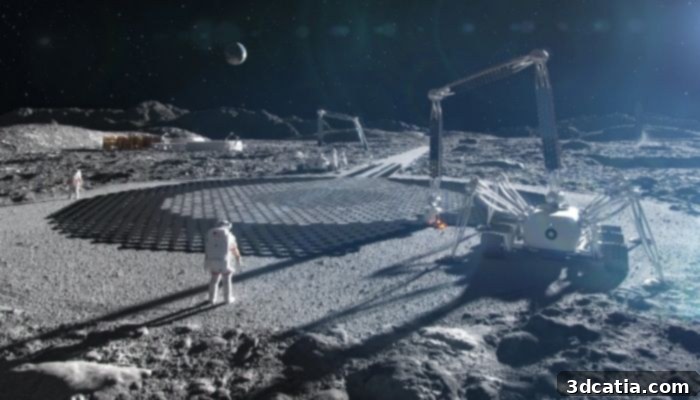
Photo credit: ICON/BIG-Bjarke Ingels Group
Space Copy: Aiming for a 3D Printer on the Moon by 2031
Space Copy is emerging as a prominent player among a new generation of companies dedicated to making 3D printing a reality on the Moon, Mars, and beyond. The company’s overarching mission is to devise innovative and practical solutions to the complex challenges inherent in constructing infrastructure in extreme environments, both on Earth and in space. In such demanding locales, standardized and traditional manufacturing processes are often prohibitively costly, logistically complex, and fraught with high risks. Launched in 2022, this ambitious startup envisions deploying fully autonomous printing solutions for remote construction projects, allowing for the rapid and efficient fabrication of critical infrastructure without direct human intervention. Furthermore, Space Copy is actively developing custom additive manufacturing techniques specifically for the on-demand production of supplies, tools, and structural components. A key focus of their research and development efforts is the creation of specialized printers capable of processing lunar soil simulant material, paving the way for the utilization of in-situ resources on the Moon. Founder Madison Feehan has articulated an ambitious, yet clearly defined, goal for the company: to have a functional 3D printer operational on the lunar surface by the year 2031. This bold objective underscores the rapid pace of innovation and the serious commitment from private industry to support humanity’s expansion into the solar system.
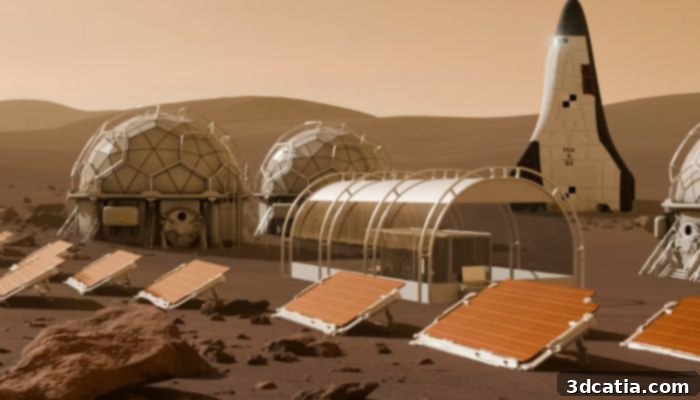
Photo credit: Space Copy
The applications of 3D printing in space are not merely theoretical; they are rapidly becoming tangible realities, fundamentally reshaping the trajectory of human space exploration. From enabling complex in-orbit manufacturing and sustaining astronaut health to building the very foundations of future extraterrestrial settlements, additive manufacturing is proving to be an indispensable technology. As we look towards even more ambitious missions to the Moon, Mars, and beyond, the role of 3D printing will only grow, paving the way for unparalleled autonomy, sustainability, and innovation in the cosmos.
What are your thoughts on these incredible 3D printing applications in space? We invite you to share your insights and comments below or engage with us on our Facebook and Twitter pages! Don’t forget to subscribe to our free weekly Newsletter to receive all the latest news and developments in the world of 3D printing directly in your inbox!