
Mastering Multi Jet Fusion: A Deep Dive into HP’s Innovative 3D Printing Technology
Additive manufacturing, commonly known as 3D printing, encompasses a vast array of technologies, each with its unique approach to creating three-dimensional objects layer by layer. It’s clear that a “one-size-fits-all” solution simply doesn’t exist within this dynamic field. While the fundamental principle of building parts incrementally remains constant, the methods employed to achieve this vary significantly. Currently, the industry categorizes additive manufacturing processes into seven distinct families:
- Photopolymerization: This family includes processes like Stereolithography (SLA) and Digital Light Processing (DLP), which utilize a light source to selectively cure liquid photopolymer resins, transforming them into solid plastic layers.
- Material Extrusion: Best exemplified by Fused Deposition Modeling (FDM) or Fused Filament Fabrication (FFF), this method melts and extrudes thermoplastic filaments through a heated nozzle, depositing material onto a build platform to form each layer.
- Material Jetting: Technologies like PolyJet operate by jetting minuscule droplets of photopolymer resin or wax onto a build platform, which are then immediately cured by UV light, similar to how an inkjet printer works but in 3D.
- Binder Jetting: In this process, a liquid binding agent is selectively deposited onto a bed of powder material (metal, ceramic, or sand) to bond particles together, forming a solid layer.
- Powder Bed Fusion (PBF): This broad category includes Selective Laser Sintering (SLS) and Direct Metal Laser Sintering (DMLS), where a thermal energy source (laser or electron beam) selectively fuses regions of a fine powder bed.
- Directed Energy Deposition (DED): DED processes melt material (wire or powder) as it is deposited through a nozzle, typically using a laser or electron beam. This is often used for repairing or adding material to existing components, particularly for large-scale metal parts.
- Sheet Lamination: This method involves bonding thin sheets of material (such as paper, metal, or composites) together, which are then precisely cut to form the desired shape.
Amidst these established categories, certain innovative technologies emerge that blur the lines. A prime example is Multi Jet Fusion (MJF) from HP, a revolutionary process that, while technically classified under Powder Bed Fusion, incorporates elements reminiscent of Material Jetting and Binder Jetting, creating a truly unique hybrid approach. This article will delve deeper into the intricacies of MJF, exploring its operational mechanics, its advantages and limitations, and the diverse applications it enables across various industries.
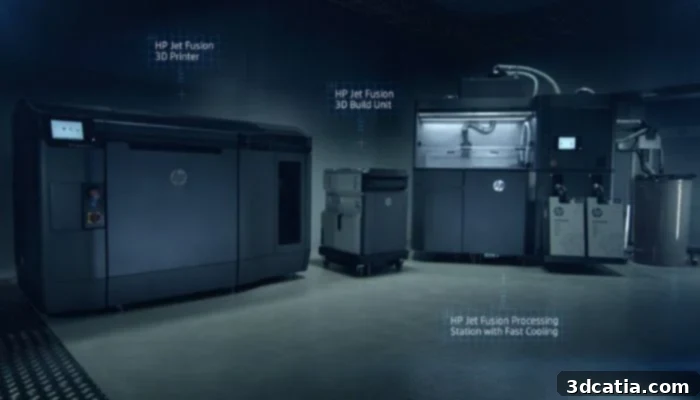
Photo Credits: HP
Understanding How Multi Jet Fusion (MJF) Works
Developed by HP and introduced to the market in 2016, Multi Jet Fusion leverages the company’s extensive expertise in inkjet printing technology. While it’s a relatively new player in the 3D printing landscape—especially when compared to pioneers like stereolithography and fused deposition modeling which date back to the early 1980s, or metal additive manufacturing processes from the 90s—MJF has rapidly gained popularity. Its ability to produce highly accurate, robust, and functional polymer parts has made it a preferred choice for numerous industrial applications. The technology is currently compatible with both rigid and elastomeric polymers, expanding its versatility in functional prototyping and end-use part production.
The MJF Printing Process: A Detailed Breakdown
At its core, MJF masterfully combines elements of powder bed fusion and material jetting, creating a unique methodology that streamlines the additive manufacturing process. The “jetting” component refers to the precise deposition of chemical agents, while “fusing” describes the thermal solidification of the powder material. Here’s a step-by-step look at how a part is fabricated using MJF:
- Powder Bed Preparation: The process begins with a thin, uniform layer of powdered material being spread across the build platform. This powder bed is meticulously pre-heated to a consistent, precise temperature, which is crucial for ensuring uniform fusion and dimensional accuracy throughout the final part.
- Agent Application: Following the powder layer, a specialized inkjet array, remarkably similar to those found in high-resolution 2D paper printers but engineered for industrial precision, moves across the powder bed. This array selectively jets two distinct liquid agents: a **fusing agent** and a **detailing agent**. The fusing agent is applied to areas where the powder material is intended to solidify and form the part’s geometry. Conversely, the detailing agent is jetted around the edges of the part geometry, actively inhibiting fusion and creating crisp, high-resolution boundaries. This meticulous control over material properties at a voxel (3D pixel) level is a hallmark of MJF technology.
- Energy Application and Fusion: Immediately after the agents are applied, a powerful infrared (IR) energy source passes over the entire layer. This energy selectively melts the powder particles that have been treated with the fusing agent. The detailing agent prevents heat absorption and fusion at the part’s perimeter, ensuring precise contours and fine features. Unlike laser-based powder bed fusion processes, which often fuse points or lines sequentially, MJF applies thermal energy across the entire layer simultaneously, significantly accelerating the build process and enhancing throughput.
- Continuous Layering and Fusion: A critical differentiator for MJF is that each subsequent layer of fresh powder and agents is deposited while the previous layers are still in a molten state. This unique characteristic facilitates exceptional inter-layer adhesion, leading to parts with superior mechanical properties and truly isotropic strength. This means the parts exhibit consistent mechanical performance in all directions, a crucial advantage for demanding engineering applications. This continuous, “wet-on-wet” fusion not only enhances part durability but also allows for the realization of finer details and more complex geometries.
- Repetition: These precise steps are repeated layer by layer, building the object from the ground up, until the entire three-dimensional part is fully formed within the powder bed.
Post-Processing and Material Handling
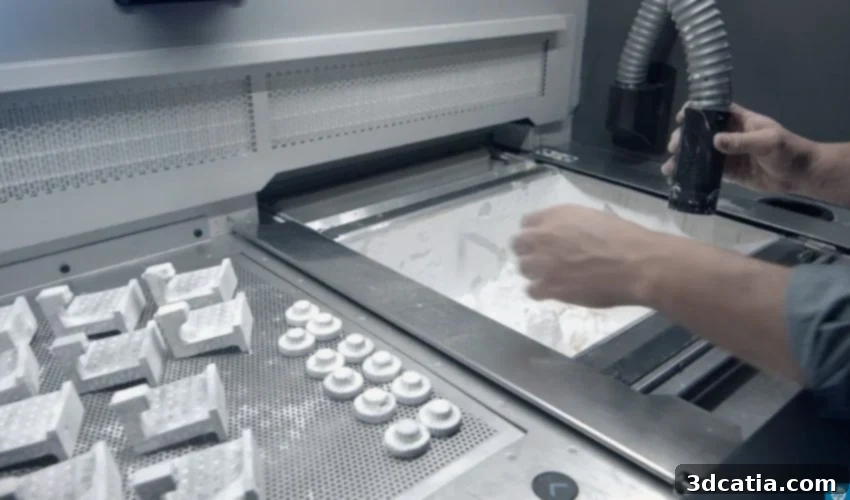
Once the printing process is complete, MJF parts require essential post-processing, primarily to remove the unfused powder surrounding the printed object. A significant advantage here, shared with technologies like Selective Laser Sintering (SLS) and Binder Jetting, is the inherent absence of support structures. Since the surrounding powder naturally supports all overhangs and complex features during printing, the time-consuming and labor-intensive step of support removal is entirely eliminated, streamlining the workflow and significantly reducing post-production costs and labor.
HP’s MJF solutions typically include a dedicated processing station where parts are moved after printing. This station efficiently facilitates the removal of loose, unfused powder, either through vacuuming, bead blasting, or other automated methods. Crucially, a high percentage of this recovered powder can be meticulously recycled and reused in subsequent builds, leading to remarkable material efficiency and reduced waste. Beyond powder removal, a wide array of post-processing techniques can be applied to MJF parts to further enhance their mechanical properties, achieve smoother surface finishes, or customize their appearance. Common post-processing steps include dyeing (for color), abrasive blasting (for surface texture), tumbling (for smoothing), and various coatings.
Current Landscape: HP’s MJF Offerings
As a proprietary technology, Multi Jet Fusion is exclusively offered by HP. The company currently provides two primary MJF production solutions designed for different scales and applications: the HP Jet Fusion 4200 series (ideal for mid-volume production) and the HP Jet Fusion 5200 series (engineered for high-volume, industrial-grade manufacturing). While the technology is continuously evolving, it is presently compatible only with a selection of high-performance polymer materials, including popular choices like TPU (Thermoplastic Polyurethane), PP (Polypropylene), PA11 (Polyamide 11), PA12 (Polyamide 12), and PA12 with glass beads for enhanced stiffness and heat resistance. HP is actively expanding its material portfolio through partnerships and internal R&D to cater to an even broader range of industrial applications and performance requirements, including flexible, rigid, and composite materials.
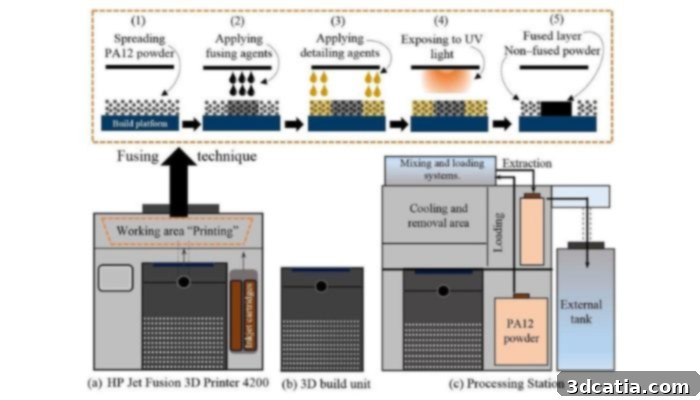
A schematic of the Multi Jet Fusion (MJF) process including the build unit and processing unit (photo credits: Amer Alomarah via ResearchGate)
Benefits and Limitations of Multi Jet Fusion
Like any advanced manufacturing technology, Multi Jet Fusion comes with its own set of compelling advantages and inherent challenges. Understanding these aspects is crucial for determining its suitability for specific production needs and ensuring optimal implementation.
The Limitations of MJF Technology
While highly innovative, MJF does present some initial hurdles, particularly concerning investment and material options:
- High Initial Investment: One of the most significant drawbacks of MJF is the substantial upfront capital cost of acquiring an HP Jet Fusion printer. Since HP is the sole provider of this proprietary technology, there are no lower-cost alternatives readily available on the market, especially compared to entry-level FDM or SLA machines. For instance, the HP Jet Fusion 4200 series typically starts at over $200,000, while the more advanced, higher-throughput HP Jet Fusion 5200 series can begin at around $350,000. While the cost per part can become highly competitive and incredibly cost-effective over time, particularly for high-volume batch production, this initial capital expenditure represents a considerable barrier for smaller businesses, startups, or those with limited budgets.
- Limited Material Choice: Despite continuous expansion and HP’s efforts since its introduction in 2016, the material selection for MJF remains relatively confined compared to more mature and open-source additive manufacturing processes. HP currently offers seven compatible materials, though not all are interchangeable between the 4200 and 5200 series machines due to varying thermal requirements and process parameters. The HP Jet Fusion 4200 is compatible with Estane® 3D PU M95A, TPA, PA11, PA12, and PA12 Glass Beads, offering a range from flexible to rigid parts. Meanwhile, the HP Jet Fusion 5200 supports PA11, PA12, PA12 Glass Beads, PP, and BASF Ultrasint® TPU01. While these materials offer a good range of characteristics for diverse applications, the specialized portfolio can still be a constraint for industries requiring very niche or specific material properties that are not yet supported by HP’s ecosystem.
- Aesthetic Considerations and Post-Processing Requirements: Parts produced directly from an MJF printer typically exhibit a slightly rough, granular surface finish and a default gray color, resulting from the unfused powder particles adhering to the surface (though white parts are now also achievable with certain materials and specific processing). This often necessitates additional post-processing steps like dyeing (to achieve specific colors), abrasive blasting, chemical smoothing, or tumbling to achieve desired colors, smoother surfaces, or specific aesthetic qualities demanded by end-use applications. During these mechanical post-processing steps, very small raised text, intricate textures, or fine cosmetic details on the part could potentially be obscured, slightly rounded, or even lost if not managed carefully.
- Geometric Constraints for Certain Structures: While offering significant design freedom due to the lack of support structures, MJF technology can still face subtle limitations with certain highly specific or delicate complex geometries. Specifically, producing some types of extremely thin-walled, intricate curved, or entirely hollow structures without sufficient venting might pose challenges in ensuring complete powder removal or maintaining structural integrity during the build and cool-down phases, potentially requiring careful design consideration or iterative optimization.
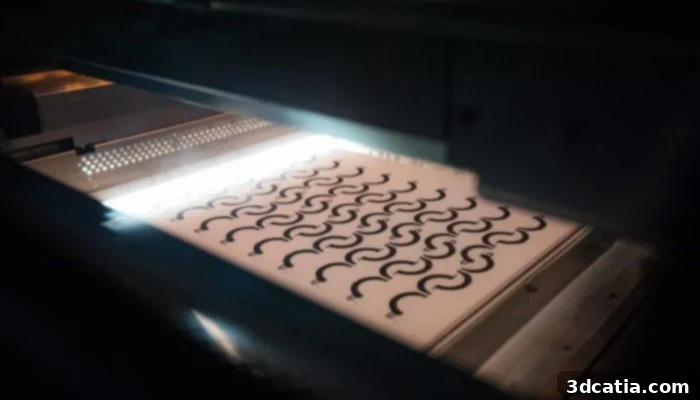
Parts being created by MJF (photo credits: Hubs)
Key Benefits of Multi Jet Fusion
Despite its limitations, MJF offers compelling advantages that firmly position it as a leading technology for both functional prototyping and robust end-part production:
- Exceptional Speed and Production Efficiency: Drawing parallels with Binder Jetting and SLS, HP Multi Jet Fusion stands out for its remarkably fast printing speeds and high production throughput. This efficiency is largely attributable to its industrial-grade inkjet array technology, which allows for the simultaneous application of agents across an entire layer, rather than point-by-point. Furthermore, MJF’s large build volume and efficient packing algorithms enable the printing of many parts within a single build, maximizing throughput. This rapid cycle time makes MJF ideal for quickly moving from design iteration to finished product, significantly accelerating product development and market entry.
- Isotropic Mechanical Properties: One of the most significant and often lauded advantages of MJF is its ability to produce parts with truly isotropic mechanical properties. This means the parts exhibit consistent strength, stiffness, and other physical characteristics regardless of the direction in which they are tested or loaded. This uniformity is critical for functional parts that need to withstand multi-directional stresses or carry loads in various orientations, making MJF a preferred choice for demanding engineering applications where anisotropic properties (a common characteristic in some other AM methods like FDM) would be unacceptable. The robust, “wet-on-wet” inter-layer fusion facilitated by the continuous melting of powder layers contributes significantly to this exceptional isotropy.
- Unparalleled Design Freedom and Geometric Complexity: The inherent powder bed nature of MJF eliminates the need for external support structures. Unfused powder naturally supports overhangs, internal channels, bridges, and complex internal geometries throughout the entire build process, providing designers with immense freedom. This allows for the creation of intricate and highly optimized parts—including complex internal lattice structures, interlocking features, and intricate internal channels—without worrying about support generation, removal, or potential part damage, which is a major advantage over many other 3D printing technologies.
- High Accuracy, Fine Details, and High-Quality Surface Finish: HP MJF’s unique voxel-level production control allows for incredibly fine detail resolution and impressive dimensional accuracy. The precise application of detailing agents ensures sharp edges and intricate features, making it suitable for parts requiring high fidelity to the original CAD model. While the initial surface can be granular, the resulting surface finish, particularly after appropriate post-processing techniques (such as bead blasting, chemical vapor smoothing, or tumbling), can achieve a high quality that rivals injection molded parts in many aesthetic and functional aspects.
- Excellent Powder Recycling Rate and Cost Efficiency: Compared to many other powder bed fusion processes, MJF boasts an impressive powder recycling rate, often ranging from 80% to 85% depending on the specific material being used. This high reusability of unfused powder contributes significantly to the overall cost-effectiveness of the process and substantially reduces material waste, making the technology more sustainable and economical for industrial-scale production, especially when combined with its high throughput.
Diverse Applications of Multi Jet Fusion Technology
Given its numerous benefits, particularly its speed, accuracy, isotropic properties, and design freedom, Multi Jet Fusion 3D printing has found extensive adoption across a broad spectrum of industries. Its versatility allows for a wide range of applications, from rapid prototyping to the production of functional end-use parts.
- Industrial and Manufacturing: In industrial settings, MJF is extensively used for creating complex jigs, fixtures, and tooling components that require high strength, precision, and durability. Its ability to produce robust parts quickly makes it ideal for accelerating manufacturing workflows, enabling custom production aids, and even short-run manufacturing of specialized components where traditional methods are too slow, costly, or inflexible. Examples include custom robotic grippers, assembly line tooling, and replacement parts.
- Automotive Sector: The automotive industry benefits immensely from MJF for producing functional prototypes for both interior and exterior components, complex air ducts, fluid reservoirs, and custom aftermarket parts. The isotropic mechanical properties are particularly valuable for testing parts under realistic stress conditions, while the speed supports rapid iteration in design cycles, allowing manufacturers to bring innovations to market faster.
- Medical and Healthcare: MJF’s precision, ability to create intricate designs, and compatibility with certain biocompatible polymer options make it exceptionally suitable for a wide array of medical applications. These include custom orthotics, highly personalized prosthetics, anatomical models for pre-surgical planning, and even components for advanced medical devices. The ability to create highly personalized and intricate designs tailored to individual patient needs is a major asset in this critical field.
- Consumer Goods: For consumer products, MJF is leveraged for creating personalized items, fashion accessories, durable eyewear components, and robust, complex casings for electronics. Its capability to produce intricate geometries, textured surfaces, and functional parts allows for innovative and aesthetically pleasing designs that cater effectively to niche markets or growing trends in mass customization and on-demand production.
- Aerospace (Prototyping & Non-Critical Parts): While often requiring certified materials for flight-critical components, MJF is increasingly used in the aerospace industry for rapid prototyping of interior cabin parts, specialized ducts, brackets, and other non-critical functional components. It offers significant design flexibility, reduces lead times for development, and allows for lightweighting initiatives that are vital in this sector.
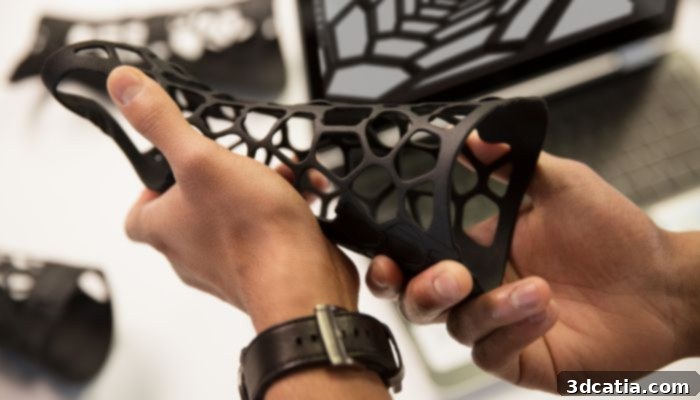
MJF can be used in a variety of sectors including medical, as this orthotic shows (photo credits: Invent Medical)
The journey of MJF is far from over. HP continues to invest heavily in refining the technology, constantly introducing new and advanced materials, and optimizing processes to achieve even more streamlined and effective production workflows. This ongoing innovation ensures MJF remains one of the most popular and relevant additive manufacturing processes, securing its position for the foreseeable future, particularly in high-performance polymer applications. Furthermore, HP has expanded its additive manufacturing portfolio with the recent unveiling of its metal 3D printing process, HP Metal Jet, demonstrating the company’s commitment to pushing the boundaries of 3D printing across even more materials and applications, including those in the demanding metal sector. For detailed information and the latest updates on HP’s Multi Jet Fusion technology, visitors are encouraged to explore HP’s official website HERE.
What are your thoughts on Multi Jet Fusion? Have you had experience using this innovative technology in your projects? We invite you to share your insights in the comments section below or join the conversation on ourLinkedIn, Facebook, and Twitter pages! Don’t miss out on the latest advancements in 3D printing; subscribe to our free weekly Newsletter here to receive news directly in your inbox. You can also explore all our informative videos on our YouTube channel.
*Cover Photo Credits: HP