
Optimizing Additive Manufacturing: The Power of Automated Post-Processing for Industry 4.0
Process and workflow automation stands as a cornerstone of Industry 4.0, revolutionizing how businesses operate across various sectors. These sophisticated automation systems are meticulously designed to control, monitor, and optimize industrial processes, machines, and devices through advanced computerized methods. Their primary objective is to enable automatic operation, significantly enhancing overall production efficiency, reliability, and output quality. The sheer growth of this sector underscores its critical importance; Fortune Business Insights projects the industrial automation market to swell to nearly $300 billion by 2026, a remarkable doubling of its 2018 valuation. This trajectory highlights the indispensable role these systems play in today’s industrial landscape, empowering companies to streamline operations and elevate performance across their entire industrial footprint. In the context of additive manufacturing (AM), this trend is particularly pronounced. While human expertise remains invaluable, the AM sector is rapidly adopting more and more automation solutions, especially in production and post-processing stages, as it continues its inevitable march towards full industrialization.
The integration of automation in additive manufacturing is not merely a convenience; it is a strategic imperative for scaling production, reducing costs, and ensuring consistency. As AM technologies mature from prototyping tools to viable mass production methods, the bottleneck often shifts from the printing process itself to the subsequent post-processing steps. These steps, historically labor-intensive and prone to inconsistencies, demand innovative solutions to keep pace with the accelerating demands of industrial output. This is precisely where specialized solutions providers like AMT step in, addressing these critical challenges head-on to enable a truly industrialized additive manufacturing workflow.
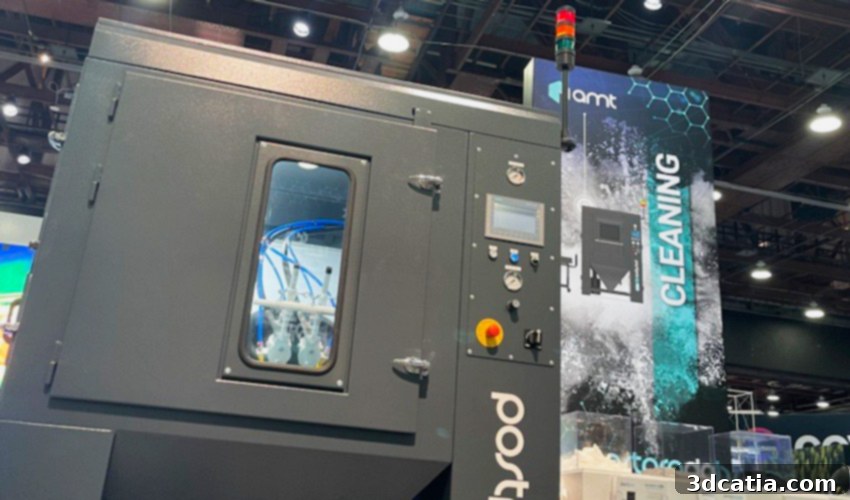
Against this backdrop of rapid industrialization, the international company AMT distinguishes itself by offering cutting-edge automated post-processing solutions specifically engineered for 3D printed parts. Leveraging advanced technologies and innovative approaches, AMT’s solutions have already enabled numerous customers to realize substantial reductions in manufacturing costs and significant optimizations in their production workflows. A prime example of this success is Blue-White Industries, a leading company dedicated to the development of sophisticated devices, accessories, and machinery for water treatment applications. Faced with the challenge of high capital investments associated with traditional mold manufacturing, Blue-White Industries began exploring 3D printing as a cost-effective and agile alternative for producing product components and prototypes. Their primary need was to find a robust post-processing solution that could not only boost production throughput but also deliver a durable and aesthetically superior surface finish, comparable to conventionally manufactured parts. It was at this crucial juncture that Blue-White Industries turned to AMT, seeking a transformative solution to elevate their additive manufacturing capabilities.
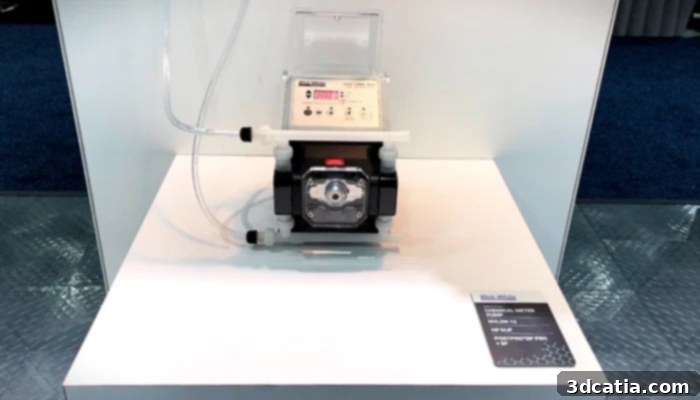
The CD1 pump developed by Blue-White Industries using AMT’s technology (photo credits: AMT)
Revolutionizing Production: The Multifaceted Benefits of Automated Post-Processing
When companies strategically integrate automation into their supply chain, their core objectives are often clear: to significantly reduce operational costs, minimize the incidence of human error, and enhance the overall traceability of their production processes. In the specialized domain of additive manufacturing, focusing specifically on post-processing, automation bestows a multitude of advantages over conventional, often manual, surface finishing systems. These benefits are transformative, impacting everything from efficiency to final product quality. For Blue-White Industries, a critical project involved the 3D printing and post-processing of essential components for their CD1 pump, a device engineered to deliver chemicals with unparalleled smoothness and continuity, crucial for water treatment applications. Patrick Murphy, Director of Engineering at Blue-White Industries, articulated their experience, stating, “We decided to adopt AMT’s PostPro Depowdering and Chemical Vapor Smoothing technology. This enabled us to reduce bead blasting time dramatically, increase throughput exponentially, and crucially, overcome early part failure even when operating under maximum load conditions. All these improvements were achieved through a process that was not only repeatable but also exceptionally reliable.”
The implementation of automated post-processing solutions addresses several pain points inherent in traditional methods. Manual post-processing is typically time-consuming, labor-intensive, and often introduces variability that can compromise part consistency and quality. Automation, on the other hand, offers precision, speed, and uniformity, making it an indispensable tool for scaling additive manufacturing operations. These systems ensure that each part, regardless of batch size, meets stringent quality standards, thereby bolstering customer confidence and expanding application possibilities for 3D printed components.
To comprehensively optimize their post-treatment workflow, Blue-White Industries seamlessly integrated AMT’s PostPro DP PRO machine into their production line. This state-of-the-art solution is specifically developed for the efficient cleaning and finishing of 3D printed parts, particularly those produced using powder-bed fusion technologies. The PostPro DP PRO represents a significant leap forward in automated post-processing. Its intelligent design and robust capabilities allow for the easy and rapid treatment of parts, effectively eliminating many of the most time-consuming and costly interventions typically found in the additive manufacturing supply chain. With this powerful system in place, Blue-White Industries has successfully unlocked new potentials, significantly expanding its field of applications to encompass a wider array of product models and designs. Beyond the immediate benefits of substantial cost reduction and a marked increase in productivity, the adoption of the PostPro DP PRO machine offers a host of other critical advantages. These include a considerable reduction in the time required for cleaning and finishing parts through its advanced depowdering and vapor smoothing capabilities. Directly linked to these efficiencies, a notable increase in production throughput was observed, attributed to the machine’s ample processing space and its significantly faster cycle times, allowing for more parts to be processed in less time without compromising quality.
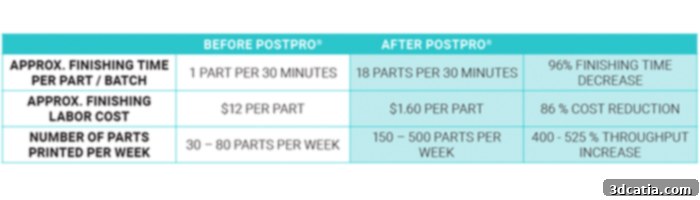
Blue White Industries saw both reduced cost and increased production thanks to AMT PostPro® automated systems (photo credits: AMT)
Advanced Solutions: Depowdering and Chemical Vapor Smoothing for Superior Part Quality
The Blue-White Industries team has also emphatically reported that the adoption of automated post-processing has profoundly contributed to elevating the strength, performance, and aesthetic appeal of their 3D printed parts. This crucial enhancement was largely achieved through AMT’s proprietary Chemical Vapor Smoothing technology. The synergy between AMT’s automated depowdering and chemical vapor smoothing systems ensures a meticulously reliable and consistently repeatable process, guaranteeing uniform quality from batch to batch. This level of consistency is paramount for end-use parts where performance and appearance are non-negotiable.
Delving into the mechanics of the depowdering process, the PostPro DP PRO machine is engineered to meticulously clean large batches of parts both gently and rapidly, often completing the cycle in as little as 10 minutes. A standout characteristic of this solution is the generous capacity of its processing basket, where the post-processing takes place. Boasting a substantial volume of up to 20 liters, the basket is ingeniously designed for easy removability, greatly streamlining the loading and unloading of parts. Furthermore, its angle is automatically adjustable, a critical feature that facilitates optimal product rotation, allowing the system to adapt seamlessly to diverse geometries and accommodate large batch volumes with maximum efficiency. These intrinsic properties collectively establish the PostPro DP PRO as an exemplary solution for optimizing post-processing workflows and achieving significantly higher throughput on the production line, without sacrificing the integrity or quality of the parts.
Beyond primary depowdering, AMT PostPro depowdering machines offer versatile functionality, also excelling in surfacing applications. Their adaptability allows for precise adjustments to cater to specific requirements for different parts and accommodate various additive manufacturing technologies. This versatility underscores AMT’s commitment to providing a comprehensive suite of post-treatment solutions, with technology spanning from advanced depowdering to sophisticated surfacing and highly effective chemical vapor smoothing. The latter technology is particularly noteworthy; it automatically smooths and seals the surfaces of 3D printed parts, meticulously achieving a surface finish that rivals the look and feel of traditional injection molding. This significantly broadens the range of applications for 3D printed parts, enabling their use in aesthetic and functional roles previously reserved for conventionally manufactured components.
The Future is Automated: Scaling Additive Manufacturing for Industrial Demands
The landscape of industrial automation systems is incredibly diverse, designed to respond with precision to the unique needs and evolving demands of each sector. This diversity unequivocally highlights the imperative of incorporating cutting-edge methods and technologies into the supply chain to not only generate substantial value but also to fully capitalize on the myriad benefits they offer. In additive manufacturing, where complexity and customization are inherent, automation in post-processing is not just an enhancement; it’s a fundamental requirement for widespread industrial adoption. It empowers manufacturers to move beyond prototyping and small-batch production, enabling the creation of high-quality, end-use parts at scale, cost-effectively, and with unparalleled consistency. This shift represents a pivotal moment, transforming 3D printing into a truly competitive and indispensable manufacturing process for the modern industrial era.
The journey of a 3D printed part from design to final product involves intricate steps, and post-processing often determines its ultimate success or failure in meeting stringent industry standards. By automating these critical stages, companies like Blue-White Industries can achieve previously unattainable levels of efficiency, quality, and economic viability. This not only optimizes current operations but also positions them for future growth and innovation in a rapidly evolving manufacturing landscape. Automated post-processing is thus an essential catalyst for unlocking the full potential of additive manufacturing and cementing its role as a key pillar of Industry 4.0.
You can delve deeper into the transformative world of post-processing automation and explore AMT’s innovative solutions by visiting their official website HERE. Discover how these advanced systems are redefining the boundaries of 3D printing and enabling a new era of industrial production.
What are your thoughts on the crucial role of post-processing automation in the advancement of 3D printing? We invite you to share your insights and engage with us in the comments section below, or connect with us on our social media platforms: Linkedin, Facebook, and Twitter. Don’t miss out on the latest developments in additive manufacturing – be sure to sign up for our free weekly Newsletter here, delivering the freshest 3D printing news directly to your inbox! Additionally, you can find all our insightful videos and in-depth content on our dedicated YouTube channel.
*Cover Photo Credits: AMT