

Project Chaos: Spyros Panopoulos Unleashes the 3D Printed Ultracar of Tomorrow
In the exhilarating world of high-performance automobiles, where speed, power, and cutting-edge engineering converge, a new contender has emerged, poised to redefine the boundaries of what’s possible. Spyros Panopoulos, a visionary Greek racing car enthusiast and the founder of his eponymous company, has captivated the automotive industry with his latest brainchild: Project Chaos. This ultracar, a culmination of two years of relentless innovation and development, promises not just raw power but also a revolutionary integration of advanced manufacturing techniques, specifically 3D printing. Initially slated for a full reveal in March 2021, early details have already sent ripples through the industry, showcasing a vehicle that aims to achieve staggering performance figures, including a top speed of 500 km/h, all powered by an immense 3,000 horsepower. Project Chaos, true to its evocative name, embodies a disruptive force, challenging conventional wisdom and setting a new benchmark for automotive excellence through its audacious design and groundbreaking technological adoption.
The automotive sector, particularly the highly competitive luxury and hypercar segments, has long been at the forefront of adopting innovative technologies to gain a decisive edge. Among these, additive manufacturing, commonly known as 3D printing, stands out as a transformative force. Its inherent ability to produce highly complex geometries, facilitate rapid prototyping, and enable extensive customization makes it an invaluable tool for manufacturers striving for unparalleled performance and bespoke solutions. Consumers in this elite market seek vehicles that are not only extraordinarily fast but also unique, offering a level of personalization that differentiates them from the mainstream. 3D printing excels in meeting this demand, allowing for tailor-made components and design features that were previously impossible or prohibitively expensive to produce. A prime example is MINI, which successfully launched a personalization service using 3D printing for side scuttles, door sills, and dashboard trims. For Project Chaos, however, the application of additive manufacturing transcends aesthetics; its primary role is to engineer highly complex, performance-critical parts that achieve significant weight reduction and dramatically shorten production lead times, crucial factors in creating an ultracar that pushes the limits of speed and agility.
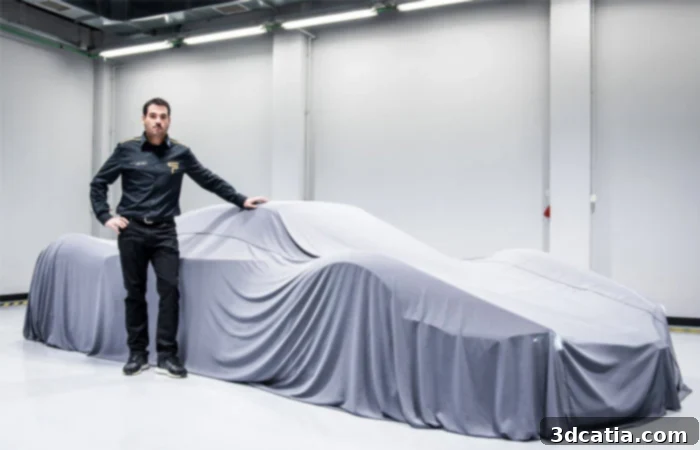
Spyros Panopoulos showcases the revolutionary Project Chaos ultracar, featuring advanced 3D printed components.
Revolutionizing Performance: Project Chaos Integrates Cutting-Edge 3D Printing Technology
At the heart of Project Chaos lies an engineering marvel: a sophisticated 4-litre V10 engine, boasting an impressive configuration of 20 injectors and 40 valves. This powerhouse is designed to be available in two distinct versions, each pushing the boundaries of material science and manufacturing. The first version is slated to feature state-of-the-art 3D printed titanium pistons and connecting rods. Titanium, renowned for its exceptional strength-to-weight ratio and high-temperature resistance, is an ideal material for components operating under extreme stress. These meticulously crafted parts will enable the engine to reach an astonishing speed of 11,000 RPM, a testament to their precision and durability. While the specific metal 3D printing process utilized hasn’t been officially confirmed, photographs released by Spyros Panopoulos strongly suggest the implementation of a Directed Energy Deposition (DED) technology. DED is particularly suited for creating high-density metal parts with complex internal structures, offering superior material properties and the ability to repair or modify components, making it a fitting choice for such a high-stakes application.
The second iteration of Project Chaos takes material innovation even further, intending to incorporate connecting rods made from advanced carbon fibre, complemented by pistons 3D printed with a specialized ceramic material. This ceramic composite is described by Spyros Panopoulos as incredibly strong, exceptionally light, and remarkably hard—qualities that were historically sought after for demanding aerospace applications, including components used in space shuttles. The use of carbon fibre for connecting rods further reduces reciprocating mass, allowing the engine to rev higher and faster with greater efficiency. Combining these advanced materials through additive manufacturing allows for an unprecedented level of material optimization, where each component is designed not only for maximum performance but also for minimum weight. This meticulous approach to material selection and fabrication is pivotal in achieving the ultracar’s ambitious performance targets, ensuring that every ounce of the 3,000 horsepower is translated into breathtaking acceleration and blistering top speeds, placing Project Chaos in an elite category of automotive engineering marvels.
The Power of “Anadiaplasi”: Generative Design Fueling Extreme Performance
Spyros Panopoulos’s expertise extends beyond just integrating existing advanced technologies; he is also a pioneer in generative design, a revolutionary approach that allows for the creation of incredibly complex components with optimal performance and minimal material usage. His deep understanding of this field has reportedly led him to develop his own unique design methodology, which he calls “anadiaplasi.” This innovative process dictates that a component’s form is organically derived and optimized based on the precise forces acting upon it. Unlike traditional design, where engineers iteratively refine shapes, “anadiaplasi” leverages computational power to generate designs that intrinsically respond to functional requirements, resulting in structures that are inherently robust and efficient.
The practical outcome of “anadiaplasi” is the creation of highly organic, biomimetic shapes that often resemble structures found in nature. These designs are not only aesthetically striking but also fundamentally lighter and, in the long run, more cost-effective to produce due to significant material savings and optimized performance. For Project Chaos, this generative design philosophy is undoubtedly a cornerstone of its engineering prowess. By allowing components to evolve into their most efficient forms, Spyros Panopoulos has likely unlocked unprecedented levels of weight reduction and structural integrity, critical for an ultracar aiming to shatter speed records. To put its mind-bending performance into perspective, Project Chaos is theoretically capable of accelerating from 0 to 100 km/h in less than 2 seconds, and reaching an astonishing 400 km/h in approximately 7 seconds. These figures place it among the fastest accelerating vehicles ever conceived, illustrating the profound impact of combining advanced materials with intelligent, generatively designed structures. Such speeds are not merely about raw horsepower; they are a testament to the meticulous optimization of every single component, from the engine internals to the chassis, all working in perfect synergy.
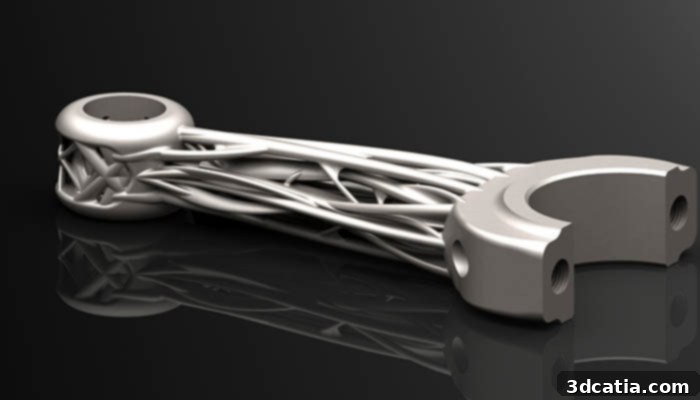
Generative design techniques, like Spyros Panopoulos’s “anadiaplasi,” enable the creation of ultra-lightweight and high-performance parts, optimized for extreme conditions. | Credits: Spyros Panopoulos
The Anticipated Reveal and Project Chaos’s Broader Impact
The automotive world eagerly awaits the complete revelation of Project Chaos, which is expected to take place at the prestigious Geneva Motor Show. This event will provide the first comprehensive look at the ultracar that has already generated immense buzz and speculation. The official unveiling will undoubtedly offer more intricate details about its design philosophy, interior features, and the full extent of its technological innovations. Until then, enthusiasts and industry experts alike are left to imagine the extraordinary blend of luxury, engineering prowess, and raw power hidden beneath its sleek, aerodynamic shell. Project Chaos is not merely another high-performance vehicle; it represents a significant leap forward in automotive design and manufacturing, showcasing how the intelligent application of additive manufacturing and generative design can redefine what is achievable on four wheels.
The implications of Project Chaos stretch far beyond the realm of niche hypercars. It serves as a powerful demonstration of the potential for additive manufacturing in the broader automotive industry. As the technology matures and becomes more accessible, the techniques pioneered by Spyros Panopoulos could influence mainstream vehicle production, leading to lighter, more fuel-efficient cars, and enabling greater customization for everyday consumers. Project Chaos pushes the boundaries not only of speed but also of sustainable engineering practices by optimizing material use and reducing waste through its generative design approach. It embodies the relentless pursuit of perfection, a philosophy that will undoubtedly inspire future generations of automotive designers and engineers. This audacious project challenges the status quo and proves that with visionary leadership and advanced technology, the future of mobility is not just faster, but also smarter and more innovative.
For those impatient to delve deeper into the enigma that is Project Chaos and its creator, Spyros Panopoulos, further information can be found on the official website HERE. What are your thoughts on this revolutionary ultracar and its groundbreaking use of 3D printing and generative design? We invite you to share your comments and predictions below or engage with us on our social media platforms. Join the conversation on our Facebook and Twitter pages! Don’t miss out on the latest advancements in automotive innovation and additive manufacturing; sign up for our free weekly Newsletter and have all the crucial 3D printing news delivered straight to your inbox!