
Unveiling “Sunken Romance”: A Porsche 911 Art Installation Forged by 3D Printing
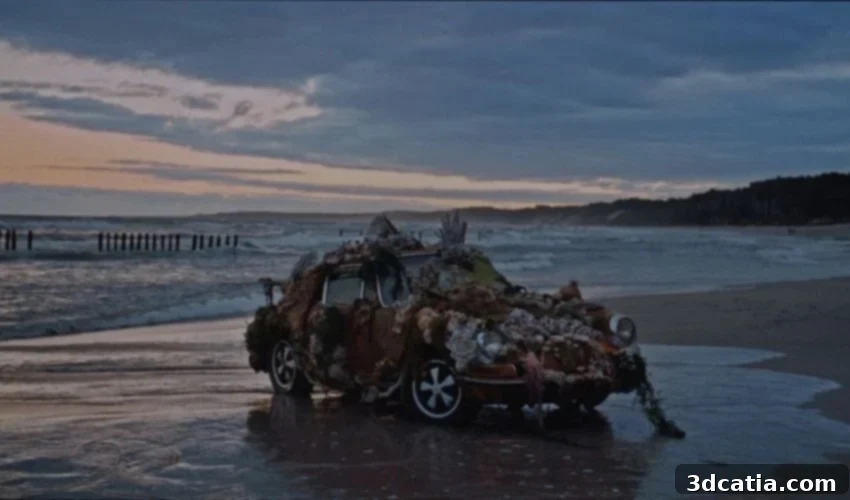
The Porsche 911 stands as an undisputed icon in the automotive world, revered by enthusiasts across generations, from its inception as a groundbreaking sports car to its status as a timeless classic. Its sleek lines, powerful engine, and rich heritage have cemented its place in history, making it far more than just a vehicle – it’s a symbol of engineering excellence and desirable luxury. Given this esteemed reputation, imagine the astonishment of beachgoers last summer in the picturesque Polish port city of Gdynia, nestled along the Baltic Sea coast, when what appeared to be a relic of a bygone era washed ashore. The object was undeniably a Porsche 911, yet its form was almost unrecognizable, a ghostly silhouette barely discernable beneath a thick, organic blanket. Its once vibrant red body, now faded to a muted hue, was heavily encrusted with layers of coral, swirling seaweed, and an array of other marine souvenirs, each telling a silent story of countless years spent beneath the waves. Initial reactions would naturally gravitate towards the dramatic discovery of a long-lost luxury car, perhaps the result of a shipwreck or a daring smuggling attempt gone awry. However, onlookers were soon reassured and delighted to discover that this was no tragic salvage operation of a forgotten automobile. Instead, this mesmerizing spectacle was a meticulously crafted art installation, a powerful statement piece where the cutting-edge technology of 3D printing played a pivotal and transformative role in its creation.
In an era marked by an ever-escalating global crisis of ocean pollution, where news of marine debris and submerged remnants of human activity becomes increasingly common, the prospect of a Porsche 911 being recovered from the sea might sadly not have been a colossal surprise. The world’s oceans are rapidly becoming vast repositories for our discarded waste, from microplastics to larger, more identifiable objects. Thus, the initial sight of such a valuable vehicle emerging from the depths could have easily been interpreted as another stark reminder of our environmental negligence. However, the intrigued public who gathered to marvel at this extraordinary exhibit had two visionary conceptual artists to thank for this thought-provoking creation: Ada Zielinska and Rafal Dominik. Their collaboration gave birth to “Sunken Romance,” an installation that transcended mere aesthetics, delving deep into themes of time, decay, and environmental degradation. The impetus behind this rather unusual yet profoundly impactful artwork was the prestigious annual art festival, Gdynia Design Days. For its latest iteration, the festival had chosen a timely and critical theme: the precarious state of our oceans and the undeniable specter of climate change. Zielinska and Dominik seized upon this theme with an ingenious idea: to present a tangible, visceral representation of what a car as iconic and valuable as a Porsche 911 might look like if it were left to the relentless, corrosive embrace of the Baltic Sea for several decades, perhaps even a century. Such an experiment, while conceptually powerful, would have been utterly unfeasible in practice, posing significant environmental risks and demanding an impractical amount of time. Consequently, the two artists ingeniously turned to advanced manufacturing techniques, recognizing the unparalleled potential of 3D printing to bring their ambitious vision to life without harming the actual environment or waiting for geological timescales.
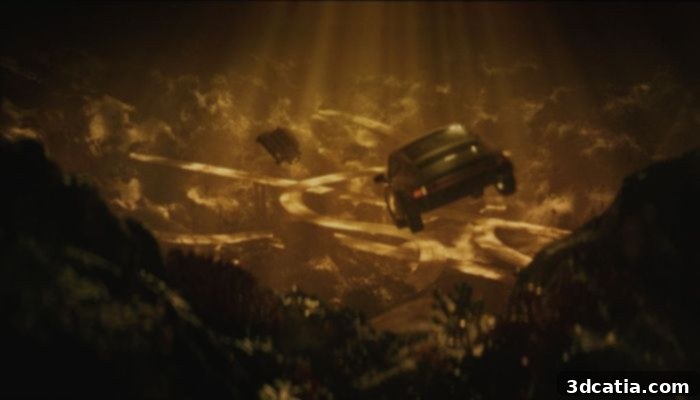
Photo Credits: Porsche
A Glimpse into the Future: The Simulated Decay of an Icon
The artistic endeavor, dubbed “Sunken Romance,” sought to capture the profound beauty and destructive power of nature’s reclaiming forces. Understanding the project’s profound message and its artistic merit, it became a significant challenge at the outset to secure a volunteer willing to donate an actual, valuable Porsche 911 for this unique artistic purpose. Such a commitment requires not only financial generosity but also a deep appreciation for conceptual art. However, after dedicated searching and persuasion, a suitable donor was found, providing a vintage 1973 model of the legendary car. This particular year adds another layer of historical resonance to the artwork, representing a golden era for the automobile. As is vividly captured in the accompanying photograph and other visual documentation, the car is presented as if it has been utterly transformed by its oceanic ordeal. It boasts an astonishingly realistic multitude of small shells, intricate corals, delicate seaweed strands, and various other simulated marine elements. These countless components, crucial for creating the illusion of deep-sea immersion, were meticulously designed and produced specifically for the “Sunken Romance” project. The magic behind this remarkable transformation lay squarely with 3D printing technology. After the individual elements were printed, they underwent a painstaking, two-week-long manual process, carefully glued and affixed to the entire surface of the car. This labor-intensive application ensured that every inch of the vehicle appeared organically encrusted, mimicking the slow, relentless work of the ocean’s ecosystem. While the artists have understandably chosen not to disclose granular details regarding the specific 3D printing technology employed, the exact materials used, or the particular 3D printer models involved, the sheer visual evidence speaks volumes about the capabilities of modern additive manufacturing in achieving such intricate and lifelike artistic effects.
The Indispensable Role of 3D Printing in “Sunken Romance”
The integral role that 3D printing played in the successful realization of this entire art installation is unequivocally clear. Without this advanced technology, the artists would have faced insurmountable hurdles. Recreating the nuanced textures, organic forms, and delicate structures of marine life – from the branching corals to the swirling patterns of seaweed and the varied shapes of barnacles and shells – would have been virtually impossible using traditional sculpting or fabrication methods, especially within a realistic timeframe and budget. 3D printing offered a degree of precision and customization that allowed Zielinska and Dominik to bring their vision of simulated decay to an unprecedented level of realism. Artists could digitally sculpt these elements with incredible detail, mimic the erosion patterns, and then reproduce them in quantity, ensuring consistency and accuracy across the entire vehicle’s surface. This process not only expedited the creation phase but also opened up new avenues for artistic expression, allowing for an iterative design process where elements could be refined and reprinted until perfection was achieved. The ability to produce bespoke, intricate components on demand transformed what could have been a logistical nightmare into an achievable artistic triumph. From concept to creation, 3D printing proved to be the cornerstone technology, enabling the artists to simulate decades of underwater exposure with captivating verisimilitude.
The profound impact of this sunken Porsche installation was immediately evident upon its unveiling to the public. The success of “Sunken Romance” in captivating its audience and provoking genuine surprise is compellingly confirmed by artist Ada Zielinska, who recounted the public’s initial reaction: “A lot of people were quite shocked and really thought it had been taken out of the sea. People were running towards it from all directions, pulling out their phones to take photos.” This powerful testimonial underscores the extraordinary realism achieved by the artists and the effective use of 3D printing. The installation’s ability to trick the eye and challenge perceptions speaks volumes about its artistic prowess. Beyond mere spectacle, this reaction signifies the artwork’s success in initiating a dialogue. By creating such a believable simulation, Zielinska and Dominik effectively circumvented the need for abstract discussions about environmental issues, instead presenting a tangible, emotional anchor for the conversation. The public’s immediate, visceral reaction highlights the effectiveness of art in raising awareness and fostering engagement with critical global challenges like ocean pollution and climate change. It transformed a theoretical problem into a visually arresting reality, making the abstract consequences of human actions tangible and deeply personal to each viewer. For those eager to delve deeper into the captivating narrative behind the “sunken” Porsche 911, further insights and details can be explored by clicking HERE, where Porsche’s official newsroom provides additional context. Alternatively, a more dynamic perspective of the installation and its creation can be enjoyed by watching the video provided below.
The Broader Impact: Art as an Environmental Catalyst
“Sunken Romance” transcends being merely an art installation; it functions as a powerful environmental catalyst, leveraging the emotional resonance of a beloved icon to highlight pressing ecological issues. The choice of a Porsche 911 is particularly brilliant, as its intrinsic value and cultural significance make its simulated decay all the more impactful. It forces viewers to confront the idea that even symbols of human achievement and luxury are not immune to the relentless forces of nature and the long-term consequences of environmental degradation. This piece effectively bridges the gap between scientific data and public perception, making the abstract threat of ocean pollution feel immediate and personal. It serves as a stark reminder that our actions today have profound implications for the world we leave behind, transforming once-pristine environments into sites of ecological decay. The artwork encourages reflection not just on the fate of luxury cars, but on the fragility of our planet’s ecosystems and the urgent need for sustainable practices. By presenting a future scenario in such a compelling way, Zielinska and Dominik have contributed significantly to the growing movement of environmental art, which uses creative expression to raise awareness and inspire action against ecological crises.
Moreover, this project showcases the incredible versatility and transformative potential of 3D printing within the artistic realm. Beyond industrial applications, 3D printing is democratizing art creation, allowing artists to realize complex visions that were once confined to the imagination or prohibitively expensive and time-consuming. “Sunken Romance” demonstrates how additive manufacturing can be used to create highly realistic, intricate details that mimic natural forms with astonishing accuracy. This technological capability empowers artists to push boundaries, explore new mediums, and bring their most ambitious conceptual ideas into tangible reality. It highlights a future where the synergy between art and technology will continue to grow, leading to innovative installations that not only delight the senses but also challenge perceptions and provoke crucial societal discussions. The precise replication of corals, shells, and marine flora, achieved through advanced manufacturing, underlines a new frontier for artistic expression, where the digital and physical worlds merge seamlessly to convey profound messages. This innovative approach ensures that art remains a relevant and powerful tool for commentary in an increasingly complex world.
What are your thoughts on this remarkable art installation and its ingenious application of 3D printing technology? Do you believe such immersive and realistic artistic representations are more effective in raising environmental awareness than traditional campaigns? We invite you to share your perspectives and engage in the conversation by leaving a comment below or by connecting with us on our vibrant social media platforms. You can find us on LinkedIn, Facebook, and Twitter. Don’t miss out on the latest advancements and breaking news from the world of additive manufacturing; be sure to sign up for our free weekly Newsletter here, delivering the freshest 3D printing news directly to your inbox! Additionally, explore a wealth of visual content, including interviews, demonstrations, and more exciting 3D printing projects, by visiting and subscribing to our comprehensive YouTube channel.
*Cover Photo Credits: Porsche