
Revolutionizing Racecar Design: How 3D Printing Powers Formula Student Innovation
Additive manufacturing, commonly known as 3D printing, is no longer a niche technology; it’s rapidly transforming various industries, and its impact on the automotive sector is becoming increasingly profound. This advanced manufacturing technique offers unparalleled advantages in terms of design freedom, rapid prototyping, and cost-efficiency. What’s particularly exciting is seeing this cutting-edge technology embraced not just by industry giants, but also by the next generation of engineers. Students worldwide are demonstrating a keen interest in leveraging 3D printing to push the boundaries of design, particularly when it comes to engineering the intricate components of their custom-built racecars.
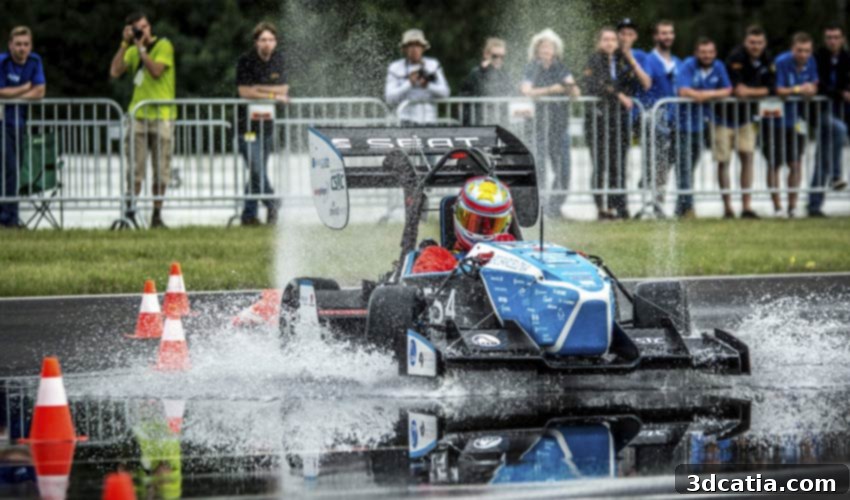
A prime example of this innovative spirit can be found at the annual Formula Student competition. This prestigious international event brings together ambitious university students from across the globe, challenging them to design, build, and rigorously test their own small-scale, single-seater racecars. It’s a demanding competition that serves as a crucible for engineering talent, pushing teams to innovate under tight deadlines and resource constraints. This year, one such team, a group of dedicated engineers from the Polytechnic University of Catalonia, garnered significant attention by strategically integrating 3D printing into the core of their car manufacturing process, yielding remarkable results.
The ETSEIB Motorsport team, comprised of 40 Spanish engineers, specifically harnessed the power of 3D printing for several critical components, most notably their racecar’s steering wheel. The ability to customize the steering wheel to precisely match various driving styles and ergonomic requirements was a game-changer. This approach not only allowed for optimal driver comfort and control but also introduced an unprecedented level of efficiency into their workflow. With participants typically having a mere nine months to complete their ambitious projects – from initial concept to a fully functional, tested racecar – time-saving methodologies are invaluable. The team’s focus on 3D printing, especially utilizing BCN3D Technologies’ advanced Fused Deposition Modeling (FDM) technology, proved to be a pivotal decision.
3D Printing: A Catalyst for Reducing Manufacturing Costs and Accelerating Development
BCN3D Technologies, a prominent Spanish manufacturer, stands behind a line of highly regarded desktop 3D printers, including the popular Sigma and its larger counterpart, the Sigmax. The ETSEIB Motorsport team’s decision to specifically choose the Sigmax was multifaceted, driven by its impressive capabilities that directly addressed the complex demands of racecar engineering. One of the primary attractions was its generous print volume, measuring 420 x 297 x 210 mm. This ample build space provided the flexibility to produce larger components in a single print, or multiple smaller parts simultaneously, significantly streamlining the manufacturing process.
Beyond sheer volume, the Sigmax’s unique “mirror mode” feature was particularly compelling for an automotive application. This innovative functionality enables the printer to produce two identical or symmetrical parts simultaneously, essentially doubling production efficiency for components that often come in pairs, such as left and right-hand side brackets, aerodynamic elements, or suspension components. This feature alone represented a substantial time-saver for the team. Furthermore, the availability of different sized nozzles for the Sigmax was another highly appreciated advantage. This versatility allowed the engineers to choose between faster prints for larger, less critical components using larger nozzles, or incredibly precise outputs for intricate, performance-critical parts with finer nozzles, optimizing both speed and accuracy as needed.
Streamlining Design and Manufacturing Workflows with Additive Manufacturing
The integration of 3D printing into the ETSEIB Motorsport team’s daily operations was preceded by thorough training in the use of the BCN3D Sigmax. Once proficient, the technology became an indispensable tool, profoundly impacting their design and manufacturing workflow. The engineers reported a dramatic acceleration in both the design iteration process and the production of finished parts. The ability to rapidly convert a Computer-Aided Design (CAD) model into a physical prototype meant that design concepts could be tested, evaluated, and refined at an unprecedented pace.
Furthermore, the team emphasized how the entire validation phase of their racecar components significantly improved. With 3D printing, engineers could quickly create and present functional prototypes directly from their CAD designs. This capability allowed for hands-on testing and evaluation of parts in real-world scenarios, identifying potential flaws or areas for improvement much earlier in the development cycle. This iterative process, moving swiftly from design to physical prototype and back to refined design, is a cornerstone of agile engineering, which 3D printing facilitates exceptionally well. A critical advantage highlighted by the team was the elimination of the need to rely on external suppliers for many of their custom parts. This self-sufficiency not only helped to drastically shorten manufacturing lead times, removing bottlenecks and delays, but also empowered the team to experiment with novel concepts and innovative ideas without the cost implications or logistical hurdles associated with outsourced production.
Mirror mode is particularly interesting for the automotive sector, enhancing production efficiency for symmetrical components.
From Prototypes to End-Use Parts: Tangible Savings and Performance Gains
The versatility of 3D printing extended beyond mere prototyping for the ETSEIB Motorsport team. They successfully leveraged the technology to directly produce numerous finished, end-use parts that were immediately mountable on their racecar. This included essential components such as custom brake line guides, cable ties designed for specific routing and securement, and the highly personalized steering wheel. The ability to create these functional parts in-house, on demand, not only ensured perfect fitment but also allowed for optimization in terms of weight and material usage, critical factors in competitive motorsport.
Pushing the boundaries further, the engineers even utilized their 3D printer to create intricate molds. These molds were then used in conjunction with traditional composite manufacturing techniques to fabricate high-performance carbon fiber parts. This hybrid approach allowed them to combine the design freedom and rapid iteration of 3D printing with the strength-to-weight ratio benefits of carbon fiber, enabling the creation of complex, lightweight structural components without incurring prohibitive costs or long lead times for traditional tooling. The financial impact of integrating 3D printing was substantial: the team reported saving thousands of euros throughout the development phase of their racecar. This significant cost reduction, coupled with the improved efficiency and design capabilities, led to an incredibly fast return on their investment, with the team seeing benefits from the very first month they began using the 3D printer.
This success story from the Formula Student competition vividly illustrates the transformative potential of additive manufacturing. It highlights how accessible, powerful 3D printing solutions like the BCN3D Sigmax can empower engineering teams, even those with limited resources and tight schedules, to achieve professional-grade results. The experience gained by the ETSEIB Motorsport students in utilizing this advanced technology will undoubtedly serve them well as they embark on future careers in the rapidly evolving automotive and manufacturing industries. Their innovative application of 3D printing sets a precedent for how future racecars, and indeed mainstream vehicles, will be designed, developed, and produced.
For those interested in delving deeper into the technical specifications and further case studies, additional information can be found on BCN3D Technologies’ official website. You can also gain more insight into their impressive work and the advantages of their technology by watching the video below, which offers a visual overview of their solutions in action.
What are your thoughts on the increasing use of 3D printing in racecar design and other demanding engineering projects? We’d love to hear your perspective! Let us know in a comment below or share your insights on our Facebook and Twitter pages! Don’t miss out on the latest advancements in additive manufacturing – sign up for our free weekly Newsletter here and get the most recent 3D printing news delivered straight to your inbox!