
Exploring the Cutting Edge: The Best 3D Printing and Additive Manufacturing Videos of 2020
As we reflect on the significant technological advancements and global shifts of 2020, the additive manufacturing industry undeniably played a pivotal role, adapting and innovating at an unprecedented pace. This past year showcased the remarkable versatility and potential of 3D printing across numerous sectors, from critical medical interventions during a global pandemic to groundbreaking developments in automotive, fashion, and even food production. The world witnessed how 3D printing transcended its traditional applications, emerging as a crucial tool for rapid prototyping, customized solutions, and sustainable manufacturing. This comprehensive review compiles the most impactful and inspiring 3D printing videos from 2020, presenting them in chronological order. These videos not only highlight significant achievements but also offer a glimpse into the future trajectory of additive manufacturing. Join us as we revisit these incredible feats of engineering and creativity that defined the year in 3D printing!
3D Printing at the Forefront: Mobilizing Against COVID-19
The year 2020 was profoundly shaped by the COVID-19 pandemic, and the 3D printing industry quickly emerged as a critical player in the global response. During the initial months of the health crisis, when supply chains faltered and essential medical equipment became scarce, the additive manufacturing community mobilized with unparalleled speed and solidarity. Countless initiatives sprang up worldwide, leveraging 3D printing technology to address urgent shortages of personal protective equipment (PPE) and other vital medical supplies. Volunteers, small businesses, and large corporations alike began producing 3D printed masks, protective visors, glasses, specialized doorknob adapters, and numerous other devices. The primary objective was clear: to safeguard frontline medical personnel and vulnerable populations most exposed to the virus. This collective effort underscored the agility and humanitarian spirit inherent in the additive manufacturing sector. The following video stands as a testament to this extraordinary period, showcasing the diverse and impactful applications of 3D printing in the monumental fight against COVID-19, demonstrating how this innovative technology offered tangible solutions in a time of dire need.
Preserving the Past: Rebuilding Culture with 3D Technologies
Beyond immediate crises, 2020 also highlighted the enduring power of 3D technologies in safeguarding humanity’s rich cultural heritage. Throughout history, invaluable artifacts and architectural wonders have succumbed to the ravages of time, natural disasters, conflicts, and environmental degradation. In mid-March, a captivating demonstration showed how three-dimensional metrology and additive manufacturing are revolutionizing cultural preservation and restoration efforts. Technology now plays an indispensable role in ensuring that our collective past endures for future generations. By utilizing advanced 3D scanners, intricate digital models of historical objects, archaeological finds, and damaged structures can be created with astonishing precision. These digital blueprints then serve as the foundation for physical reproductions, meticulously crafted using 3D printers. The resulting replicas are often indistinguishable from the originals in terms of detail and accuracy, allowing for conservation, study, and even public display without risking the original artifacts. The company Acciona, a leader in sustainable infrastructure solutions, provided a compelling explanation of this process, showcasing the immense potential of large-format additive manufacturing machines in the critical context of rebuilding and preserving global culture.
Bioprinting Breakthroughs: Advances in Functional Organ Production
One of the most awe-inspiring and potentially life-changing topics covered in additive manufacturing videos during 2020 was the remarkable progress in bioprinting functional human organs. The medical sector has been profoundly transformed by bioprinting technologies, which enable the creation of highly customized solutions for individual patients. This revolutionary method involves using a patient’s own stem cells to print tissues and organs, thereby allowing implants to seamlessly integrate with the subject’s body without the significant risk of rejection commonly associated with traditional organ transplants. This personalized approach holds immense promise for addressing the critical shortage of donor organs and for developing innovative treatments for various diseases. Many dedicated researchers and pioneering companies have committed themselves to advancing this field, focusing on creating complex organs and tissues through additive cellular manufacturing. These efforts are rapidly pushing the boundaries of personalized medicine, offering hope for countless individuals. The featured video vividly illustrates some of the most impactful bioprinting projects that have emerged, demonstrating how this cutting-edge technology is poised to revolutionize healthcare and enhance human well-being on an unprecedented scale.
JELL’s Strategic Investment: Leveraging Siemens Technology for Metal 3D Printing
JELL, a distinguished tool supplier with a decade of experience in metal additive manufacturing, showcased its strategic vision in 2020 by making significant investments in advanced 3D printing solutions. Known for its ability to rapidly validate concepts and deliver ready-to-use parts, JELL’s latest move involved integrating Concept Laser machines and adopting Siemens NX software. Siemens NX is a comprehensive CAD (Computer-Aided Design) solution that streamlines the entire product development process within a single, unified environment. This strategic shift eliminates the need for cumbersome data transfers between disparate software platforms, a common bottleneck in traditional design and manufacturing workflows. Designers at JELL can now efficiently model and simulate results directly within the same platform, leading to substantial time savings and improved productivity. Furthermore, JELL is actively employing sophisticated design techniques such as topological optimization, which allows for the creation of lightweight yet incredibly strong components by optimizing material distribution based on load requirements. This video offers an insightful look into how JELL leverages Siemens’ cutting-edge technology to push the boundaries of metal additive manufacturing, driving innovation and efficiency in its operations.
Photocentric’s Engineering Marvel: The 3D Printed Motorcycle
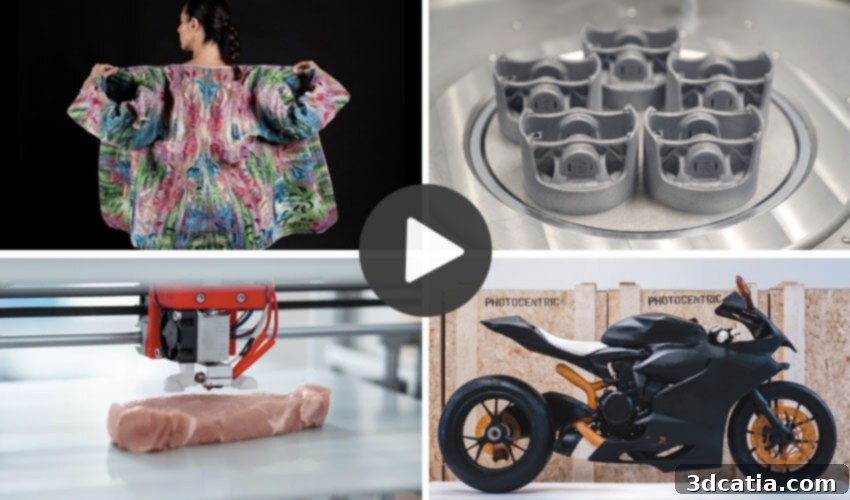
In early June 2020, Photocentric, a renowned specialist in 3D printing resins and LCD-based additive manufacturing, unveiled an astonishing achievement: a motorcycle largely produced using stereolithography (SLA) technology. This groundbreaking project demonstrated the immense capabilities of large-format resin 3D printing. Leveraging their powerful Liquid Crystal Maximus and Liquid Crystal Magna machines, which boast impressively large print volumes, Photocentric was able to design and fabricate numerous substantial components for the motorcycle. These parts included significant sections of the bodywork, complex structural elements, and even tires, all produced through additive manufacturing. The process involved meticulous design, precise printing, and a substantial post-processing effort to achieve the desired mechanical properties and aesthetic finish. The result was a visually captivating and structurally sound motorcycle, a testament to the potential of resin-based 3D printing for producing large, intricate, and functional objects. This video provides a fascinating glimpse into the innovative journey behind Photocentric’s 3D printed motorcycle, showcasing the convergence of advanced materials, cutting-edge technology, and expert craftsmanship.
BMW Accelerates Innovation: The Additive Manufacturing Center
Mid-June 2020 marked a significant milestone for the automotive industry with the grand opening of BMW’s state-of-the-art Additive Manufacturing Campus. This substantial investment, totaling 15 million euros, solidifies BMW’s commitment to integrating advanced 3D printing into its core manufacturing processes and research initiatives. The facility is designed to be a hub for both the rapid production of prototypes and the efficient manufacturing of serial production parts. It houses an impressive array of industrial 3D printers from leading manufacturers such as SLM Solutions, EOS, and Carbon, showcasing BMW’s multi-technology approach to additive manufacturing. Beyond production, a core focus of the center is dedicated to intensive research and development (R&D) in existing additive technologies, alongside the exploration and adoption of novel printing methods and materials. This strategic investment is poised to significantly enhance BMW’s capabilities in additive manufacturing, allowing the group to develop unparalleled expertise, accelerate vehicle development cycles, and ultimately emerge as a dominant leader in the application of 3D printing within the competitive automotive market. The center embodies BMW’s vision for a future driven by innovation and precision engineering.
The Future of Food: The 3D Printed Meat Revolution
Among the many innovative additive manufacturing solutions showcased in 2020, one of the most surprising and impactful was undoubtedly the emergence of 3D printed meat. This cutting-edge technology presents a compelling alternative to traditional livestock rearing, offering a sustainable and ethical solution to the negative environmental and ethical consequences associated with conventional meat production. As global populations grow and demand for protein rises, the need for innovative food solutions becomes ever more pressing. 3D printed meat addresses these challenges by creating plant-based or cultured meat products that closely replicate the sensory experience of conventional meat. Several pioneering companies have already launched, utilizing advanced 3D printing methods to create these next-generation food items. A prime example is Redefine Meat, which introduced “The Alt-Steak” in 2020. This revolutionary plant-based meat product is meticulously engineered to reproduce the texture, taste, and appearance of a beef fillet, offering a realistic and satisfying culinary experience without animal products. Crucially, Redefine Meat’s technology enables high-volume production at a low cost, paving the way for large-scale market adoption and making sustainable protein accessible to a wider audience. This video explores the burgeoning field of 3D printed meat, highlighting its potential to transform our food systems and pave the way for a more sustainable future.
Porsche’s Performance Edge: Integrating Additive Manufacturing into Engine Design
In a testament to the transformative power of additive manufacturing, German luxury car manufacturer Porsche announced in July 2020 its successful integration of 3D printing into the design and creation of pistons for its high-performance Porsche 911 GT2 RS engine. This bold move underscores the automotive giant’s commitment to pushing the boundaries of engineering and performance. To achieve this, Porsche partnered with Trumpf, a leading manufacturer of metal 3D printing solutions. The sophisticated machinery employed utilizes a laser powder bed fusion process, precisely melting fine aluminum powder layer by layer to construct the complex piston geometry. Porsche engineers highlighted that 3D printing enabled the design of pistons that are not only 10% lighter than their conventionally manufactured counterparts but also equally, if not more, resistant and durable. Crucially, the technology allowed for the incorporation of an intricate, internal cooling duct within the piston structure—a feature that would have been impossible to achieve with traditional manufacturing methods. This innovative cooling duct significantly lowers the temperature within the piston by approximately 20°C, directly enhancing engine safety, prolonging component lifespan, and substantially boosting the overall performance level of the iconic engine. This video demonstrates how Porsche is leveraging additive manufacturing to gain a competitive edge in high-performance automotive engineering.
SEAT’s Innovation Hub: The Advanced Additive Manufacturing Center
Further solidifying the automotive industry’s embrace of 3D printing, Spanish car manufacturer SEAT unveiled its new Advanced Additive Manufacturing Center in 2020, representing a significant investment in cutting-edge production capabilities. This modern facility is equipped with a diverse fleet of nine industrial 3D printers, showcasing SEAT’s comprehensive approach to leveraging additive manufacturing. The lineup includes a powerful HP Multi Jet Fusion system, an advanced Selective Laser Sintering (SLS) machine, six versatile FDM (Fused Deposition Modeling) 3D printers, and a high-precision PolyJet solution. This broad spectrum of technologies enables SEAT to produce parts with an extraordinary level of detail, achieve critical mechanical properties, and integrate highly advanced functionalities into its components. The machines operate continuously, 24 hours a day, maintaining an impressive average production rate of 50 parts per day. SEAT emphasizes that approximately 80% of these parts are prototypes, crucial for accelerating the development cycles of new vehicles and refining designs more rapidly. The remaining 20% comprises specialized tools, jigs, fixtures, and customization components, highlighting the flexibility and utility of 3D printing in supporting various aspects of vehicle manufacturing and personalization. This video provides an inside look at SEAT’s innovative center, demonstrating how they are driving efficiency and innovation in automotive production.
Fashion Forward: Ganit Goldstein and Stratasys Pioneer 3D Printed Textiles
The year 2020 also saw significant strides in the application of 3D printing within the dynamic world of fashion. A standout collaboration emerged between visionary designer Ganit Goldstein and the multinational additive manufacturing giant, Stratasys. Together, they crafted a breathtaking custom collection that seamlessly blended traditional handcrafted methods with revolutionary direct 3D printing on fabric. Goldstein’s innovative technique involved developing a Japanese-inspired dress, among other pieces, where digital designs were directly applied onto durable textiles using Stratasys’s advanced PolyJet technology. This process allowed for the creation of intricate patterns and structures in a vibrant array of colors, resulting in a mesmerizing, bright effect when the garment is in motion. The project was a key component of Re-FREAM, a collaborative research initiative generously funded by the European Union, aimed at exploring the intersection of art, design, and cutting-edge technology. This unique partnership not only pushed the boundaries of textile design but also demonstrated the immense potential of 3D printing to revolutionize fashion manufacturing, offering unprecedented levels of customization, creativity, and material efficiency. This video beautifully showcases Goldstein’s original designs and the pioneering spirit of this collaboration.
Redefining Textiles: 3D Printing by Under-extrusion (DefeXtiles)
In a fascinating display of ingenuity, late October 2020 brought forth a groundbreaking development from Jack Forman, a PhD student at MIT. Forman ingeniously transformed one of the most common challenges in FDM (Fused Deposition Modeling) 3D printing—under-extrusion—into a novel manufacturing technique for textiles. Under-extrusion, typically considered a defect, occurs when the 3D printer fails to extrude an adequate amount of filament, leading to gaps or thinner layers in the printed part. Instead of correcting this issue, Forman learned to precisely control this “defect” to intentionally design and create what he termed “DefeXtiles.” This innovative method produces a tulle-like fabric with controllable porosity and elasticity, capable of forming simple or highly complex shapes and geometries. By manipulating the degree of under-extrusion, Forman was able to craft interactive models, elegant skirts, delicate lace pieces, and even a functional badminton shuttlecock. This work represents a paradigm shift, demonstrating how a perceived limitation in 3D printing can be harnessed to unlock entirely new material properties and applications, particularly in the realm of soft robotics, wearable technology, and customized apparel. This video delves into the specifics of DefeXtiles, exploring its unique properties and the expansive possibilities it offers for future textile and product design.
Microrobots Revolutionize Medicine: Precision Drug Delivery
Our final spotlight for the best 3D printing videos of 2020 illuminates an incredible advancement in the medical sector: additively manufactured microrobots. These microscopic devices represent a monumental leap forward in targeted drug delivery and minimally invasive therapies. The longstanding goal for many researchers has been to develop devices small enough to navigate the intricate network of human blood vessels, precisely delivering medicines to specific, diseased parts of the body while minimizing side effects on healthy tissues. In a significant breakthrough, scientists at the esteemed Swiss Federal Institute of Technology (ETH) in Zurich finally achieved this long-sought objective. Their success stems from a sophisticated new manufacturing technique, significantly enhanced by the expertise of Professor Salvador Pané, who has dedicated several years to perfecting stereolithography for micrometric applications. This high-precision 3D printing technique is uniquely capable of producing complex objects at an incredibly small scale, down to the micrometric level. What makes this achievement even more remarkable is the scientists’ ability to intricately print both metal and plastic materials with such unparalleled precision that the two materials intertwine as closely and robustly as links in a chain, creating robust yet flexible microrobots. This video offers an astonishing look into these tiny marvels, showcasing their potential to revolutionize diagnostics and therapeutic interventions in medicine.
The year 2020, despite its unprecedented challenges, proved to be a vibrant and innovative period for 3D printing and additive manufacturing. From the rapid deployment of medical supplies in response to the pandemic to revolutionary breakthroughs in bioprinting, sustainable food production, high-performance automotive engineering, and intricate fashion design, the industry demonstrated its incredible adaptability and immense potential. The videos highlighted above are merely a snapshot of the remarkable ingenuity and dedication that characterized the additive manufacturing community throughout the year. They serve as a powerful reminder of how technology, when applied with vision and purpose, can address critical global needs, preserve culture, and push the boundaries of what is possible. As we look ahead, the trajectory set in 2020 promises an even more exciting future for 3D printing, with continued innovations poised to reshape industries and improve lives worldwide. What do you think of our selection of the best 3D printing videos of 2020? Let us know in a comment below or on our Facebook and Twitter pages! Don’t miss out on the latest advancements; sign up for our free weekly Newsletter here and get the most recent 3D printing news delivered straight to your inbox!