
3D Printing and Augmented Reality: Revolutionizing Immersive Learning in the Modern Classroom
In an era defined by rapid technological advancement, educators worldwide are continually seeking innovative methodologies to captivate students and transform traditional learning environments. The challenge lies in moving beyond rote memorization and passive consumption of information towards dynamic, engaging experiences that foster deeper understanding and critical thinking. Against this backdrop, the integration of cutting-edge technologies like 3D printing and augmented reality (AR) is emerging as a powerful solution, offering unprecedented opportunities to create immersive and interactive educational content. This revolutionary approach is precisely what lies at the heart of a pioneering new workbook project, a collaboration between Switzerland’s leading selective laser sintering (SLS) 3D printer manufacturer, Sintratec, and the esteemed Zurich University of the Arts (ZHdK).
Sintratec, renowned for its precision SLS 3D printing systems, partnered with Jonas Christen, a dedicated research associate from ZHdK’s Knowledge Visualization group. Their shared vision was to develop educational materials that transcend the limitations of two-dimensional learning, creating a multi-sensory experience that brings complex subjects to life. The result is an innovative system combining physical, 3D-printed artifacts with interactive AR overlays, designed to provide students with an unparalleled, hands-on learning journey within the classroom.
The Synergy of Analog and Digital: A Hybrid Learning Approach
While augmented reality offers immense potential for engaging students, there’s also a recognized risk: the sheer novelty and “wow” factor of AR can sometimes distract students from the actual learning content. Jonas Christen astutely addressed this concern, explaining, “A pure AR application bears the risk that the students are distracted by the fascination for the medium and absorb little information. That’s why the AR technology is combined with an analog workbook.” This statement underscores a critical pedagogical insight: true learning often benefits from a balance between digital immersion and tangible interaction. By grounding the AR experience within a physical workbook, students remain anchored to the learning material, using the digital enhancements as supplementary tools rather than primary sources of distraction.
This hybrid model leverages the strengths of both worlds. The analog workbook provides a familiar, structured framework for note-taking, problem-solving, and reflective thinking. Simultaneously, the AR component adds layers of interactive information, allowing students to visualize concepts, manipulate virtual objects, and explore complex processes in a dynamic, three-dimensional space. While similar hybrid AR teaching tools exist in the market, the introduction of custom 3D-printed supplements offers a distinct advantage. These custom physical models, integral to the learning experience, can significantly reduce the overall cost of acquiring such advanced teaching tools, making them more accessible to a wider range of educational institutions. This cost-effectiveness, combined with the unparalleled detail and tactile feedback offered by 3D prints, positions this project as a leader in educational technology innovation.
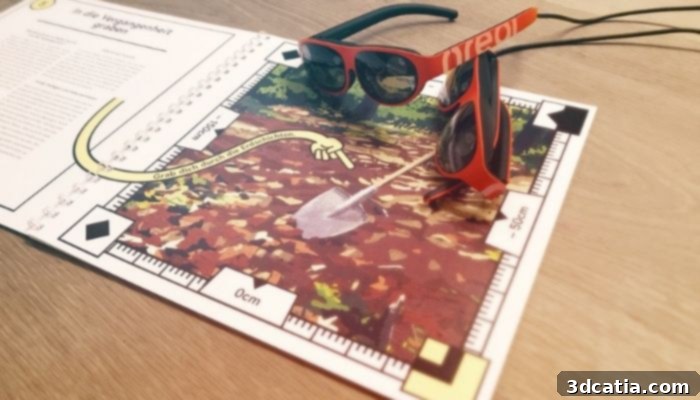
The AR supplemented workbook teaches students the digital workflow of modern archeology.
Bringing Ancient History to Life: The 3D-Printed Archeological Replica
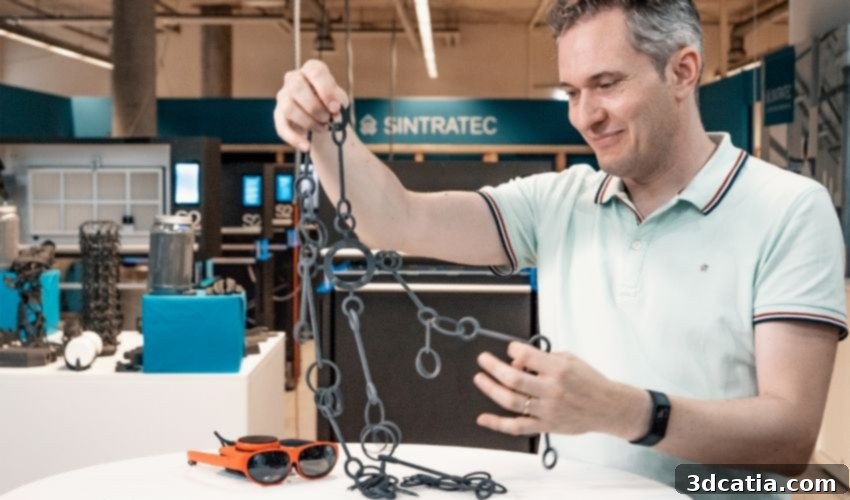
The initial focus of this groundbreaking workbook project centers on a specific and fascinating subject: modern archeology. To provide students with a truly authentic learning experience, the project utilizes a replica of an ancient bronze archeological object – a “chain divider.” This intricate artifact, believed to have served as an ornament for horses, dates back to approximately 400 BC and was unearthed in 2014 at Uetliberg mountain, near Zurich. Replicating such a complex historical item with absolute fidelity was crucial for the project’s educational goals, requiring a technology capable of extreme precision and detail.
For this critical task, the Sintratec S2 system, employing selective laser sintering (SLS) technology, proved to be the ideal choice. The replica for the workbook was meticulously 3D-printed using PA12 nylon material. This choice was deliberate, as PA12 nylon is known for its excellent mechanical properties, durability, and ability to capture intricate details, making it perfect for creating robust and realistic tactile models. Jonas Christen elaborated on the technical advantages: “The Sintratec technology allows us to reproduce the extremely fine aspects of the object in great detail. The accuracy, robustness and haptics of SLS printing were important factors for us.” The exceptional detail and tactile quality of the SLS-printed replica are paramount, as they enable students to physically interact with an object that feels remarkably close to the original artifact, providing a tangible connection to ancient history.
Mimicking the real-world archeological process, after the replica is printed, it undergoes essential post-processing. This includes careful depowdering within the Sintratec S2 system, a crucial step to remove excess PA12 powder and reveal the final, intricately detailed form of the artifact. This practical aspect further enriches the learning experience, offering a glimpse into the meticulous work involved in preparing archeological finds for study and exhibition. The ability to produce such high-fidelity replicas at a potentially lower cost and higher speed than traditional molding methods makes 3D printing, especially SLS, an invaluable tool for educational institutions and museums.
An Immersive Journey into Archeology with AR Glasses
The true power of this project unfolds as students don AR glasses. Through these lenses, the physical 3D-printed replica on their workbook transforms into a portal to the past. Students can experience each critical step of the archeological process in a vivid, three-dimensional animated sequence directly superimposed onto the surface of the workbook and the artifact. This immersive visualization allows them to gain a profound sense of the archaeologist’s methodical approach, from initial site survey and excavation techniques to artifact recovery, documentation, and preservation.
Instead of merely reading about an historical discovery, students actively witness its uncovering and analysis. The AR experience can guide them through virtual stratigraphic layers, highlight intricate details of the artifact’s construction, and even animate its possible use by ancient civilizations. This highly complex ancient artifact, the “chain divider,” which dates back over two millennia, is no longer just a static image or a description in a textbook. It becomes a dynamic learning tool, allowing students to virtually interact with its history and significance. This hands-on learning experience is made possible thanks to the extraordinary technological advances of 3D printing, particularly the unparalleled fine detail and material robustness achievable with SLS technology.
Jonas Christen further emphasized the dual benefit of this approach: “The 3D-printed reconstruction serves as a visual object for the students to experience the dimensions of the find, but can also provide archaeologists with new insights about its possible use.” This highlights that the project is not just about teaching students; it also offers a valuable tool for researchers. The ability to create accurate, durable replicas allows archaeologists to handle and study artifacts without risking damage to priceless originals, and to explore hypotheses about their function in a tangible way. This innovative use of technology bridges the gap between educational outreach and scientific research, creating a symbiotic relationship that benefits both learners and experts. The journey to explore this project further is available HERE.
Transforming Education: Broader Implications and Future Prospects
The Sintratec and ZHdK collaboration represents a significant leap forward in educational technology, demonstrating how additive manufacturing and augmented reality can converge to create profoundly effective learning tools. The implications extend far beyond archeology. Imagine biology students dissecting virtual organs on 3D-printed anatomical models, or engineering students visualizing complex mechanical processes directly on scaled prototypes. History lessons could transport students to ancient battlefields or allow them to interact with replicas of historical documents. This hybrid approach has the potential to democratize access to rare and fragile artifacts, making them accessible for study without the need for physical proximity or extensive conservation efforts.
Moreover, this methodology fosters the development of crucial 21st-century skills. Students are not just passively receiving information; they are actively engaging with it, developing digital literacy, problem-solving capabilities, and critical thinking. The tactile experience of handling a 3D-printed object, combined with the visual and interactive elements of AR, caters to diverse learning styles, making complex concepts more understandable and memorable for a broader range of students. It reduces the monotony often associated with traditional academic subjects by injecting an element of discovery and exploration into every lesson.
As educational institutions continue to seek methods to enhance student engagement and outcomes, projects like this point towards a future where classrooms are dynamic, interactive spaces. The marriage of tangible 3D prints and immersive AR experiences offers a powerful framework for experiential learning, preparing students not just with knowledge, but with the skills to navigate an increasingly technological world. This innovative partnership between Sintratec and ZHdK is not merely about teaching archeology; it’s about pioneering a new pedagogical paradigm that could redefine how we learn and teach across disciplines.
What are your thoughts on this innovative augmented reality project from Sintratec and ZHdK? We invite you to share your insights and predictions for the future of educational technology in the comments section below. Engage with us and join the conversation on our Linkedin, Facebook, and Twitter pages! Don’t miss out on the latest advancements and news in the additive manufacturing industry; sign up for our free weekly Newsletter here to receive direct updates to your inbox. You can also explore all our compelling videos on our YouTube channel for more in-depth content.
Photo Credits: Sintratec