
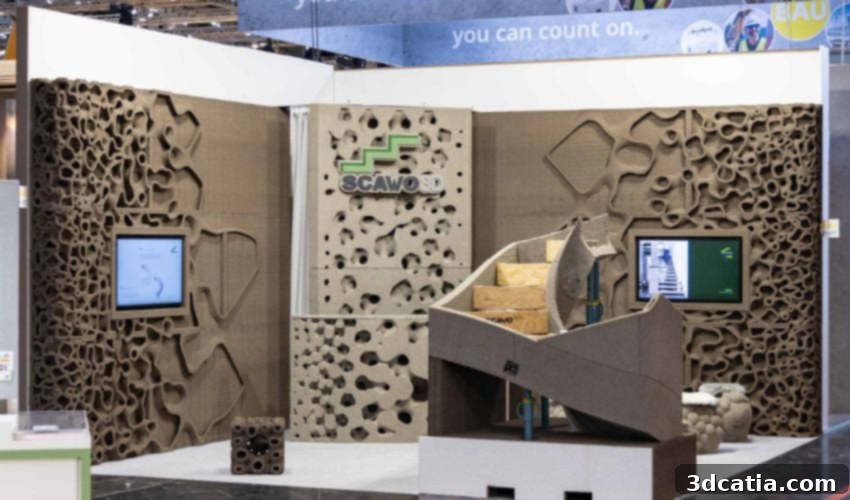
Scawo3D: Pioneering High-Strength, Geometrically Complex 3D Concrete Printing with Selective Paste Intrusion
The landscape of construction is undergoing a profound transformation, with 3D printed houses at the forefront of this innovation. While conventional 3D concrete printing often relies on extrusion methods, where robotic systems meticulously build structures layer by layer, one company is challenging the norm with a distinct and powerful approach. Scawo3D, based in Sarntal, South Tyrol, Italy, has introduced its groundbreaking Selective Paste Intrusion (SPI) technology, a powder bed process that is set to redefine the possibilities of concrete component manufacturing. Unlike traditional methods, Scawo3D’s process yields isotropic concrete with exceptional strength and inherent weather resistance, allowing for the realization of virtually limitless and complex geometries at surprisingly manageable production costs. We delved deeper into this innovative methodology through an exclusive interview with Philip Schneider from Scawo3D.
3DN: Could you briefly introduce yourself and tell us about your role at Scawo3D?
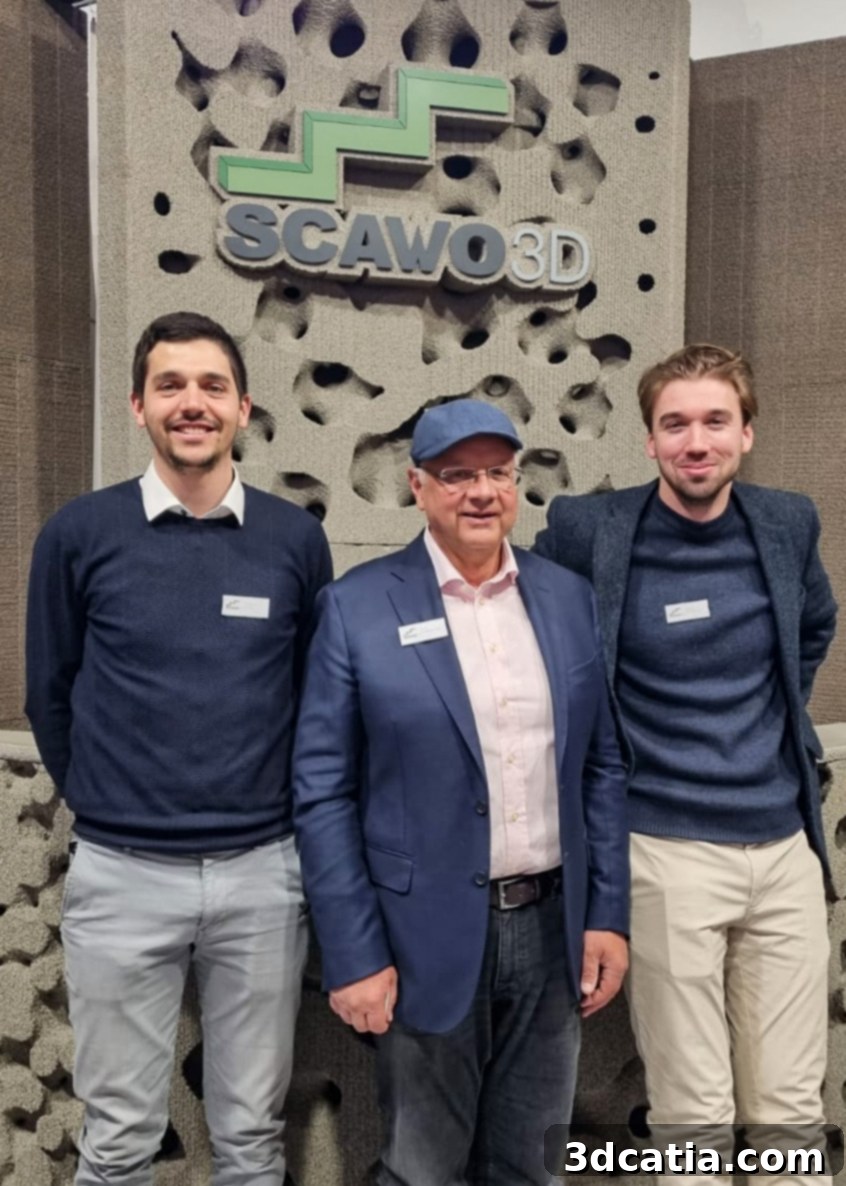
Scawo3D team (from left to right): Andreas Spiess (machine programming), Kurt Wohlgemuth (company owner, inventor) and Philip Schneider (architecture & computational design) (photo credits: Scawo3D)
My name is Philip Schneider. My academic background is in architecture, with a specialized focus on computational design and digital fabrication, which I pursued at the Technical University of Munich. My journey into concrete 3D printing and ultimately to Scawo3D began in early 2022. During my studies, I was involved in the design of a 3D-printed pedestrian bridge, a project that Scawo3D helped bring to life. This hands-on experience solidified my interest in the field.
Scawo3D is recognized as the innovator behind the world’s first print head specifically designed for cement paste, integral to our novel concrete 3D printing process: Selective Paste Intrusion, or SPI. We are not only the developers and sole manufacturers of this advanced print head but also a leading service provider in concrete 3D printing. Our commitment is to continuous development and optimization of the SPI process. This dedication ensures that we can equip our customers with the most effective machines and enhance the accessibility and affordability of our services.
Within Scawo3D, my responsibilities span architecture and computational design. This involves exploring and developing potential applications of the SPI process within the construction industry. The unique capability of our process to realize highly complex geometries in concrete places significant demands on the software used for both modeling and planning. It’s my role to ensure we utilize sophisticated software for intricate designs and to lead the development of proprietary solutions for specific applications. For instance, we are currently collaborating with Skeno GbR and Timo Harboe ApS to develop a specialized plugin for Rhinoceros and Grasshopper, specifically tailored for the planning and execution of complex free-form staircases. This work is critical to pushing the boundaries of what’s possible in architectural concrete design.
3DN: What was the motivation behind Scawo3D’s decision to implement 3D printing technology?
Scawo’s origins trace back to a patented process for manufacturing CNC-milled formwork from EPS (Expanded Polystyrene) for reinforced concrete stairs. This method offered significant advantages in creating custom designs. However, over time, a crucial limitation emerged: the inadequate fire protection rating of EPS material severely restricted its widespread adoption in the construction sector. This challenge prompted the company to seek an alternative, leading to the pivotal decision to develop a 3D printing process capable of producing concrete components that met the highest fire protection standards. This strategic shift marked the birth of Scawo3D.
Over the subsequent decade, our team dedicated itself to research and development. The initial breakthrough was the Selective Cement Activation (SCA) process, a precursor technology that also utilized a powder bed, where a dry mortar mixture was selectively activated. While innovative, SCA’s material properties proved insufficient for load-bearing applications, which are fundamental in structural concrete. This realization spurred further advancements, ultimately leading to the refinement and establishment of the SPI process. Production utilizing SPI technology commenced in mid-2022. Throughout this entire development phase, stairs served as our primary test object. The rationale was simple yet profound: stairs inherently combine intricate geometries with stringent static and load-bearing requirements. If our process could reliably produce complex, structurally sound stairs, it could undoubtedly be applied to a myriad of other architectural and construction elements. We are pleased to confirm that this hypothesis proved correct, showcasing the versatility and robustness of our SPI technology.
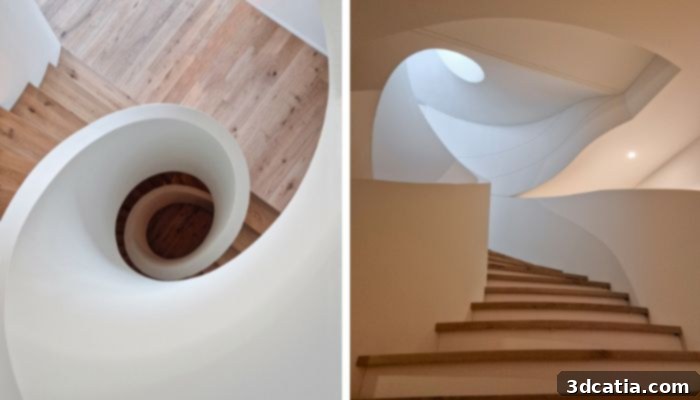
Completed staircase (photo credits: Tschanen/André Wäspi).
3DN: Could you explain your Selective Paste Intrusion (SPI) process in more detail?
Selective Paste Intrusion (SPI) represents a revolutionary paradigm in 3D concrete printing, fundamentally differing from the more commonly known extrusion-based 3D printing, which is often employed directly on construction sites. Our system operates as a stationary, factory-based solution utilizing a sophisticated powder bed. The core principle of SPI mirrors that of other powder bed additive manufacturing processes, such as the Selective Laser Sintering (SLS) technique used for plastics. The critical distinction lies in our material: the powder bed is filled with carefully selected aggregates, and instead of a polymer, we print with a specialized concrete or mortar paste.
The printing process itself is meticulously executed layer by layer. Each new layer begins with the application of loose aggregate, followed by the precise deposition of cement paste. This cement paste, formulated from cement, water, and a small amount of superplasticizer for flow control, is selectively applied by our innovative print head, which features hundreds of tiny nozzles. These nozzles bind the aggregate locally, forming the solid structure of the desired component. After the paste is applied, a fresh layer of loose aggregate is spread, and the cycle repeats until the entire print is complete. A key advantage of this method is that the surrounding loose aggregate serves a dual purpose: it acts as a perfect, self-supporting formwork for the printed parts during the entire printing and curing process. This inherent support mechanism allows us to produce virtually any geometry without the typical limitations imposed by overhang angles or complex internal cavities that challenge extrusion-based systems.
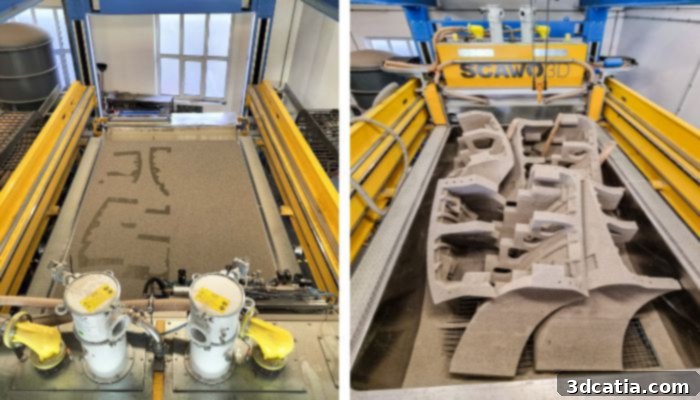
Left: The 4 x 2.5 x 1.5 m pressure bed during the production of the staircase formwork. Right: Formwork elements for a 3.5 m high flight of stairs (photo credits: Scawo3D)
Our large-scale printer boasts an impressive construction chamber capacity of 15 cubic meters, with precise dimensions of 4 x 2.5 x 1.5 meters. It currently operates with a layer height of 3 millimeters. This combination of a fine layer height and the high density of nozzles in our print head allows us to achieve an exceptionally fine resolution of 3 millimeters for construction-grade concrete components. Despite this high resolution, our production speed is remarkably efficient; we can complete a 15-cubic-meter print in approximately eight hours. Furthermore, ongoing machine optimization initiatives are projected to reduce this printing time to a mere four hours in the near future, significantly enhancing our throughput.
The resulting material from the SPI process exhibits properties comparable to standardized concrete, achieving strength classes ranging from C25/30 to C60/75. This robust performance allows our technology to be applied across a broad spectrum of applications. The high compressive strength ensures that SPI-printed parts can fulfill load-bearing functions, even in outdoor environments exposed to varying weather conditions in our latitudes. This opens up possibilities for components such as structural walls, intricate vaulted ceilings, and decorative yet functional facades. Beyond structural elements, the versatility of SPI also extends to producing a wide array of objects for both indoor and outdoor use, including custom garden furniture, elaborate sculptures, and bespoke architectural features, limited only by imagination.
3DN: What are the distinct advantages of inkjet concrete printing, such as SPI, compared to extrusion-based methods?
One of the most significant differentiators between our SPI process and traditional extrusion 3D concrete printing lies in the overall complexity – or rather, the relative simplicity – of our approach. This advantage stems partly from our commitment to factory-based manufacturing, at least for the foreseeable future, as opposed to on-site construction. While some might view factory production as a constraint, it offers undeniable benefits: we operate under rigorously controlled and constant environmental conditions. This eliminates the need to adapt machinery or material formulations to fluctuating temperatures, humidity, or other unpredictable site-specific variables. Consequently, the concrete material we use is remarkably simple, comprising only cement, water, and a minimal amount of superplasticizer; it avoids the necessity for complex chemical additives often required in extrusion printing to manage cure times in varying conditions. The consistent, short time interval between the deposition of each layer – just a few seconds – means that the inherent open time of conventional cement is perfectly adequate for our process, further simplifying the material composition.
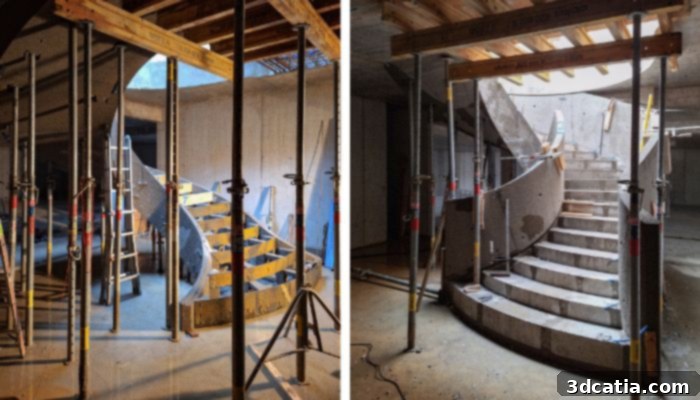
Assembly of the staircase formwork on the construction site (photo credits: Skeno/Scawo3D)
This consistent layer-to-layer timing introduces another crucial advantage: predictability in production. Regardless of the complexity of the geometry being printed or how densely our build chamber is utilized, the printing time for a 15-cubic-meter volume remains constant. This consistency allows us to effectively manage and control pricing based on the capacity utilization of our build chambers, offering greater transparency and efficiency in cost estimation for clients. Furthermore, the factory-based production model inherently makes SPI technology exceptionally well-suited for projects involving existing buildings or challenging construction sites. These locations often present difficult access or confined spaces, where the deployment of large gantry-style extrusion printers is impractical. With the SPI process, components can be prefabricated in manageable sizes, easily transported, and assembled on-site, eliminating the need for extensive on-site infrastructure for 3D printing. In essence, our “inkjet concrete printing” approach significantly liberates designers, providing unparalleled freedom to explore intricate forms and functions that were previously unfeasible with conventional or extrusion-based methods.
3DN: What have been the most impressive projects you have completed with 3D printing so far?
We’ve had the privilege of working on several groundbreaking projects that truly showcase the capabilities of SPI technology. Two stand out as particularly impressive achievements:
The first is “Bridge the Gap,” a collaborative effort with the Collaborative Research Center “Additive Manufacturing in Construction” (AMC TRR 277) and the Technical University of Munich. This project was a landmark, being the first to conclusively demonstrate the viability of concrete 3D printed via a powder bed process as a primary supporting structure. It manifested as a prototype for a pedestrian bridge, featuring load-bearing spans of 5 x 2.5 meters. Remarkably, this bridge was printed in 21 individual parts and then assembled using a dry-joining method – meaning no mortar or other compensating materials were used in the joints. The design ingeniously incorporated details for integrated tension elements, also without requiring a permanent bond. This innovative configuration allowed the entire bridge to be assembled within a single day and, crucially, to be assembled and dismantled multiple times without any damage or destruction to its constituent parts. “Bridge the Gap” serves as a powerful testament to efficient material utilization, leveraging concrete’s high compressive strength while circumventing its low tensile strength through clever design. Furthermore, by employing a single-origin material, the project champions principles of the circular economy, facilitating future recycling or downcycling efforts.
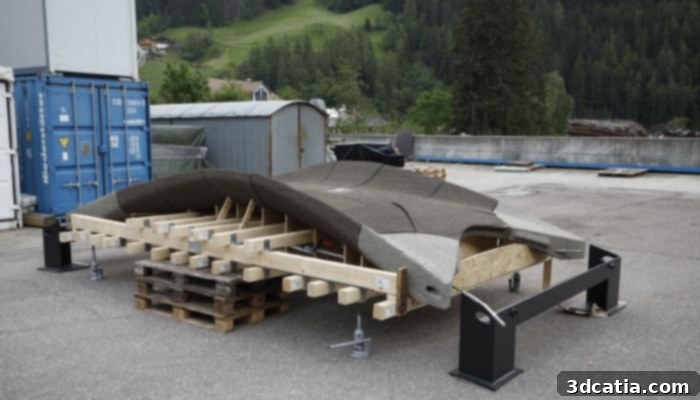
First assembly of the bridge on a specially developed substructure in Sarnthein (photo credits: AMC TRR 277 / Ema Krakovska)
Our second highlight is the H. staircase, which represents the largest staircase to date created using our 3D-printed formwork. This stunning free-form staircase features an elliptical floor plan, spanning over three meters in diameter across two floors. The Swiss construction company, Tschanen AG, approached us after realizing that traditional construction alternatives would far exceed their budget. Through seamless cooperation between the planners, the construction company, and Scawo3D as producers, this project unequivocally proved the adaptability and effectiveness of the SPI process for diverse and complex applications. A key benefit was the simplified logistics: rather than transporting a single, cumbersome prefabricated staircase, we supplied manageable, smaller parts. This not only eased transportation but also enabled rapid on-site assembly within just a few days. The efficiency was remarkable; while Scawo3D was still installing the first flight of stairs, Tschanen AG was already prepared and swiftly completed the installation of the second. Beyond structural and logistical advantages, the 3D-printed parts provided an excellent base for subsequent surface treatments. Plasterers could apply plaster directly to the formwork, eliminating the need for extensive leveling or preparation to correct major unevenness, thereby saving time and labor on site.
3DN: What significant opportunities does 3D printing offer to architecture, and what are the main challenges hindering its broader adoption?
Historically, concrete 3D printing processes faced considerable limitations, either struggling to realize all desired geometries or compromising material strength and weather resistance due to the inherent layer-by-layer structure or specific material compositions. With the SPI process, we have effectively overcome both of these critical issues. This breakthrough grants architects and designers unprecedented freedom of form during the design process, allowing components to be conceived not only with novel aesthetics but also with optimized structural properties. Consequently, concrete elements can now be statically optimized to a degree that was previously only achievable through exceptionally complex and labor-intensive traditional formwork. For these compelling reasons, I firmly believe that 3D printing, particularly with advanced methods like SPI, holds the transformative potential to ignite a revolution in architecture, drawing inspiration from and reinterpreting construction methods that have, perhaps, been overlooked or forgotten over time.
The synergistic interplay of superior material properties and boundless geometric freedom allows for a radical rethinking and optimization of solid construction. For example, it enables the creation of less complex, yet simultaneously thermally insulating and load-bearing components from a single material. Geometrically, these parts can be far more intricate than what was previously feasible, yet paradoxically, they can feature fewer structural layers, leading to overall material efficiency. This approach facilitates the construction of buildings that are inherently more sustainable, demanding less maintenance in the future due to their enhanced durability and integrated functionality. Moreover, the full static potential of vaulted ceilings can be harnessed using computer-aided design, significantly reducing the material volume required for building ceilings – a category that typically constitutes the largest proportion of material in any structure. Beyond purely functional elements, this technology also offers an exciting opportunity to enrich our urban landscapes, perhaps starting with the often-monotonous German cityscape, by introducing ornamental facades or integrated art on buildings, transforming public spaces into more engaging environments.
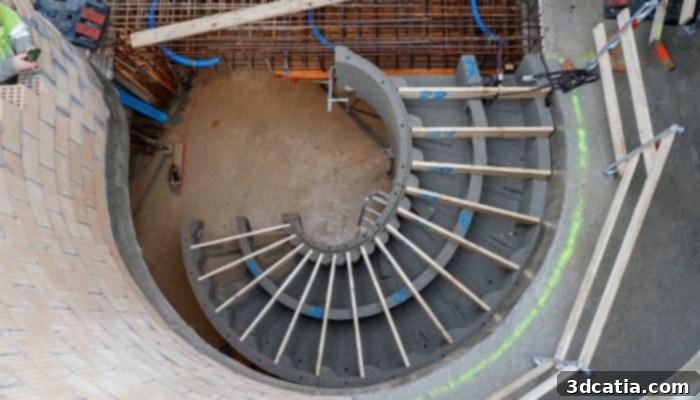
Assembly of the staircase formwork on the construction site: Fully installed first flight of stairs without balustrades (photo credits: Skeno/Scawo3D)
Conversely, the most substantial challenge we face is scaling this relatively new process for broader, mainstream practical application. Currently, we actively receive and undertake requests for bespoke design objects, artistic installations, and manageable construction elements like stairs. However, we envision a far greater potential for the SPI process in larger-scale structural applications. To draw a historical parallel, while hydraulic binders were known to the Romans, it took until the 19th century and the advent of industrialization for cement to achieve widespread acceptance. This analogy underscores a crucial point: we are still in the early stages of additive manufacturing in construction, and significant adoption takes time and sustained effort.
Despite the inherent challenges, additive manufacturing in construction has gained considerable momentum. The industry is currently grappling with a severe shortage of skilled labor while simultaneously facing an urgent demand for rapidly created new living spaces. This confluence of factors is finally bringing much-needed attention to the critical discussion surrounding sustainability in building practices. In principle, all the fundamental conditions are aligned for the emergence and adoption of new technologies that facilitate different, faster, and more efficient construction methods. The primary impediment, particularly in regions like Germany, lies in an industry framework still heavily reliant on standards that can be opaque and are often rooted in a body of knowledge that does not fully account for today’s dynamic requirements or the vast architectural possibilities now enabled by advanced technologies. While this is changing, progress can be slow.
Through pioneering projects and extensive research, institutions like the Technical University of Munich have clearly demonstrated where and how additive manufacturing can be most effectively integrated into the construction industry. Thus, a tremendous amount of valuable research is ongoing. Encouragingly, there are initial signs that some of these research findings are beginning to transition into practical application, spurred by initiatives such as “Building Type E” in Germany. By easing rigid standards, this initiative aims to grant planners and building owners greater flexibility to construct more simply, resource-efficiently, and ideally, more cost-effectively, paving the way for innovation. Nevertheless, we eagerly await customers beyond the research sector who possess the courage and, initially, the financial willingness to embrace and invest in a cutting-edge technology like the SPI process. We have consistently demonstrated, and will continue to prove, that large-scale construction, involving load-bearing components, is not only feasible but advantageous with our technology. For more detailed information about Scawo3D and our innovations, please visit our official website.
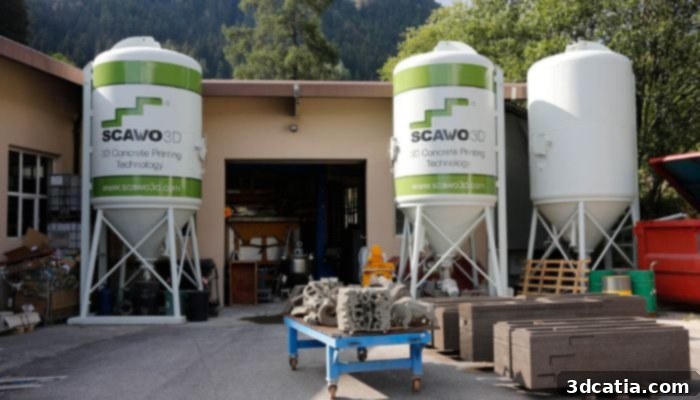
Production of Scawo3D in Sarnthein, South Tyrol (photo credits: Scawo3D)
What are your thoughts on Scawo3D’s innovative approach to 3D concrete printing? We invite you to share your comments below or engage with us on our LinkedIn, Facebook, and Twitter pages! Don’t forget to sign up for our free weekly Newsletter here to receive the latest 3D printing news directly in your inbox. You can also explore all our compelling videos on our YouTube channel for more insights into the world of additive manufacturing.
*Cover Photo: Scawo3D trade fair stand at BAU 2025 in Munich (photo credits: Skeno/Scawo3D)