

US DoD Boosts 3D Printing Investment: Unpacking the Future of Military Additive Manufacturing Growth
The United States Department of Defense (DoD) stands as a monumental catalyst for the widespread adoption and advancement of additive manufacturing (AM) technologies across diverse military applications. This pivotal role has been consistently demonstrated through numerous impactful use cases within the American armed forces, and its influence is further underscored by a recent, comprehensive report. Titled “Additive Manufacturing in Military and Defense 2024,” this authoritative study from Additive Manufacturing Research provides compelling insights into the projected robust growth of military and defense spending on AM in the coming years within the United States.
Authored by Tali Rosman, an industry veteran with a distinguished background at Stratasys and XEROX, who notably oversaw the installation of the first metal 3D printer aboard a U.S. Navy ship, the report meticulously analyzes and forecasts the burgeoning opportunities for 3D printing within the critical military and defense sectors. At its core, the research illuminates a dramatic surge in DoD expenditure dedicated to additive manufacturing for defense purposes, tracing this financial commitment from previous years and projecting its trajectory into the future. The findings are particularly striking: while the 2023 iteration of the report documented $300 million in direct DoD spending for that year, the 2024 figures reveal a substantial increase to an impressive $800 million. This remarkable growth is not merely a transient spike; it is anticipated to continue its steady ascent, ultimately reaching an estimated $2.6 billion by the year 2030. This substantial financial commitment signifies the DoD’s clear strategic prioritization of AM as an indispensable capability for enhancing national security and military readiness.
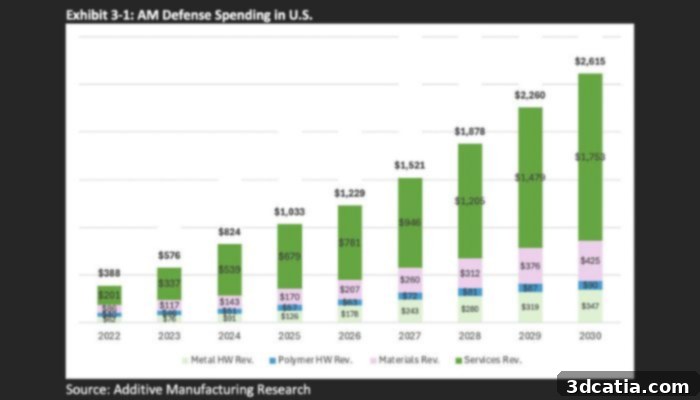
A graph illustrating the projected growth of the additive manufacturing defense sector, including a breakdown by key technologies (photo credits: Additive Manufacturing Research)
The report meticulously delves into the underlying reasons propelling the astonishing expected 166% growth per year within this vital field. To achieve this, Rosman undertook an in-depth examination of the DoD budget, forecasting spending trends across leading types of industrial 3D printing technologies. These include well-established methods such as powder bed fusion (PBF), directed energy deposition (DED), metal binder jetting, and bound metal deposition. Each of these sophisticated additive manufacturing processes has already been successfully deployed for a wide array of critical applications within the American military, leveraging their unique capabilities for producing complex components, repairing high-value parts, and enabling rapid prototyping. As visually depicted in the accompanying graph, the sector anticipating the most significant expansion appears to be 3D printing services, indicating a growing reliance on specialized expertise and outsourced production. This is closely followed by the materials segment, highlighting the increasing demand for advanced alloys and polymers. Metal hardware then ranks as the third largest growth area, reflecting the military’s ongoing need for high-performance, custom metal parts, with polymer hardware also demonstrating robust growth for lighter, more specialized components.
This projected growth is a testament to the transformative potential of additive manufacturing in addressing key challenges faced by modern military forces. Technologies like powder bed fusion are crucial for producing intricate, high-strength metal components, enabling lightweight designs and consolidating complex assemblies that are impossible with traditional manufacturing. Directed energy deposition, on the other hand, offers unparalleled capabilities for repairing critical parts, extending the lifespan of expensive equipment, and even building large structures directly. Metal binder jetting promises high-volume production of metal parts with greater speed and cost-efficiency than other metal AM processes, making it ideal for scalable applications. Meanwhile, bound metal deposition provides an accessible entry point into metal additive manufacturing, allowing for in-house production of functional metal parts with reduced infrastructure requirements. The diverse strengths of these technologies collectively contribute to the DoD’s strategic objectives, enhancing everything from weapon systems performance to logistical resilience.
Beyond the financial forecasts, the report further explores the fundamental drivers behind this impressive growth trajectory, offering profound insights into the truly transformative role that additive manufacturing is poised to play in both defense and broader military applications. This comprehensive analysis was informed by extensive first-person interviews conducted with key branches of the U.S. military, including the U.S. Navy, U.S. Air Force, Space Force, and the U.S. Army. These discussions specifically focused on the myriad initiatives underway to seamlessly incorporate and effectively leverage 3D printing within the United States Military’s operational framework. A major force driving this pervasive interest and strategic adoption across the U.S. defense sector is the foundational DoD Additive Manufacturing Strategy, which was initially unveiled in 2021. This strategy provides a clear roadmap and guiding principles for integrating AM into military logistics, sustainment, and acquisition processes, aiming to enhance readiness, improve supply chain resilience, and accelerate innovation.
The DoD Additive Manufacturing Strategy emphasizes several critical pillars, including the establishment of a robust AM industrial base, fostering a skilled workforce, developing a digital thread for seamless data flow, and certifying AM parts for mission-critical applications. By strategically investing in these areas, the DoD aims to move beyond simple prototyping to on-demand, localized manufacturing of spare parts, custom tools, and even mission-specific components directly in the field or at forward operating bases. This capability significantly reduces logistical burdens, shortens lead times for critical components, and minimizes reliance on fragile global supply chains, thereby enhancing operational agility and reducing costs over the long term. The transformative power of AM extends to design freedom, enabling engineers to optimize parts for weight reduction, improved performance, and multi-functional integration, which can have profound implications for aircraft, naval vessels, ground vehicles, and soldier-worn equipment. The ability to rapidly iterate designs and produce tailored solutions for unique operational challenges gives the U.S. military a distinct tactical advantage.
In a recent press release, Additive Manufacturing Research highlighted that the report carries significant implications for a broad spectrum of stakeholders, including defense contractors, technology providers, strategic investors, and influential policymakers. The company emphatically calls for proactive measures and collaborative efforts to fully harness the immense potential of additive manufacturing. This imperative has seemingly been amplified by the increasingly precarious geopolitical landscape, characterized by escalating global tensions and complex security challenges. In such an environment, AM offers critical advantages such as enhanced supply chain resilience, allowing for the localized production of vital parts and reducing dependency on overseas manufacturing. It also facilitates rapid innovation and customization of equipment to adapt to evolving threats, providing a strategic edge in an unpredictable world. The ability to produce parts on-demand, closer to the point of need, minimizes logistical vulnerabilities and ensures continuous operational readiness even when traditional supply lines are disrupted, making it a cornerstone of modern defense strategy.
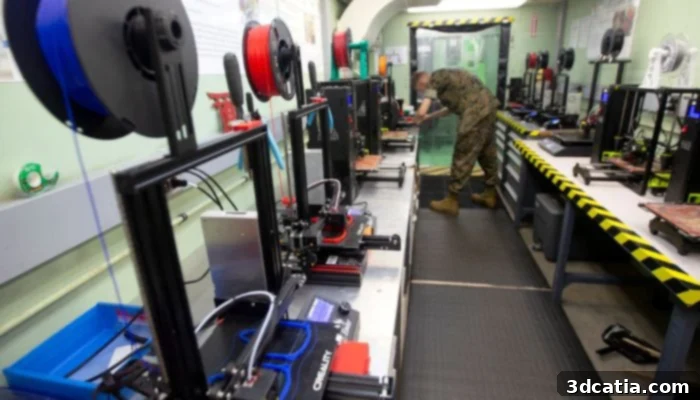
The significant increase in DoD spending underscores the growing implementation of additive manufacturing for diverse military applications (photo credits: DoD)
The comprehensive report extends its coverage to many of the primary influential players within the additive manufacturing and defense sectors. This includes, but is by no means limited to, the Department of Defense itself as a leading end-user and driver, along with innovative entities such as Astro America, known for its focus on industrializing AM technologies, Lincoln Electric, a pioneer in large-scale metal additive manufacturing, Ursa Major, which leverages AM for advanced rocket propulsion systems, and major aerospace and defense giants like Airbus, Boeing, and Eaton Corporation, all of whom are deeply integrating AM into their product development and manufacturing processes. This detailed compilation of key industry actors makes the report an invaluable resource for anyone involved in additive manufacturing who is contemplating a strategic move into the defense sector, as well as for those already established in defense seeking to strategically adopt and expand their capabilities in additive manufacturing. Whether you are looking to understand market trends, identify potential partners, or simply stay abreast of the latest developments, the insights offered are critical. You can gain access to the full report or download a complimentary sample by following the link provided HERE.
The insights from this Additive Manufacturing Research report clearly indicate that AM is no longer an experimental technology within the military but a fundamental pillar of future defense capabilities. The substantial financial commitments from the DoD, combined with the strategic integration across all service branches, highlight a future where on-demand manufacturing, supply chain resilience, and rapid innovation are paramount. This trend is set to reshape military logistics, procurement, and battlefield readiness for decades to come, ensuring the U.S. military maintains its technological superiority and operational flexibility in a rapidly changing global environment.
What are your thoughts on this significant report concerning AM spending and its implications for the defense sector? We invite you to share your perspectives in a comment below or engage with us on ourLinkedIn,Facebook, andTwitter pages! To stay informed with the very latest in 3D printing news, don’t forget to sign up for our free weeklyNewsletter here, delivered straight to your inbox! Additionally, you can find all our engaging videos and in-depth discussions on ourYouTube channel.