

GH Induction Revolutionizes Industrial Heating with World’s Largest 3D Printed Pure Copper Coils
In a monumental leap forward for industrial heating technology, GH Induction has proudly announced the successful creation of the largest 3D printed coil crafted from pure copper. This groundbreaking achievement was made possible through the sophisticated Electron Beam Melting (EBM) process, marking a significant milestone in the application of additive manufacturing for high-performance components. These coils are not just any parts; they are indispensable elements in electromagnetic induction systems, designed to heat metal parts with unparalleled efficiency and precision.
GH Induction’s journey into this innovative domain began over a decade ago with the launch of its 3D Inductors brand in 2014. This initiative was specifically dedicated to the production of these critical induction coils directly from pure copper using additive manufacturing techniques. The company’s foresight in embracing additive manufacturing was driven by a clear understanding of its inherent advantages. These benefits include a substantial reduction in production costs per part, a remarkable increase in the lifespan of the coils, and the ability to achieve geometries previously impossible with traditional methods. Through continuous innovation and optimization, GH Induction has now pushed the boundaries further, successfully designing and producing a significantly larger coil by enhancing the printing volume, which has been expanded to an impressive 180 x 180 x 350 mm.
The Critical Role of Induction Coils in Modern Industry
Induction coils are far more than simple electrical components; they are the heart of electromagnetic induction technology, a process central to numerous industrial applications. Traditionally, these coils have been meticulously manufactured by hand, involving labor-intensive processes such as brazing or soldering. While effective, these conventional methods often limit design complexity, increase manufacturing time, and can lead to variations in quality. In contrast, 3D printing offers a paradigm shift.
The primary function of an induction coil is to generate an electromagnetic field that induces eddy currents within a conductive workpiece, causing it to heat up. This heating process must be activated in a fast, safe, and precisely controlled manner to ensure optimal material treatment and energy efficiency. The technology finds widespread use across virtually all industrial sectors, primarily for heat treating metals to alter their properties (e.g., hardening, annealing) or for assembling components through processes like brazing and soldering. GH Induction’s 3D Inductors brand leverages 3D printing, specifically an EBM machine developed by GE Additive, to redefine how these essential components are made.
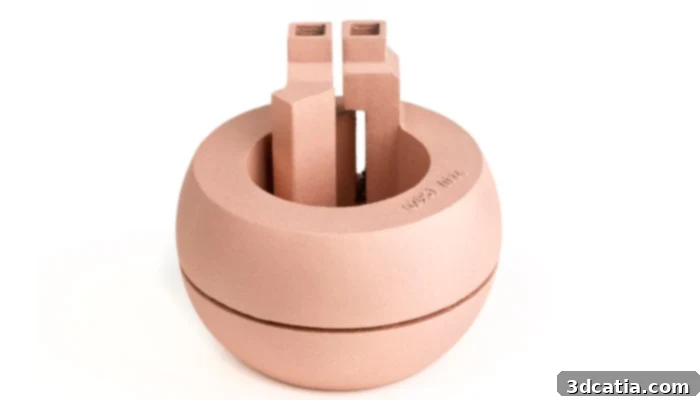
One of the coil’s 3D printed elements (photo credits: GH Induction)
Innovating Scale: From Standard to Largest-Ever 3D Printed Copper Coils
Since its inception, GH Induction’s 3D Inductors division has utilized a 180 x 180 x 180 mm printing plate for the additive manufacturing of its high-purity copper coils. This initial volume allowed for significant advancements over traditional methods, but the company’s vision extended beyond these initial capabilities. Recognizing the growing demand for larger, more powerful induction solutions, GH Induction’s engineering teams meticulously re-evaluated and re-optimized the arrangement of various components within a single coil design. This strategic rethinking was crucial in maximizing the potential of the additive manufacturing process.
The result of this intensive R&D effort was the ability to leverage a much larger build size – pushing the limits to 180 x 180 x 350 mm. This enhanced capability enabled GH Induction to achieve what was once considered impossible: designing and fabricating the largest pure copper 3D printed coil to date. In a recent press release, the company highlighted the profound implications of this advancement: “The ability to stack and achieve full optimization of the build volume and the ability to process pure copper are very advantageous because they also generate energy efficiency gains and longer life for the inductor coils.” This statement underscores not only the manufacturing prowess but also the significant operational and economic benefits that these larger, more complex coils bring to industrial clients. The increased size means that a broader range of industrial components can now benefit from the superior heating characteristics provided by 3D printed induction coils, opening doors to new applications and higher throughputs.
Ensuring Unmatched Material Quality: The RRR Advantage
Beyond sheer size and geometric complexity, the performance of an induction coil hinges critically on the purity and integrity of its material. Understanding this, GH Induction’s teams subjected their 3D printed copper to rigorous quality testing, with a particular focus on its purity. The key metric utilized for this evaluation was the Residual Resistivity Ratio (RRR). This highly sensitive indicator is crucial for assessing the quality of metallic conductors, especially for applications where electrical and thermal conductivity are paramount, such as induction coils.
The RRR is calculated by comparing the electrical resistivity of a material at a very low temperature (e.g., 4 Kelvin) to its resistivity at a higher reference temperature (e.g., 273 Kelvin). A higher RRR value signifies a denser material with fewer internal voids and impurities. These imperfections can act as scattering centers for electrons, increasing resistance and reducing overall conductivity. Therefore, a higher RRR directly translates to superior thermal and electrical conductivity, which is essential for efficient energy transfer in induction heating processes. The copper used by GH Induction in their 3D printed coils has achieved an outstanding RRR of over 250. This figure stands in stark contrast to that of ordinary copper, which typically ranges between 5 and 150. This exceptional RRR value not only validates the purity of the copper processed via EBM but also guarantees that GH Induction’s coils offer unparalleled performance in terms of energy efficiency, minimal heat loss, and extended operational lifespan.
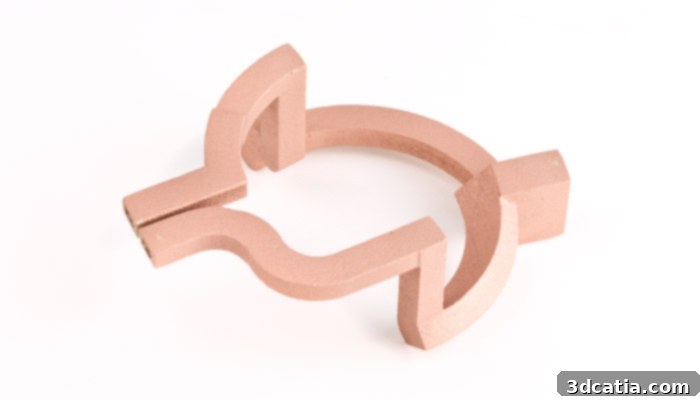
Another 3D printed component for the coil (photo credits: GH Induction)
Additive Manufacturing: Unlocking Superior Design and Performance
The adoption of additive manufacturing, specifically EBM, provides GH Induction with a distinct competitive advantage, allowing for the production of components that surpass the capabilities of traditional manufacturing. This technology enables the creation of high-quality components not only with exceptional material purity, as demonstrated by the impressive RRR values, but also with highly complex internal and external geometries. These intricate designs are simply unattainable with conventional coil fabrication methods. The freedom of design offered by 3D printing means that coils can be custom-tailored to specific application requirements, optimizing heat distribution, energy transfer, and overall process efficiency to an unprecedented degree. This level of customization leads to more efficient heating, reduced material waste, and significant energy savings for industrial users.
The ability to produce custom geometries also means that GH Induction can design coils with integrated cooling channels, optimized magnetic fields, and enhanced durability. This translates into induction heating systems that are not only more effective but also more robust and sustainable. The implications for industries relying on induction heating – from automotive and aerospace to medical and tool manufacturing – are profound. Companies can now achieve more precise heat treatment of complex parts, reduce cycle times, and improve the quality of their final products. GH Induction’s commitment to pushing the boundaries of 3D printing with pure copper is setting a new standard for performance and innovation in industrial heating.
To delve deeper into the innovative solutions offered by 3D Inductors and explore how these advanced coils can transform your industrial processes, click HERE.
What are your thoughts on these pioneering 3D printed coils made of pure copper and their potential impact on industrial heating? Share your insights and join the conversation by leaving a comment below or connecting with us on ourLinkedIn,Facebook, andTwitter pages! Don’t miss out on the latest advancements in additive manufacturing – subscribe to our free weeklyNewsletter here to receive the newest 3D printing news directly in your inbox. You can also explore our extensive collection of videos and tutorials on our dedicatedYouTube channel for more in-depth content.