
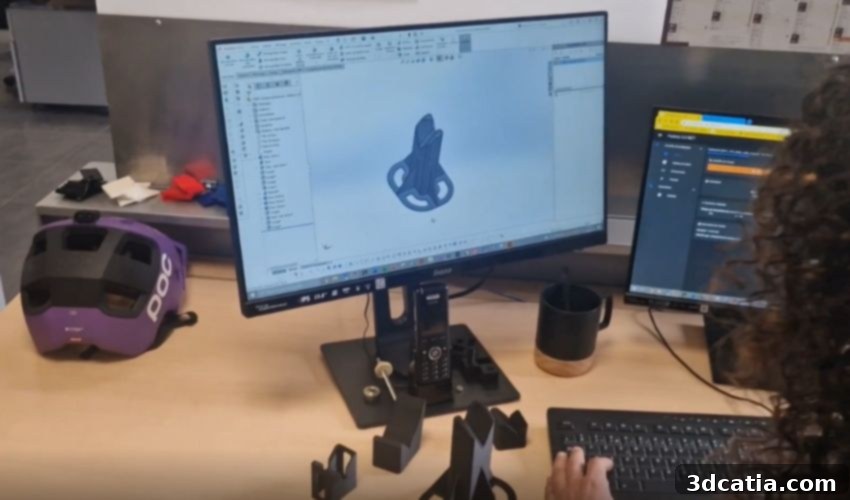
Revolutionizing High-Precision Manufacturing: How Symetrie Leverages OMNI3D 3D Printing for Advanced Hexapod Production
The global manufacturing landscape is undergoing an unprecedented transformation. Recent years, marked by significant disruptions such as the Global Supply Chain Crisis of 2022 and the profound impact of the COVID-19 pandemic, have starkly highlighted the vulnerabilities of traditional, globally dispersed production models. This has spurred a decisive shift towards more resilient and localized manufacturing strategies, emphasizing the immense benefits of internal and regional production capabilities. Within this evolving industrial ecosystem, the adoption of additive manufacturing, commonly known as 3D printing, has surged across a multitude of sectors, offering unparalleled agility, design freedom, and efficiency. A compelling illustration of this trend comes from the innovative French company Symetrie, renowned for its cutting-edge engineering solutions. Symetrie has strategically integrated an industrial 3D printer from OMNI3D into its operations to enhance the manufacturing process of its highly specialized hexapods, marking a significant step towards optimizing its production capabilities and ensuring supply chain robustness.
For those unfamiliar with the term, hexapods represent a pinnacle of precision engineering. According to Symetrie, these are sophisticated parallel kinematic mechanical systems, aptly named for their six independent “legs” or actuators. Their primary function is to accurately position or precisely move an object within a three-dimensional space, providing an exceptional six degrees of freedom (three translational and three rotational). What truly sets hexapods apart is their remarkable combination of high accuracy, superior resolution, and inherent stiffness, making them indispensable in applications where minuscule errors can have catastrophic consequences. Since its inception in 2001, Symetrie has diligently cultivated its expertise, establishing itself as one of the world’s foremost providers of advanced hexapod solutions, catering to both demanding positioning and intricate motion simulation applications across diverse industries. Their commitment to innovation and precision has solidified their reputation as a leader in this highly specialized field.
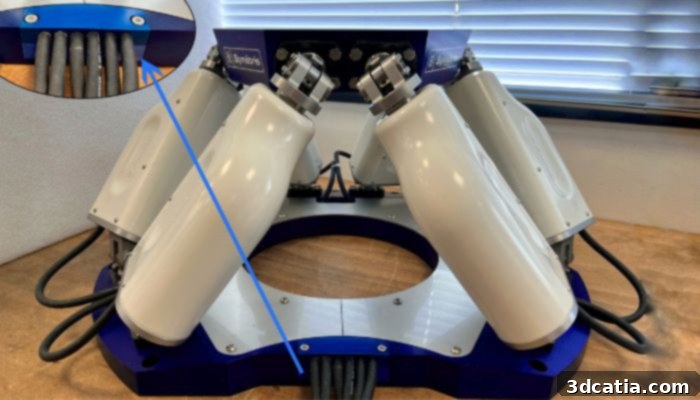
Symetrie turned to 3D printing to make its hexapods
Symetrie engineers and manufactures two principal types of hexapod systems, each designed for specific, high-stakes applications. The first category comprises precision positioning systems. These are crucial for tasks requiring micron-level accuracy, such as the exact placement of samples on beamlines in particle accelerators, the meticulous alignment of mirrors on advanced observation satellites, or the fine-tuning of components within powerful astronomical telescopes. The ability to achieve and maintain such precise positions is critical for scientific discovery and technological advancement. The second category involves motion systems, which are engineered to realistically simulate complex movements. These systems are extensively utilized for testing and qualifying sensitive equipment by replicating the dynamic motions experienced by vehicles like boats, trucks, tanks, or even airplanes. This allows engineers to rigorously evaluate the performance of various components, including advanced sensors, critical optical components, inertial measurement units (IMUs), and high-precision gravimeters, under simulated real-world conditions, ensuring their reliability and operational integrity before deployment.
Symetrie’s highly specialized hexapod solutions are particularly vital for meeting the stringent requirements of leading industrialists and cutting-edge research laboratories worldwide. Their technology plays a pivotal role in large-scale technological projects that push the boundaries of science and engineering, including the development of critical components for projects such as the Laser MegaJoule, the James Webb Space Telescope (JWST), and the GAIA space telescope. The applications of these versatile hexapods are remarkably diverse, spanning an impressive array of sectors. To highlight just a few, hexapods are indispensable in astronomy for telescope stabilization and instrument calibration, in the automotive industry for component testing and simulation, in defense for targeting and sensor platforms, in the energy sector for precise alignment of delicate equipment, in medical fields for surgical robotics and imaging, in naval applications for wave compensation and marine research, in space exploration for satellite mechanisms and ground support, and in optics for lens alignment and beam steering. Given such a broad and critical operational scope, the question naturally arises: how exactly can advanced 3D printing technologies be harnessed to aid in the intricate design, rapid prototyping, and efficient production of these sophisticated machines?
The Transformative Benefits of Integrating 3D Printing for Hexapod Production
Symetrie’s strategic decision to adopt additive manufacturing wasn’t merely about embracing new technology; it was a pragmatic response to a growing operational challenge. Historically, Symetrie has maintained full control over its production pipeline, meticulously designing, assembling, and qualifying all its hexapods internally at its facilities. While this approach ensured unparalleled quality and precision, the company experienced a significant surge in demand for its machines in recent years. Concurrently, the global supply chain disruptions, especially exacerbated during the COVID-19 pandemic, led to increasingly frequent and prolonged delays from external suppliers. This unfortunate confluence of increased orders and unreliable external supply often forced Symetrie to postpone customer deliveries, a situation that was clearly unsustainable and detrimental to both customer satisfaction and the company’s reputation.
In response to these pressing challenges, Symetrie made a pivotal investment in 2022, acquiring an industrial 3D printer: specifically, the Factory 2.0 NET 3D printer from OMNI3D. This decision proved to be profoundly beneficial, offering multifaceted improvements to their operations. Not only did the in-house 3D printing capability help to directly compensate for the increasingly frequent delays from external suppliers, thereby enabling Symetrie to consistently avoid postponing critical customer deliveries, but it also significantly reduced overall production costs. By producing more parts internally, the company minimized reliance on expensive external sourcing, eliminated minimum order quantities, and streamlined its inventory management, leading to tangible financial efficiencies and enhanced operational control.
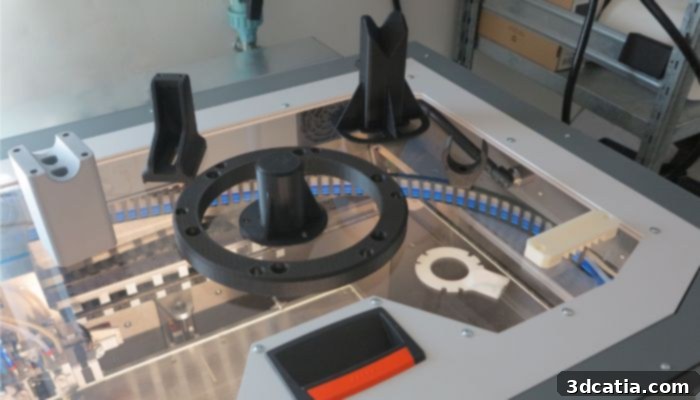
Parts made using OMNI3D’s Factory NET 2.0 3D printer for Symetrie’s hexapods
Today, 3D printing has become an indispensable technology integrated across various services within Symetrie, demonstrating its versatility and strategic value. For instance, it is extensively used to fabricate specialized tools and fixtures essential for internal manufacturing processes. This includes creating precise jigs for setting up intricate micromechanical systems or printing custom blocks designed to position actuators with unparalleled accuracy and repeatability during the complex assembly phase of the hexapods. These crucial parts are initially prototyped rapidly in PLA (Polylactic Acid), often with minimal material usage, allowing engineers to quickly validate designs and functionality. Once the design is confirmed, the final, robust versions are then printed using advanced materials like CF-PA12 (Carbon Fiber reinforced Polyamide 12). The switch to CF-PA12 not only enhances the structural integrity and durability of the components but also significantly reduces the risk of breakage, a critical factor for precision machinery. Impressively, these final versions can be produced in as little as two hours, showcasing the rapid production capabilities of industrial 3D printing.
Irvin Stil, Symetrie’s production manager, emphatically notes the profound impact of this adoption: “The OMNI3D printer allows a reactivity to the unexpected needs of production, and manufacturing possibilities of parts impossible to machine.” This quote encapsulates two of additive manufacturing’s most significant advantages: unparalleled agility in responding to unforeseen challenges and the liberation from traditional manufacturing constraints, enabling the creation of geometries and complexities previously deemed impossible or prohibitively expensive through conventional machining methods.
Beyond tooling and assembly aids, the 3D printer has been instrumental in manufacturing functional parts directly integrated into finished hexapod products. This includes components such as specialized cable trays designed to meticulously manage wiring, precision spacers for the fixed platform of the hexapods, and protective PCB (Printed Circuit Board) covers – all produced efficiently in less than 3 to 4 hours. This speed and on-demand production capability proved particularly invaluable when Symetrie faced an urgent request from a customer who required a bespoke interface part. This component was critical for seamlessly connecting Symetrie’s HEGOA hexapod with an optronic system. Leveraging their in-house OMNI3D printer, Symetrie was able to print the complex part in CF-PA12 in just six hours, a stark contrast to the several days, or even weeks, that would have been necessary if they had relied on traditional manufacturing means and external suppliers. This incident powerfully demonstrated the competitive advantage and enhanced customer responsiveness afforded by their additive manufacturing capabilities.
The selection of the Factory 2.0 NET from OMNI3D was not coincidental but a meticulously calculated choice based on its advanced features perfectly tailored to Symetrie’s industrial needs. One particularly attractive characteristic was its substantial build volume, which facilitates the simultaneous printing of a large number of small parts or the creation of larger, more complex components in a single batch, significantly optimizing workflow and throughput. Furthermore, OMNI3D’s extensive range of available materials, coupled with the printer’s precisely controlled heating chamber, is critical for working with advanced engineering thermoplastics like CF-PA12, ensuring optimal material fusion and preventing warping or delamination. The inclusion of a double extrusion system offers enhanced versatility, allowing for multi-material printing or the use of soluble support materials (ODS20). Soluble supports are particularly crucial in industrial applications such as hexapods, as they enable the production of highly intricate geometries with complex internal structures and overhangs, drastically simplifying post-processing and ensuring the integrity of delicate features. These combined features underscore why the Factory 2.0 NET is an ideal industrial solution for high-precision manufacturing. You can learn more about OMNI3D HERE or check out the video below to see their technology in action:
The collaboration between Symetrie and OMNI3D exemplifies how industrial 3D printing can profoundly impact high-precision engineering, addressing critical supply chain vulnerabilities while simultaneously boosting efficiency, reducing costs, and enabling rapid innovation. This case study serves as a compelling testament to additive manufacturing’s growing role in shaping the future of industrial production, proving its value in even the most demanding applications. What are your thoughts on the transformative use of 3D printing for the production of advanced hexapods and similar precision systems? We invite you to share your insights in a comment below or join the conversation on our LinkedIn, Facebook, and Twitter pages! Don’t forget to sign up for our free weekly Newsletter here to receive the latest 3D printing news straight to your inbox! You can also find all our compelling videos and industry insights on our YouTube channel.
*All Photo Credits: OMNI3D