
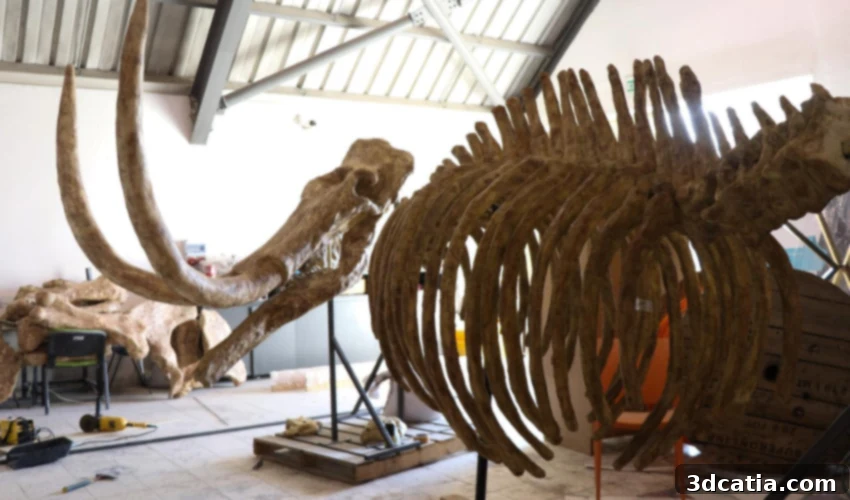
Revolutionizing Paleontology: 3D Printing Restores 7.7 Million-Year-Old Fossils in Kayseri, Türkiye
In a remarkable blend of ancient history and cutting-edge technology, researchers in central Türkiye’s Kayseri province are employing advanced 3D printing techniques to breathe new life into fossils dating back an astounding 7.7 million years. This pioneering approach is transforming the field of paleontology, offering a precise, cost-effective, and non-invasive method for restoring invaluable prehistoric remains. Discovered near the Yamula Dam in 2017 by a local goat herder, these fossils represent a diverse array of ancient megafauna, providing an extraordinary window into Türkiye’s Miocene-era ecosystems. The ongoing restoration efforts are meticulously preparing these magnificent specimens for their grand debut at the eagerly anticipated Kayseri Paleontology Museum, promising an unprecedented journey for visitors through the region’s deep past.
A Groundbreaking Discovery at Yamula Dam
The initial discovery near the Yamula Dam by a goat herder in 2017 marked the beginning of an extraordinary paleontological endeavor. Subsequent excavations unearthed a treasure trove of well-preserved remains, painting a vivid picture of life millions of years ago. Among the incredible finds are the skeletal fragments of formidable saber-toothed cats, majestic giraffes, colossal elephants, powerful mammoths, robust rhinos, agile three-toed horses, swift antelopes, ancient turtles, and various species of pigs. This rich collection offers scientists a unique opportunity to study the biodiversity, climate, and geological history of the region during the late Miocene epoch. The scale and diversity of the Yamula Dam site underscore its global significance, positioning it as a key location for understanding mammalian evolution and ancient biogeography.
Overcoming Traditional Restoration Challenges
For decades, paleontologists have relied on traditional methods to restore incomplete fossil specimens. Typically, missing gaps in fossils were filled using chemical molds, a process that, while effective to some extent, presented numerous challenges. This method was inherently time-consuming, often requiring extensive labor and specialized expertise. More critically, it frequently involved exposing the delicate, millions-of-years-old fossils to various chemicals, posing a significant risk of damage or degradation to the original material. The irreversibility of some traditional treatments also meant that once a fossil was restored, altering or correcting the restoration was difficult, if not impossible. Furthermore, achieving high levels of precision for intricate skeletal structures was often a painstaking task, limiting the anatomical accuracy of the reconstructed mounts.
The Power of Digital Paleontology: 3D Scanning and Additive Manufacturing
The advent of high-precision 3D scanners and advanced additive manufacturing techniques has revolutionized the field of fossil restoration. This modern approach completely bypasses the need for potentially harmful chemical molds, offering a non-invasive and highly accurate alternative. The process begins with the meticulous 3D scanning of each fossil fragment. This cutting-edge technology captures incredibly detailed digital data of the specimens, including their precise dimensions, contours, and surface textures, all without any physical contact that could potentially compromise their integrity. This digital capture is crucial for preserving the unique characteristics of each ancient bone.
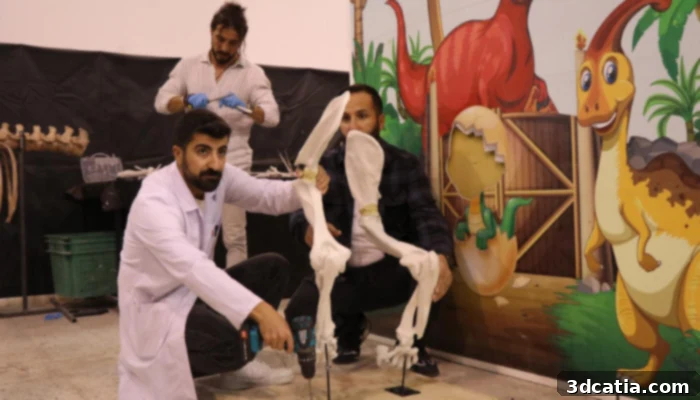
Once scanned, the digital data is processed and utilized by a team of paleontologists and specialized designers. They meticulously analyze the bone fragments, compare them with existing scientific literature, and create mathematical drawings to inform the design of the missing parts. This data is then used in sophisticated CAD (Computer-Aided Design) software to digitally replicate the missing bones. These digital models are then uploaded to a slicer software, which prepares them for 3D printing. The team can then print these replacement parts locally, utilizing advanced 3D printing technologies capable of producing durable and aesthetically suitable components. This seamless digital workflow ensures that every replacement part is designed with extreme precision, promising a perfect fit with the original fossil fragments.
Transformative Benefits: Preservation, Efficiency, and Cost Savings
The adoption of 3D printing has introduced a multitude of benefits to fossil restoration, fundamentally enhancing how ancient remains are conserved and presented. One of the primary advantages is the significantly improved preservation of the original fossils. By eliminating the need for chemical agents and extensive physical manipulation, the integrity and delicate structure of these invaluable specimens are maintained for future study and generations. The non-invasive nature of 3D scanning and printing means that the original fossils remain untouched, allowing for reversibility in restoration decisions and ensuring the long-term archival quality of the discoveries.
Beyond preservation, the technology has brought about dramatic cost reductions and unparalleled efficiency. Previously, the process of mounting large animal skeletons, such as a complete giraffe, could cost millions of lira and often necessitated outsourcing to specialized facilities overseas. This involved complex logistics, high transportation costs, and lengthy timelines. With 3D printing, the Kayseri team can now produce and mount these intricate pieces entirely in-house for a mere fraction of the previous cost. This not only empowers local experts but also dramatically speeds up the restoration process, making it possible to prepare more specimens for exhibition in a shorter timeframe. Researchers have already celebrated the completion of full skeletal mounts for impressive creatures like giraffes, rhinos, and elephants, while a majestic saber-toothed cat mount is rapidly nearing completion. Each custom-printed part is meticulously designed to fit seamlessly with the original fossil, creating complete and visually stunning skeletons that offer visitors an unprecedented view of these ancient giants.
The Meticulous Process of Digital Reconstruction
The sophisticated process of digitally reconstructing these ancient animals is guided by rigorous scientific analysis and interdisciplinary collaboration. After the initial identification of each species based on the fossil fragments, researchers delve into extensive academic literature to compile accurate anatomical measurements and comparative data. This ensures that every digitally designed replacement part is biologically accurate and consistent with the known morphology of the creature. Expert paleontologists create intricate mathematical drawings and 3D models, meticulously detailing the form and structure of the missing bone sections. These precise models are then uploaded to specialized slicer software, which translates the digital design into instructions for the 3D printer, dictating layer-by-layer fabrication. Once printed, the individual components undergo careful post-processing, which may include cleaning, sanding, and coloring to match or contrast with the original bone. Finally, these perfectly tailored printed components are skillfully assembled with the original fossil bones, culminating in complete and anatomically correct skeletal structures that stand as testaments to ancient life.
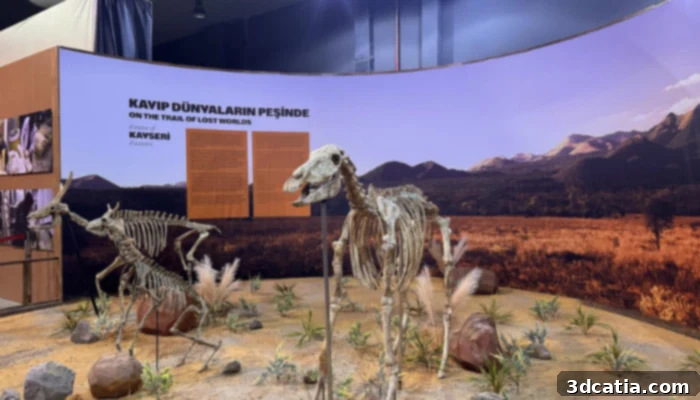
Bringing Prehistoric Türkiye to Life at the Kayseri Paleontology Museum
The culmination of these painstaking efforts will be unveiled with the opening of the under-construction Kayseri Paleontology Museum. Here, the beautifully reconstructed mounts will serve as the centerpiece of an immersive exhibition, taking visitors on an extraordinary journey through Türkiye’s prehistoric landscapes. Imagine standing face-to-face with a saber-toothed cat or marveling at the sheer scale of an ancient giraffe, brought back to life through the synergy of paleontological expertise and modern technology. The museum promises to showcase the magnificent large mammals that once roamed the Kayseri region millions of years ago, offering invaluable educational opportunities and fostering a deeper appreciation for the planet’s rich natural history. The innovative use of 3D printing is not just restoring ancient remains; it’s giving them new life, making the distant past more accessible, tangible, and inspiring than ever before.
The Broader Impact and Future of Paleontological Restoration
The groundbreaking work being done in Kayseri sets a significant precedent for paleontological restoration worldwide. This approach demonstrates how advanced manufacturing technologies can address long-standing challenges in conservation, research, and public education. The digital archives created through 3D scanning offer immense potential for future research, allowing scientists globally to study detailed fossil replicas without needing to handle the delicate originals. Furthermore, these digital models can be used for virtual exhibits, educational programs, and even citizen science projects, democratizing access to these invaluable scientific assets. The synergy between modern technology and paleontological research, as showcased by the Kayseri project, heralds a new era where ancient discoveries are not only preserved with greater care but also made more vibrant and accessible, bridging the vast expanse of time between the Miocene epoch and the modern world.
What are your thoughts on this incredible blend of ancient history and modern technology? Would you visit this museum exhibit to witness these 3D printed marvels? Let us know in a comment below or on our LinkedIn or Facebook pages! Plus, don’t forget to sign up for our free weekly Newsletter to get the latest 3D printing news straight to your inbox. You can also find all our videos on our YouTube channel.
*Cover Photo Credits: AA Photo Turkey