

Revolutionizing Vision: 3D Printed Corneas Promise a Future Free from Donor Shortages
The human cornea, a delicate yet crucial component of the eye, serves as its outermost protective layer and primary lens, focusing light onto the retina to enable sight. Its integrity is paramount for clear vision. Globally, millions suffer from debilitating vision impairment or complete blindness due to corneal damage caused by infections, injuries, genetic malformations, or degenerative diseases. For many, the only hope for restoring sight lies in a corneal transplant. However, this life-changing procedure is severely limited by a global scarcity of suitable donor tissue, leaving the vast majority of patients without treatment. This critical challenge has spurred innovative research into alternatives, culminating in groundbreaking developments in 3D printing technology.
A collaborative team of visionary researchers from Switzerland’s Empa, in partnership with the University of Zurich, the esteemed Zurich Veterinary Hospital, and the renowned Radboud University in the Netherlands, is pioneering a transformative solution. They are developing a transparent, biocompatible corneal implant, meticulously crafted using advanced 3D printing technology. This revolutionary implant is engineered to permanently repair damaged corneas, eliminating the reliance on precious donor tissue and opening up unprecedented possibilities for the millions worldwide currently living with compromised vision. This scientific endeavor represents a significant leap forward in precision medicine, offering not just a replacement part, but a path to genuine tissue regeneration and lasting visual restoration.
The cornea’s remarkable structure, a mere 500 to 600 micrometers thin, is an intricate marvel of nature, responsible for approximately two-thirds of the eye’s total focusing power. Its transparency is vital, allowing light to pass through unobstructed, while its robust composition protects the delicate inner structures of the eye from external threats. When this essential tissue is compromised, whether by bacterial or viral infections, traumatic injuries, or congenital conditions like keratoconus, the resulting opacity or irregularity can drastically diminish visual acuity, leading to partial or complete vision loss. The impact on an individual’s quality of life, independence, and overall well-being is profound and far-reaching.
Addressing corneal damage through traditional transplantation methods, while effective for some, faces immense logistical and medical hurdles. Annually, only approximately 100,000 corneal transplants are performed worldwide. This figure pales in comparison to the estimated 12.7 million people who suffer from corneal blindness globally, creating an enormous gap between need and availability. The shortage of viable donor tissue is a primary barrier, exacerbated by stringent selection criteria, preservation challenges, and the geographical disparity in access to healthcare. Furthermore, even with a successful transplant, patients face lifelong risks of immunological rejection, requiring chronic immunosuppressive medication that carries its own set of side effects and complications. These factors underscore the urgent need for synthetic, readily available, and patient-specific alternatives.
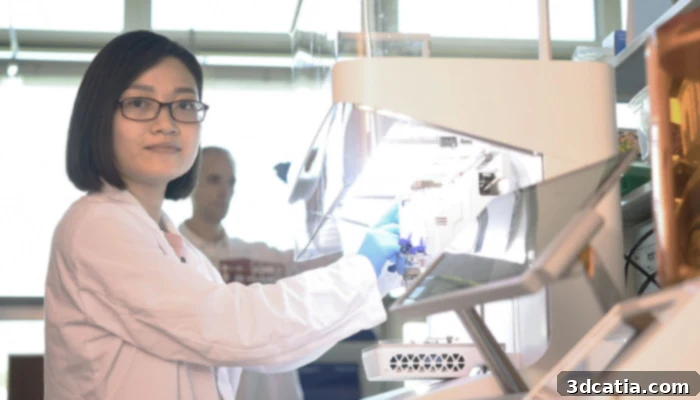
Hien Le is one of the lead researchers working on the artificial cornea. (Photo Credit: Empa)
The Swiss-led research team is directly confronting this critical shortage with an ingenious solution: a self-adhesive artificial cornea fabricated from a sophisticated hydrogel. This bio-ink comprises a carefully balanced blend of collagen, a principal structural protein found naturally in the cornea, and hyaluronic acid, a biomolecule known for its excellent biocompatibility, lubricity, and hydration properties. This unique combination mimics the natural extracellular matrix of the human cornea, providing an ideal environment for cellular integration and long-term functionality. The innovative implant is produced using 3D extrusion bioprinting, a technique that allows for unparalleled precision in creating complex biological structures.
What makes this 3D bioprinting approach particularly revolutionary is its capacity for personalization. The technology enables the precise customization of the implant’s shape and curvature, perfectly matching the unique anatomical dimensions of each patient’s eye. This bespoke fitting is crucial for optimal visual outcomes and integration, avoiding the “one-size-fits-all” limitations of traditional grafts. Beyond tailoring the geometry, specific additives are incorporated into the hydrogel mixture. These carefully selected components are designed to provide the necessary biomechanical stability, ensuring the implant is robust enough to protect the eye from physical stress, yet remains exquisitely transparent, a non-negotiable requirement for clear vision. This intricate balance of strength and optical clarity is a testament to the advanced material science employed in this project.
Beyond simply replacing damaged tissue with a structural substitute, this cutting-edge implant possesses a remarkable regenerative capability. It can be meticulously seeded with human stem cells derived directly from the patient’s own eye. This groundbreaking feature empowers the implant to actively support and facilitate the regeneration of the surrounding host tissue. By integrating the patient’s own cells, the artificial cornea is not merely an inert patch; it becomes a dynamic scaffold that encourages natural healing and integration. This cellular component is expected to significantly enhance the long-term viability of the implant, reducing the risk of rejection and promoting a more durable restoration of corneal function and clarity, thereby offering a truly permanent solution.
Another significant advancement incorporated into the design is its self-adhesive nature. This innovative feature entirely eliminates the need for surgical sutures, which are traditionally used to secure corneal grafts. While necessary, sutures introduce several potential post-operative complications, including infection, inflammation, astigmatism induced by uneven tension, and discomfort for the patient, often requiring subsequent removal. By bypassing sutures, the 3D-printed cornea significantly reduces these risks, leading to a smoother, safer, and potentially faster recovery process. This simplified surgical technique not only benefits the patient by minimizing discomfort and complications but also streamlines the procedure for ophthalmologists, potentially broadening access to this life-changing treatment.
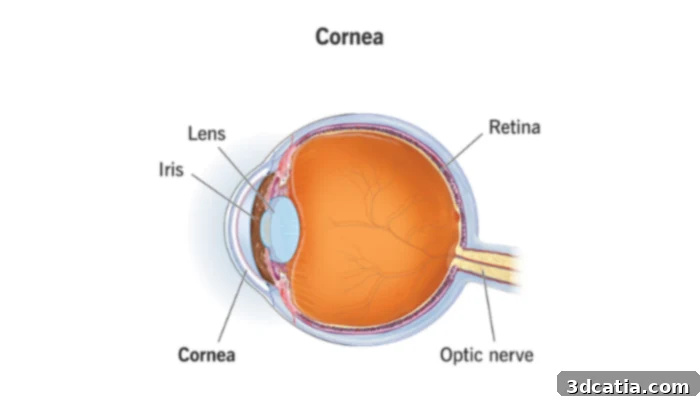
The cornea is the outermost layer of the eye, and helps protect the iris. (Photo Credit: Cleveland Clinic)
Markus Rottmar, a distinguished researcher from Empa’s Biointerfaces Lab, aptly underscores the profound significance of this pioneering research. He states, “This approach could transform corneal therapy by making implants widely available without relying on donor tissue.” His words encapsulate the immense potential of this project to democratize access to vision restoration. By ingeniously combining the precision of 3D printing with the restorative power of stem cell technology, the research team is not merely developing an alternative; they are actively shaping a new generation of personalized, permanent, and accessible solutions for millions of patients suffering from vision impairment across the globe. This synergistic approach promises a future where corneal blindness is no longer a life sentence.
This ambitious project stands as a powerful testament to the transformative potential of 3D printing within the realm of precision medicine. The ability to produce implants that are not only biocompatible but also perfectly tailored to the individual anatomical and physiological requirements of each patient represents a paradigm shift in medical treatment. By innovating a method that could make corneal repair more accessible, safer, and substantially more effective than conventional transplantation techniques, Swiss researchers and their international collaborators are not just pushing the boundaries of what’s possible; they are redefining them. Their work offers a beacon of hope, promising a future where advanced medical solutions are within reach for all who need them.
What are your thoughts on this groundbreaking research? We invite you to share your perspective in a comment below or join the conversation on our LinkedIn, Facebook, and Twitter pages! For more in-depth coverage of 3D printing applications in the medical field, explore our dedicated section here. Don’t miss out on the latest advancements – sign up for our free weekly Newsletter here to get cutting-edge 3D printing news delivered straight to your inbox! You can also find all our engaging videos on our YouTube channel. Interested in more medical and dental 3D printing news? Visit our dedicated page HERE.
*Cover Photo Credit: ESO Supernova