
Revolutionizing Materials: How 3D Printed Auxetic Plastics are Reshaping Engineering with Self-Sensing Capabilities
Imagine stretching a common material, like a rubber band. You’d instinctively expect it to become thinner as it elongates. This intuitive behavior is characteristic of most conventional materials found in our everyday lives. However, a groundbreaking development from researchers at the University of Glasgow has unveiled a class of plastics that defy this norm. These innovative materials exhibit an astonishing property: they grow wider when pulled, rather than narrowing. Such materials are known as auxetic materials, and the Glasgow team achieved this counter-intuitive behavior by meticulously engineering and 3D printing their intricate internal geometries. This breakthrough promises to redefine the boundaries of material science, offering unprecedented functionality. But how precisely are these remarkable auxetic plastics fabricated, and what transformative applications do they hold for the future?
The scientific community, along with various industries, took keen notice when, in late June, the University of Glasgow team published their significant findings in the prestigious journal Materials Horizons. Their research detailed a breakthrough in developing and designing novel auxetic structures, leveraging high-performance engineering plastics. This study not only showcases the immense potential of additive manufacturing but also demonstrates how this technology can create “self-monitoring” materials. These materials possess programmable properties, meaning their characteristics like strength, stretchability, and strain sensitivity can be precisely tailored during the design and fabrication process. Auxetic materials, in general, are celebrated for their extraordinary mechanical characteristics, including significantly enhanced energy absorption capabilities, improved damage tolerance, and superior indentation resistance. Consequently, the auxetic plastics developed by the Glasgow team harbor immense potential for a multitude of advanced applications across various sectors, from aerospace to biomedicine.
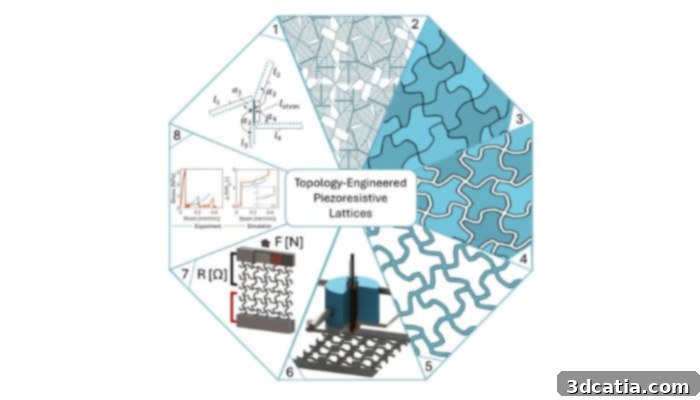
Illustration of the Glasgow study (Photo Credit: Johannes Schneider et al./Materials Horizons)
The creation of these specialized structures relied on an FDM Apium P220 3D printer, supplied by Apium Additive Technologies GmbH. FDM, or Fused Deposition Modeling, is a widely adopted additive manufacturing technique known for its ability to produce complex geometries layer by layer. The choice of material for these pioneering structures was equally crucial: PEEK (Polyether Ether Ketone). PEEK is a strong, high-performance, semi-crystalline thermoplastic renowned for its exceptional properties. It is not only highly resistant to heat and wear but also boasts an impressive strength-to-weight ratio, enabling it to substitute certain metals in demanding applications. Furthermore, PEEK is lightweight, biocompatible, and chemically inert, making it a material of choice already widely utilized in various high-performance engineering fields, as well as for biomedical implants and devices. The strategic decision to use PEEK allowed the researchers to exert precise control over both the mechanical and electrical behavior of the auxetic lattices, unlocking the potential for unprecedented functionalities.
Professor Shanmugam Kumar, the corresponding author of the study and a distinguished expert in materials and additive manufacturing at the University of Glasgow’s James Watt School of Engineering, highlighted the significance of their work: “We’ve shown that it’s possible to design PEEK lattices that are not only auxetic but also capable of sensing strain and damage without the need for embedded electronics.” This statement underscores one of the most remarkable aspects of their innovation: the inherent self-sensing capability of the materials themselves, eliminating the complexity and potential failure points associated with external electronic components.
The Fabrication Process: Crafting Self-Sensing Auxetic Materials
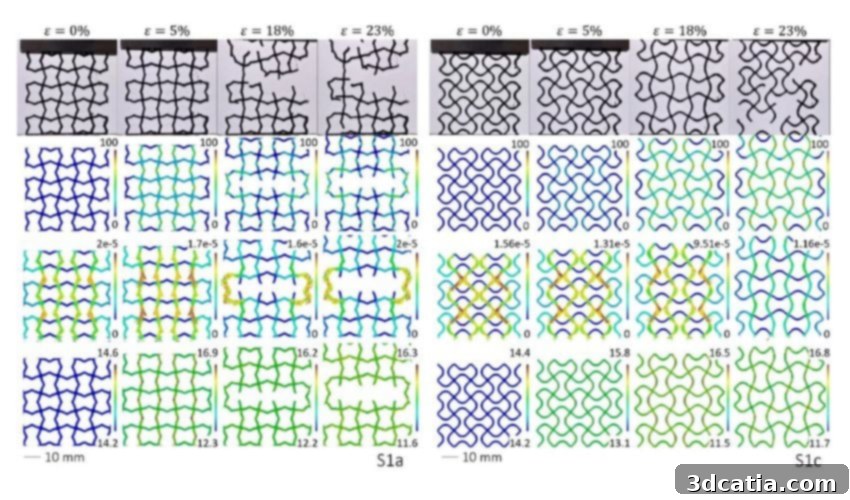
The intrinsic self-sensing capability of these advanced plastics stems from a fascinating physical phenomenon known as piezoresistivity. Piezoresistivity allows materials to “sense” and respond to mechanical deformation – whether they are being stretched, compressed, or impacted – by undergoing a measurable change in their electrical resistance. The Glasgow researchers masterfully harnessed this phenomenon by creating a family of two-dimensional (2D) lattices. These lattices were meticulously fabricated from four distinct types of PEEK-based feedstock, three of which were ingeniously infused with carbon nanotubes. The incorporation of these carbon nanotubes is key; they impart electrical conductivity to the plastic, effectively transforming it into an intricate, distributed sensor network. When these lattices are subjected to mechanical strain, the arrangement and connectivity of the conductive nanotubes within the polymer matrix change, leading to a quantifiable alteration in their internal electrical resistance. This change serves as a direct indicator of the applied mechanical stress or damage.
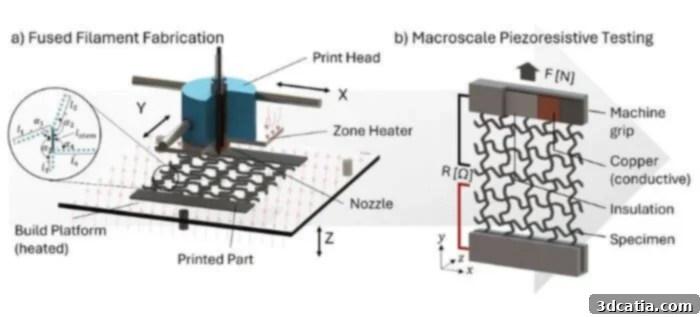
Illustration of the printing process (Photo Credit: Johannes Schneider et al./Materials Horizons)
The ingenious design of these self-sensing auxetic materials is rooted in repeating unit cells shaped like a double-ended ‘Y’, forming a distinctive branch-stem-branch layout. This specific architectural framework was not arbitrary; it was carefully chosen because it offers an extensive range of design flexibility. By precisely manipulating parameters such as the thickness of the branches and stems, the angles between them, and the overall spacing of the units, the team could meticulously fine-tune the mechanical properties of each structure. This iterative design process allowed the researchers to compile a comprehensive catalogue of materials. This catalogue features a diverse array of auxetic plastics, each exhibiting varying levels of auxeticity (how much they widen when stretched), stiffness, overall strength, and sensitivity to mechanical strain or potential damage. This systematic approach lays the groundwork for creating highly customized materials for specific engineering requirements.
To complement the development of these novel materials, the researchers also engineered a sophisticated computational model. This powerful digital tool is capable of accurately predicting how these auxetic materials will behave under a wide spectrum of different loading conditions. Crucially, the model precisely captures how the lattices’ electrical resistance changes in direct response to mechanical stress. This predictive capability is a game-changer, as it allows engineers to optimize material behavior in a simulated environment *before* committing resources to 3D printing a physical sample. Professor Kumar elaborated on the profound implications of this integrated approach: “By combining design, fabrication, and predictive modelling, we can now create materials that behave exactly as needed for a given application, whether that’s absorbing impact, sensing damage, or deforming in controlled ways.” He further articulated a visionary shift in material engineering philosophy: “That means we can move towards a ‘design for failure’ philosophy where materials are not only strong and lightweight, but also intelligent, able to monitor their own integrity over time.” This concept moves beyond merely preventing failure to actively understanding and managing it, leading to safer, more durable, and more efficient structures.
Diverse Applications: The Future of Smart Auxetic Materials
The current study, focusing on high-performance PEEK, represents a significant advancement built upon previous foundational research by the same team. In a prior study, published last year, the researchers explored auxetic materials using PLA (polylactic acid) infused with carbon black. From that earlier work, they successfully created a library of 56 distinct auxetic lattice structures. These PLA-based lattices demonstrated impressive capabilities, ranging from dramatic stretchability to sensing minute strains and withstanding substantial loads. Similar to their PEEK counterparts, these PLA structures were also electrically conductive and responded to mechanical deformation through changes in their piezoresistivity. Professor Kumar drew a clear distinction between the two material sets, emphasizing their respective strengths: “The PLA-based designs are ideal for temporary applications like smart scaffolds in low-load biomedical implants, or disposable sensors embedded in sports gear.” He added, “The PEEK-based materials, on the other hand, open the door to permanent, load-bearing smart components in much more demanding environments.” This highlights the versatility of auxetic design, adaptable to various material properties and application needs.
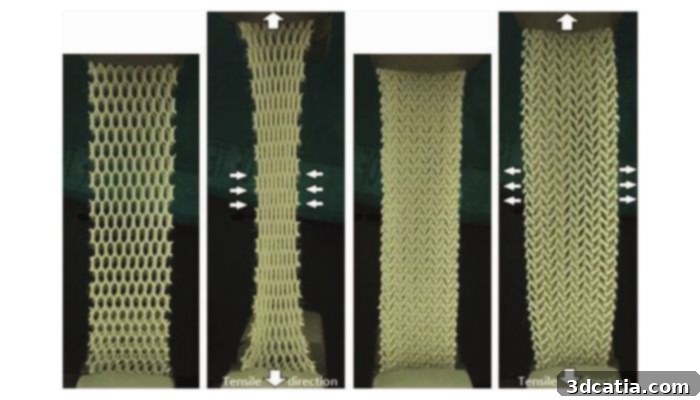
A comparison between conventional and auxetic spacer fabrics, from a different study. (Photo Credits: Wang Z, Hu H.)
The potential applications for these advanced PEEK auxetic materials are truly expansive and transformative. Professor Kumar outlined several exciting possibilities that could revolutionize various industries. In the medical field, they could lead to the development of smart orthopaedic implants that can actively monitor bone healing, detect early signs of stress or infection, and even adapt to the body’s changing needs, providing real-time data to clinicians. For the aerospace sector, these materials could be used in aerospace skins, offering enhanced structural integrity, improved impact resistance against debris, and continuous structural health monitoring, which could significantly reduce maintenance costs and improve flight safety. Furthermore, their unique properties make them ideal for cutting-edge wearable technologies, where they could provide adaptive comfort, perform subtle health monitoring, or even integrate responsive elements into smart clothing.
Beyond these, the PEEK auxetics hold promise for creating more robust and lighter impact-resistant vehicle structures, enhancing passenger safety in automotive and other transportation industries. Their self-sensing capabilities are also invaluable for broader structural health monitoring applications, extending to critical infrastructure such as bridges, buildings, and industrial machinery, providing early warnings of fatigue or damage. Professor Kumar concluded with an inspiring vision: “We’re essentially giving designers a toolkit for building the next generation of multifunctional materials, ones that are as intelligent as they are strong.” This research marks a pivotal step towards a future where materials are not merely passive components but active, intelligent entities capable of sensing, adapting, and informing. To delve deeper into the specifics of this groundbreaking study, readers are encouraged to explore the full research paper available HERE.
What are your thoughts on these innovative 3D printed auxetic materials and their potential impact on engineering and technology? Share your insights and comments below, or engage with us on our LinkedIn or Facebook pages! And don’t miss out on the latest advancements in additive manufacturing—sign up for our free weekly Newsletter to receive the most current 3D printing news directly in your inbox. For more visual content, explore all our videos on our YouTube channel.
*Cover Photo Credits: Johannes Schneider et al./Materials Horizons