
Innovative Carbon Capture: How 3D Printing is Fighting Climate Change with Advanced Filters
Climate change stands as one of the most formidable challenges humanity faces in the 21st century. Driven by an escalating concentration of carbon dioxide (CO2) and other greenhouse gases in the atmosphere, our planet is experiencing an unprecedented warming trend. This phenomenon, often referred to as the greenhouse effect, has profound implications for global ecosystems, economies, and societies. While the complexity of addressing global warming is immense, prompting a concerted effort from scientists worldwide, a promising new study from North Carolina State University suggests that additive manufacturing, commonly known as 3D printing, could offer a significant part of the solution. Researchers have successfully demonstrated the feasibility of creating highly effective carbon dioxide capture filters using advanced 3D printing techniques, opening new avenues in the fight against atmospheric carbon pollution.
The Urgency of Carbon Capture: Addressing the Climate Crisis
The direct correlation between rising atmospheric CO2 levels and global warming is undeniable. Human industrial activities, particularly the widespread combustion of fossil fuels, have released staggering amounts of carbon dioxide into the atmosphere. The National Oceanic and Atmospheric Administration (NOAA)’s Global Monitoring Lab reported that in 2022, the global average atmospheric carbon dioxide reached a record-breaking 417.06 parts per million. This figure represents an increase of over 50% compared to pre-industrial levels, signaling an alarming acceleration of CO2 accumulation. Beyond atmospheric warming, the absorption of excess carbon dioxide by the world’s oceans has led to a concerning 30% increase in ocean acidity, threatening marine life and biodiversity. While an ideal long-term solution involves a global shift away from fossil fuels, the immediate practicalities and potential disruptions to global economies make this transition a monumental undertaking. Consequently, there is an intense and urgent global search for technologies capable of actively capturing and storing existing carbon from the atmosphere and industrial emissions.
Traditional Carbon Capture Methods and Their Limitations
Current carbon capture technologies generally fall into two categories: point-source capture and direct air capture (DAC). Point-source capture involves removing CO2 directly from large emission sources like power plants or industrial facilities. DAC, on the other hand, extracts CO2 directly from the ambient air, offering a more diffuse but potentially scalable solution. While these technologies show promise, they often face significant challenges. Many traditional capture methods are energy-intensive, requiring substantial power for chemical absorption or filtration processes, which can offset some of their environmental benefits if the energy source isn’t renewable. Furthermore, the materials used in these filters can be expensive, difficult to manufacture with the required precision, and may have limited durability, necessitating frequent replacement. Scaling these systems to industrial levels also presents considerable engineering and cost barriers, highlighting the need for more efficient, sustainable, and cost-effective material development.
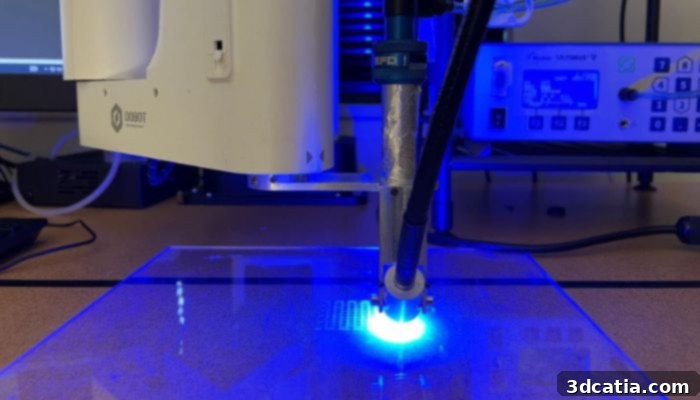
The making of the carbon dioxide capture filters using 3D printing (photo credits: Sen Zhang and Jialong Shen, NC State)
Additive Manufacturing: A Catalyst for Innovation in Environmental Solutions
Additive manufacturing, or 3D printing, has emerged as a transformative technology across numerous industries, renowned for its ability to create complex geometries, customize designs, and accelerate prototyping. Unlike traditional subtractive manufacturing methods that remove material from a larger block, 3D printing builds objects layer by layer from digital models, leading to minimal material waste and unprecedented design freedom. This inherent flexibility makes 3D printing an ideal candidate for developing novel solutions to complex challenges, including environmental ones. Its capacity to precisely control material deposition and structure enables the creation of highly optimized filters, catalysts, and other functional components that would be impossible or impractical to produce with conventional techniques. By leveraging 3D printing, researchers can experiment with new material combinations and intricate architectures, pushing the boundaries of what’s possible in fields like carbon capture.
NC State’s Breakthrough: 3D Printing Advanced Carbon Dioxide Capture Filters
A recent groundbreaking demonstration by researchers at NC State University has proven that 3D printing can indeed be harnessed to create highly efficient carbon dioxide capture filters. Their innovative approach involves 3D printing a specialized hydrogel material designed to encapsulate carbonic anhydrase, a naturally occurring enzyme. This enzyme is crucial because it significantly accelerates a vital chemical reaction: the conversion of carbon dioxide and water into bicarbonate, a much more stable and manageable form of carbon. This enzymatic reaction is fundamental to biological carbon sequestration and is highly efficient. Jialong Shen, an Assistant Research Professor of Textile Engineering, Chemistry, and Science at NC State and the study’s lead author, highlighted the advantages of this manufacturing process: “This manufacturing process, using 3D printing, makes everything faster and more precise. If you have access to a printer, and the raw materials, you can make this functional material. We formulated the hydrogel in a way that would be mechanically strong enough to be 3D printed, and also extruded into a continuous filament.” This statement underscores the accessibility and precision that 3D printing brings to the development of such sophisticated functional materials.
The Innovative 3D Printing Process Behind the Filters
The researchers opted for 3D printing due to its inherent speed, versatility, and ability to create intricate structures essential for efficient carbon capture. Their specific technique cleverly combines aspects of extrusion-based 3D printing with photopolymerization, bearing similarities to processes like material jetting. This involved developing a unique 3D printing “ink” formulated from two distinct organic compounds and, crucially, the carbonic anhydrase enzyme. This specialized ink allowed them to precisely print thread-like filaments of the hydrogel onto a two-dimensional grid. As the filaments were extruded, the solution was solidified using UV light, creating a stable, porous structure. A significant challenge in this process was formulating a hydrogel that not only could be continuously extruded but also possessed sufficient mechanical strength to maintain its structural integrity during and after 3D printing. The success in achieving this balance demonstrates a sophisticated understanding of material science and additive manufacturing capabilities.
Promising Results and Scalability Potential
The efforts of the NC State team have yielded encouraging results. In initial small-scale experiments, their 3D-printed filters successfully captured 24% of the carbon dioxide from a test gas mixture. While this percentage might appear modest compared to some theoretical benchmarks, it is a significant proof of concept, especially considering the filter’s diminutive size – less than an inch in diameter. This initial success paves the way for future optimization and scalability. The inherent advantages of 3D printing mean that these filters can be scaled up dramatically, produced in larger dimensions, or designed with various shapes and geometries. This flexibility allows for the creation of modular filters that can be stacked in large columns, potentially leading to a substantial increase in carbon capture efficiency in real-world applications. Furthermore, rigorous testing of the filter’s durability revealed impressive performance: it retained 52% of its initial carbon capture efficiency after more than 1,000 hours of continuous operation. This durability is a critical factor for industrial adoption, as it suggests a longer lifespan for the filters, reducing maintenance costs and improving overall economic viability.
The Future of 3D Printed Carbon Capture: A Hopeful Outlook
The implications of this research extend far beyond the laboratory. By demonstrating a viable method for 3D printing enzyme-infused hydrogel filters, NC State researchers have opened a new frontier in the development of advanced carbon capture technologies. Such materials could be integrated into direct air capture units, industrial exhaust systems, or even building ventilation systems to actively remove CO2 from the environment. The precision and customization offered by additive manufacturing mean that filters can be tailored to specific applications, optimizing their performance for different gas mixtures and operating conditions. As Sonja Salmon, the study’s co-corresponding author and associate professor of textile engineering, chemistry, and science at NC State, eloquently states: “This work is still early stage, but our findings suggest there are new ways to make materials for carbon capture devices. We’re offering hope for carbon capture.” This hope is rooted in the continuous innovation that 3D printing enables, promising more efficient, durable, and scalable solutions for one of humanity’s most pressing environmental crises. This breakthrough represents a significant step forward in our collective efforts to mitigate climate change and build a more sustainable future.
For those interested in delving deeper into the specifics of this groundbreaking research, the full study can be accessed HERE.
*Cover Photo Credits: Image by wirestock on Freepik