

Wohlers Report 2020: Charting the Evolution and Industrialization of Additive Manufacturing
Every year, the highly anticipated Wohlers Report from Wohlers Associates, Inc., an esteemed American firm, stands as the definitive benchmark for the additive manufacturing industry. This comprehensive publication offers unparalleled insights into the global AM market, documenting the latest technological advancements, emerging trends, and significant growth patterns. The Wohlers Report 2020, marking its remarkable 25th edition, delivered an extensive 380-page analysis, packed with crucial data on the state of additive manufacturing. It meticulously details the industry’s expansion, presenting over 250 concrete examples of AM applications currently in production or under active development across various sectors. This milestone edition underscores the profound shift occurring within manufacturing, as 3D printing transcends its prototyping origins to embrace large-scale industrial applications.
The preceding edition, the Wohlers Report 2019, prominently highlighted the robust growth observed in 3D printing materials, with a particular emphasis on metals. The report vividly illustrated this trend by noting a substantial 41.9% increase in revenue derived from metal additive manufacturing processes. Among these, Laser Powder Bed Fusion (LPBF) was identified as the most prevalent and impactful method. LPBF is a sophisticated process where a high-power laser selectively melts metallic powder layer by layer, fusing it to create complex geometries directly from a digital design. This technology’s precision and capability to produce strong, lightweight parts have been instrumental in driving its adoption. Furthermore, the 2019 report observed a significant paradigm shift: additive manufacturing technologies were increasingly being employed for industrial-scale production, moving beyond their traditional role in rapid prototyping. This marked a pivotal moment, as reflected by a notable deceleration in the annual growth of desktop 3D printers, indicating a maturing market with a clear focus on professional and industrial applications.

Throughout 2019, numerous other industry analyses corroborated the findings of the Wohlers Report, consistently pointing towards this accelerated transition in additive manufacturing. Manufacturers worldwide are demonstrating a burgeoning interest in integrating 3D printing technologies into their full-scale production workflows. This growing enthusiasm is driven by the compelling benefits that additive manufacturing offers, including unprecedented opportunities for mass customization, significant reductions in production costs, and dramatically shorter lead times from design to finished product. The Wohlers Report 2020 provides a compelling illustration of this trend through the case study of Jabil, a prominent American global manufacturing services company. Jabil successfully redesigned an impeller – a critical component in various machinery – specifically for additive manufacturing. Traditionally, this impeller consisted of 73 separate metal parts that required laborious manual assembly. By leveraging additive manufacturing, Jabil was able to produce the entire impeller as a single, structurally optimized part using a fiber-reinforced polymer composite. This innovative approach not only simplified the manufacturing process but also delivered staggering efficiency gains, enabling the production of fifty impellers in the same timeframe it previously took to produce just one. This example powerfully showcases how AM can revolutionize supply chains and enhance product performance.
A particularly significant trend detailed in the report is the increasing number of users who are now producing end-use parts with additive manufacturing. This marks a pivotal moment, as it signifies a move beyond mere prototypes or tooling, directly into functional components that are integrated into final products. The Wohlers Report 2020 meticulously analyzes the maturing and emerging applications of AM for true series production. It highlights how industries are leveraging 3D printing not just for small batches, but for consistent, high-volume manufacturing of complex components. A prime example cited is the groundbreaking collaboration announced last year between HP and Volkswagen. This partnership focused on scaling 3D printed parts for automotive production. Volkswagen made a substantial investment by installing an impressive fleet of 90 HP 3D printers across its manufacturing facilities. This strategic deployment enabled the automotive giant to produce 10,000 functional parts within a remarkably short period of just a few weeks. Volkswagen’s ambitious goal is to elevate this output to between 50,000 and 100,000 functional parts annually, each roughly the size of a football. This endeavor dramatically demonstrates how industrial 3D printing is poised to transform the automotive supply chain, offering unprecedented flexibility, accelerating design iterations, and reducing waste in component manufacturing.
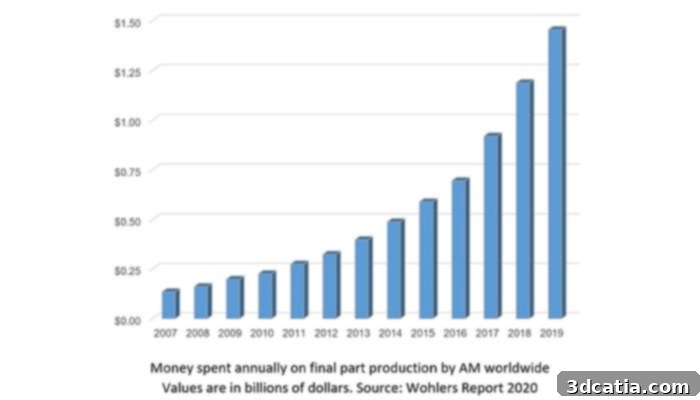
Beyond applications and market statistics, the Wohlers Report 2020 delves deeply into the foundational elements driving the global additive manufacturing industry forward. It provides extensive analysis of patents being filed, detailing the innovative intellectual property emerging from this dynamic sector. The report also scrutinizes the landscape of startups, identifying new ventures that are pushing the boundaries of AM technology and business models. Furthermore, it thoroughly examines investment trends, tracking the flow of capital into research and development (R&D) and highlighting areas of significant financial interest. These comprehensive analyses offer a holistic view of the AM ecosystem, revealing where innovation is concentrated and where future growth is anticipated.
The unparalleled depth and authority of the Wohlers Report 2020 are directly attributable to its extensive and collaborative data collection methodology. The report was meticulously compiled from input provided by a record-breaking ensemble of industry stakeholders. This included invaluable contributions from 129 service providers, offering insights into market demands and operational challenges. Additionally, 114 manufacturers of industrial AM systems shared critical data on technological advancements and market penetration. The perspective of 40 producers of third-party materials and desktop 3D printers further enriched the report, providing a comprehensive view of the entire supply chain. Beyond commercial entities, the report rigorously documents government-sponsored research and development initiatives, highlighting public sector investment in AM innovation. It also covers collaborations and consortia, which are crucial for standardization and knowledge sharing, alongside the diverse activities of 139 academic and research institutes around the world. These institutions are at the forefront of fundamental research, material science, and process optimization. The credibility and global scope of the report are further cemented by the expertise of seventy-nine co-authors and contributors from 33 different countries, who provided their expert views, opinions, and regional market intelligence. This collaborative effort ensures that the Wohlers Report 2020 remains the most authoritative and comprehensive review of the additive manufacturing industry available globally, providing essential guidance for businesses, researchers, and policymakers alike. For those seeking more detailed information directly from the source, additional resources are available HERE.
The Wohlers Report 2020 unmistakably paints a picture of an additive manufacturing industry in full maturation, steadily moving from niche applications to mainstream industrial production. The insights it provides are crucial for understanding the ongoing transformation of global manufacturing. As AM technologies continue to evolve, enabling greater material versatility, higher production speeds, and enhanced part performance, their impact on various sectors—from automotive and aerospace to healthcare and consumer goods—will only intensify. The report serves as a vital guide for stakeholders looking to navigate this complex yet incredibly promising landscape, highlighting both opportunities and challenges. Its comprehensive nature ensures that readers are well-informed about the patents shaping the future, the startups driving innovation, the investments fueling growth, and the collaborative research efforts that underpin the industry’s advancements.
What are your thoughts on the transformative trends highlighted in the Wohlers Report 2020? We invite you to share your perspectives in the comments section below or join the discussion on our Facebook and Twitter pages! Don’t miss out on the latest advancements and industry news; make sure to sign up for our free weekly Newsletter, delivering all the essential updates in 3D printing directly to your inbox!