
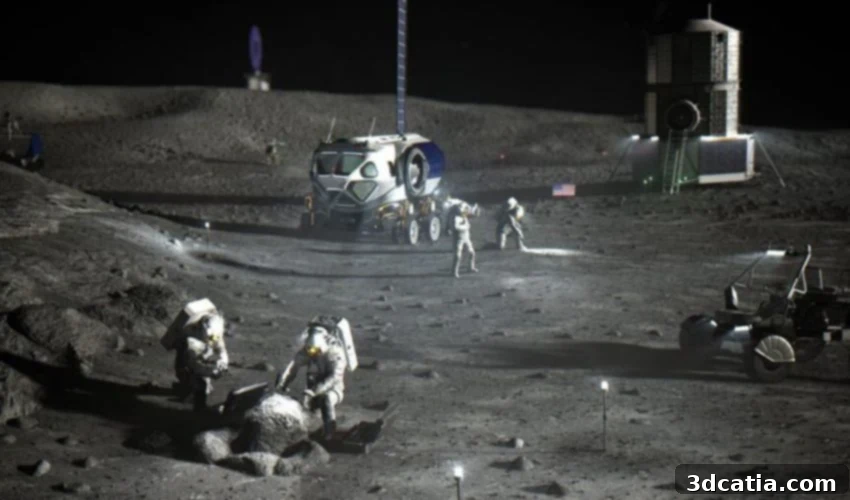
3D Printed Lunar Regolith Bricks: Pioneering Sustainable Construction for Moon and Mars Habitats
Since humanity first ventured beyond Earth’s atmosphere in the 1960s, the dream of not just visiting but truly living among the stars has captured our collective imagination. While the notion of residing on the Moon or Mars might once have belonged solely to the realm of science fiction, it is now an active frontier of research and development. A key enabler for this ambitious future is emerging from the world of advanced manufacturing: 3D printing. This revolutionary technology is proving to be instrumental in overcoming the formidable challenges of constructing extraterrestrial habitats, bringing humanity one significant step closer to establishing permanent outposts on other celestial bodies.
A recent breakthrough from the University of Central Florida (UCF) has dramatically advanced this vision. Researchers there have successfully engineered 3D printed bricks, designed specifically for constructing bases like the proposed Artemis Base Camp, utilizing locally sourced lunar regolith and saltwater as primary materials. This achievement marks a pivotal moment, transitioning theoretical concepts into tangible, robust building blocks capable of enduring the harsh realities of the lunar environment.
The concept of leveraging 3D printing for off-world construction is not entirely new. Indeed, numerous projects are already underway, exploring various methodologies and materials. For instance, Redwire’s ongoing experiments aboard the International Space Station (ISS) are dedicated to understanding how lunar regolith – the loose soil and rock deposits covering the Moon’s surface – can be transformed into viable habitation structures. Similarly, NASA is actively collaborating with AI Space Factory to develop a 3D printed lunar habitat prototype under the ambitious Artemis program. Beyond the Moon, Washington State University is leading cutting-edge research into the feasibility of 3D printing construction materials on Mars, using Martian regolith simulants.
However, much of this work, while promising, has remained largely in the conceptual or preliminary testing phases, often focusing on the printing process itself rather than the ultimate structural integrity in extreme conditions. What distinguishes the UCF project is its demonstrable success in creating regolith bricks that not only print but also possess the proven ability to withstand the extreme environmental stressors characteristic of outer space. This breakthrough shifts the paradigm from “can we print it?” to “can what we print actually survive and function?” – a critical question for any aspiring extraterrestrial settlement.
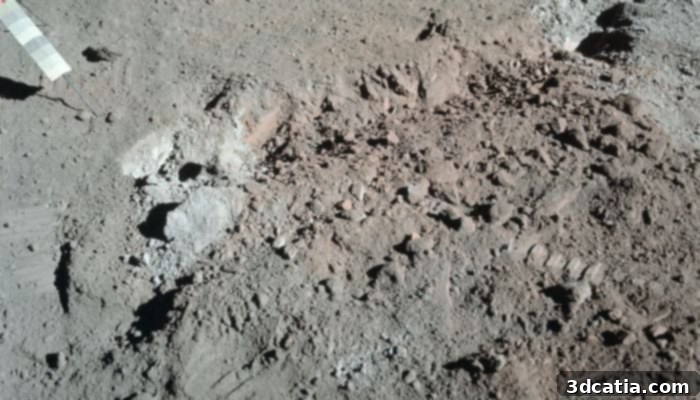
Lunar regolith consists of loose rocks, dust and materials found on the surface of the Moon (photo credits: NASA)
UCF Breakthrough: 3D Printed Lunar Regolith Bricks Built for Extreme Environments
The groundbreaking study, titled “Effect of sintering temperature on microstructure and mechanical properties of molded Martian and Lunar regolith,” was recently published in the esteemed journal Ceramics International. This pivotal research was conducted by a dedicated team at UCF, spearheaded by Associate Professor Ranajay Ghosh from the Department of Mechanical and Aerospace Engineering. The lead author of this significant paper is Peter Warren, a diligent research assistant, supported by a team of co-authors including Nandhini Raju, Hossein Ebrahimi, Milos Krsmanovic, aerospace engineering professor Seetha Raghavan, and Jayanta Kapa. Their collective objective was ambitious: to determine if a permanent Artemis base camp on the Moon could realistically be constructed using these innovative 3D printed lunar regolith bricks, thereby paving the way for sustainable lunar habitation.
The Innovative Binder Jetting Process for Extraterrestrial Manufacturing
To fabricate these remarkable bricks, the UCF team harnessed the power of binder jetting – an additive manufacturing technology particularly well-suited for processing ceramic-like materials. Unlike laser-based 3D printing methods, which struggle with the high melting points and unique properties of regolith, binder jetting excels at consolidating powdered materials. The key components of their material recipe were simulated regolith sourced from UCF’s renowned Exolith Lab and an ingeniously simple yet effective binding agent: saltwater. This choice is particularly significant because water, even salty water, is a resource believed to be available on the Moon and Mars, making the process highly conducive to in-situ resource utilization (ISRU).
Professor Ghosh emphasized the immense potential of binder jetting for regolith-based extraterrestrial manufacturing. The process involves depositing a liquid binder onto layers of powder, selectively adhering particles to build a 3D object layer by layer. While the initial “green parts” produced by this method were, as expected, relatively fragile, their strength was dramatically enhanced through a subsequent sintering process. By baking these green parts at extreme temperatures, reaching up to 1200 degrees Celsius, the team successfully transformed them into exceptionally strong, durable bricks perfectly suited for their intended purpose in the harsh vacuum of space.
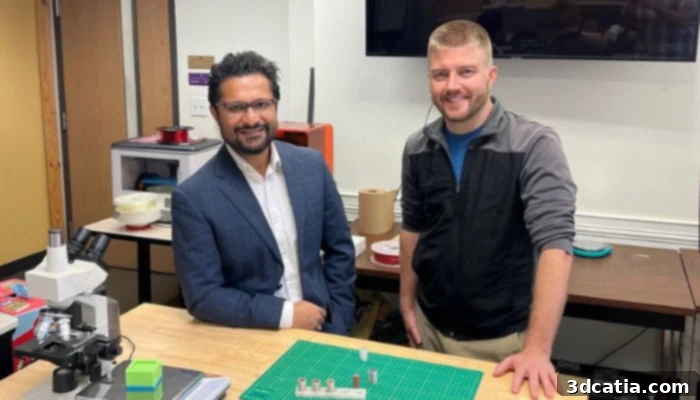
UCF Mechanical and Aerospace Engineering Associate Professor Ranajay Ghosh and graduate research assistant Peter Warren displaying the cylindrical bricks created using simulated lunar and Martian regolith and saltwater (photo credits: UCF)
Robust Results: Withstanding the Demands of Space
The results of the UCF study are not merely promising; they are truly groundbreaking. The researchers discovered that the resulting cylindrical bricks exhibited an astonishing ability to withstand immense pressure. Specifically, these bricks were found to endure pressures up to 250 million times the Earth’s atmosphere (roughly 25 GPa), demonstrating an extraordinary level of compressive strength. This remarkable resilience strongly suggests that binder jetting, when combined with localized extraterrestrial materials, can be a viable and highly effective method for constructing durable structures and components in space. Such strength is crucial for shielding future inhabitants from cosmic radiation, micrometeorite impacts, and the extreme thermal fluctuations prevalent on the Moon and Mars.
Perhaps the most significant implication of this research lies in its clear demonstration that off-world structures can indeed be built using resources found directly in space. This paradigm shift, known as In-Situ Resource Utilization (ISRU), represents a cornerstone for sustainable space exploration and colonization. By opening up this critical pathway, future space missions can drastically reduce their reliance on transporting prohibitively heavy and expensive building materials from Earth. Every kilogram launched from Earth costs thousands of dollars, making ISRU a game-changer for economic feasibility. This reduction in launch mass, valuable space, and overall mission cost makes the establishment of long-term human habitation on the Moon and Mars not just a possibility, but a much more probable reality.
The Future of Space Exploration: Sustainability Through ISRU
Professor Ghosh succinctly articulated the profound impact of their work, stating, “This research contributes to the ongoing debate in the space exploration community on finding the balance between in-situ extraterrestrial resource utilization versus material transported from Earth. The further we develop techniques that utilize the abundance of regolith, the more capability we will have in establishing and expanding base camps on the Moon, Mars, and other planets in the future.” His words underscore a fundamental truth: the long-term success of human expansion into space hinges on our ability to live off the land, transforming local resources into tools for survival and growth.
The ability to use readily available lunar regolith and saltwater not only cuts down on launch costs but also fosters self-sufficiency. Imagine a lunar base that can repair itself, expand its facilities, and even create new tools using materials found right outside its door. This capability is vital for mitigating risks associated with long-duration missions, where resupply from Earth is infrequent, costly, and potentially unreliable. Furthermore, the robust nature of these 3D printed bricks means that future lunar or Martian settlements could offer enhanced protection against the hostile environments of space, including dangerous radiation, extreme temperature swings, and the constant threat of micrometeoroid bombardment. The UCF study provides tangible evidence that such protective structures are within reach, moving us closer to truly sustainable space living.
While this research represents a monumental leap forward, the journey towards fully autonomous extraterrestrial construction is ongoing. Future work will likely focus on optimizing the binder jetting process for zero-gravity or low-gravity environments, developing methods for automating material extraction and processing on the Moon, and refining the structural designs of habitats to maximize safety and efficiency. Integrating advanced robotics and artificial intelligence will also be crucial for these self-sufficient building operations. Nevertheless, the UCF team’s success with regolith and saltwater bricks firmly establishes a viable and exciting path forward for realizing humanity’s dream of permanent off-world habitation. If you would like to delve deeper into the specifics of this groundbreaking research, you can purchase the full study HERE.
What are your thoughts on these innovative 3D printed lunar regolith bricks and their potential to transform space exploration? We invite you to share your comments below or engage with us on our LinkedIn,Facebook, andTwitter pages! Don’t miss out on the latest advancements in additive manufacturing—sign up for our free weeklyNewsletter here to receive the newest 3D printing news directly in your inbox! You can also explore all our insightful videos on ourYouTube channel.
*Cover Photo Credits: NASA