
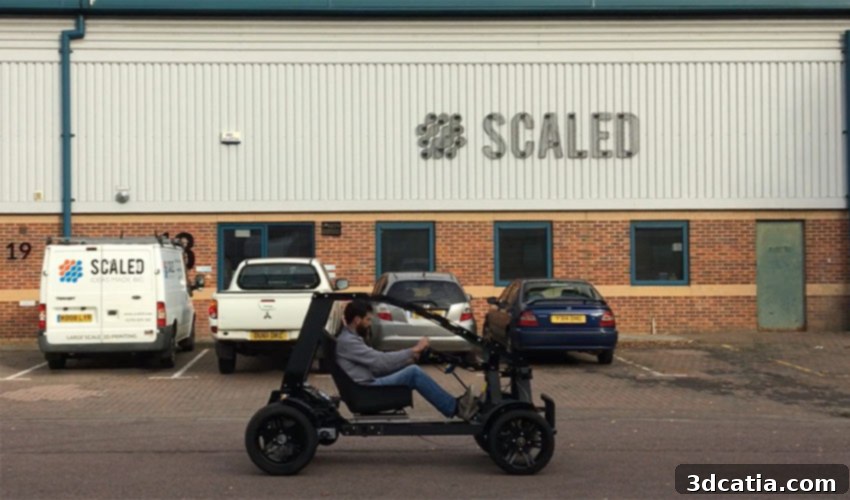
Scaled’s Project Chameleon: The Future of 3D Printed Electric Vehicle Mass Customization
The automotive industry has long been a pioneer in adopting advanced manufacturing techniques. Historically, additive manufacturing (AM), more commonly known as 3D printing, found its primary niche in creating functional prototypes. It allowed designers and engineers to quickly iterate on designs, test concepts, and significantly reduce development cycles. However, as 3D printing technologies matured, the automotive sector began to recognize their broader potential, moving beyond mere prototyping to embrace end-use part applications. This shift has enabled the production of highly complex geometries, previously unachievable with traditional methods, and opened doors to unprecedented levels of customization at the design and production stages. A compelling example that perfectly encapsulates these possibilities is Project Chameleon, a groundbreaking 3D printed electric vehicle (EV) initiative launched in the UK by Scaled. Scaled is a company at the forefront of large-format 3D printing, leveraging advanced robotics for material extrusion processes.
At its core, Project Chameleon embodies a revolutionary vision for vehicle ownership and manufacturing. As articulated on the Scaled website, it presents “the opportunity to own a vehicle, designed from the ground up to be ideally suited to a particular environment. True mass customisation. Sustainable. Affordable. Aesthetic.” This ambitious project delves into multiple facets where 3D printing offers distinct advantages. It emphasizes optimizing structural design through advanced DfAM (Design for Additive Manufacturing) techniques, which are crucial for producing higher-performance parts that are lighter and more efficient. Concurrently, Project Chameleon is committed to delivering a product that is not only technologically superior but also environmentally sustainable, economically accessible, and visually appealing.
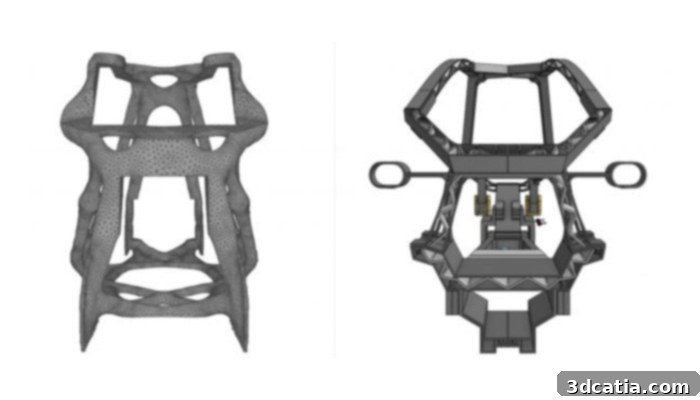
The 3D printed electric vehicle chassis was optimized using topology optimization software | Image via Scaled
While additive manufacturing undeniably offers cost-effectiveness and speed for prototyping, its competitive edge against conventional manufacturing technologies for true mass production, such as injection molding or CNC machining, has traditionally been limited. For producing parts at an immense scale, these established methods remain incredibly reliable and, in many cases, more cost-efficient per unit. However, this dynamic shifts dramatically when the focus moves from mass production to mass customization. This is precisely where AM shines. Scaled eloquently explains this paradigm shift: “By moving away from mass production to mass customisation, specialisation becomes affordable. This paradigm shift is possible by being able to prototype and manufacture using the same technology: large scale 3D printing. Design and manufacture of a first production vehicle will be cheaper than traditional methods.“
Project Chameleon stands as a testament to this philosophy. Scaled highlights that the project eliminated the need for expensive, specialized production equipment and tooling, which are typically major capital expenditures in traditional automotive manufacturing. Instead of complex, sprawling assembly lines, every variant of the Chameleon vehicle can be produced within a single, highly versatile manufacturing cell. This not only dramatically reduces infrastructure costs and physical footprint but also offers unparalleled flexibility. Furthermore, the typical bottlenecks associated with long lead times for specialized parts or retooling for new models are virtually eliminated. In Project Chameleon, lead times are primarily dictated by the speed at which a vehicle can be 3D printed, ushering in an era of rapid product development and on-demand manufacturing.
Manufacturing Endless Vehicle Variants in a Single Manufacturing Cell
The Project Chameleon initiative, which commenced just six months prior, culminated in the successful operation of the vehicle on October 15th, 2020. This rapid development cycle itself is a significant achievement, underscoring the agility offered by large-scale 3D printing. From a design and material perspective, the Chameleon vehicle showcases advanced engineering. Its chassis, a critical structural component, is crafted from high-end 3D printed thermoplastics, chosen for their strength, durability, and lightweight properties. In a nod to sustainability, the project also incorporates recycled plastics for certain components, demonstrating a commitment to circular economy principles within automotive manufacturing. The engineering team set an ambitious target for a 1:1 weight-to-payload ratio, aiming for the vehicle to weigh just over 100kg. This ultra-lightweight design is crucial for maximizing the efficiency and range of an electric vehicle. Achieving this was made possible by employing cutting-edge design techniques, particularly stochastic topology optimization. This method allows for the intelligent removal of redundant material, resulting in incredibly strong yet lightweight structures. This entire process, from design to final production, adheres to a “factory in a box” approach, enabling the complete manufacturing of diverse vehicle configurations within a compact, single manufacturing cell.
During the crucial modeling stage, Scaled collaborated with Rafinex, a specialist in advanced simulation software, to seamlessly integrate topology optimization into the Chameleon’s design process. Rafinex’s software is distinguished by its stochastic capabilities. This means it doesn’t just optimize for a single, ideal load case; instead, it rigorously tests countless random variations in loading conditions and environmental stresses. This comprehensive analysis ensures that the final optimized structural design is inherently robust and ideally suited to real-world operational conditions, where impacts and loads rarely occur exactly as planned or predicted. This method significantly enhances the vehicle’s safety, durability, and overall performance in unpredictable environments.
The true power of the Chameleon platform lies in its ability to offer unparalleled customization. Utilizing the very same hardware and software tools, each vehicle produced is meticulously custom-made to the precise specifications and requirements of the individual customer. As Scaled articulates, “The Chameleon Platform makes vehicles specifically adapted to their environment. The customer specifies their requirements and receives a vehicle designed to efficiently meet its task.” This bespoke approach means that a vehicle could be configured for specific urban delivery challenges, designed for rugged off-road utility, or tailored for particular industrial applications. This project serves as a compelling case study, offering profound insights into the latest advancements in mass customization, where every customer receives a uniquely designed and manufactured device perfectly matched to its intended operating environment and specific task. It represents a significant leap forward from standardized products, empowering users with vehicles that are truly their own.
The implications of projects like Chameleon extend far beyond a single vehicle model. They demonstrate the transformative potential of large-scale additive manufacturing to fundamentally redefine the automotive supply chain, foster localized production, and accelerate innovation. By minimizing traditional tooling costs and enabling rapid iteration, smaller companies and startups can enter specialized vehicle markets with greater agility and lower capital expenditure. This could lead to a proliferation of highly specialized vehicles addressing niche needs, contributing to more efficient and sustainable transportation solutions globally. Project Chameleon is not just an electric vehicle; it’s a blueprint for a more adaptable, customer-centric, and environmentally conscious future of manufacturing.
For more in-depth information about this fascinating project, you can visit the official page HERE. We’d love to hear your thoughts on this innovative concept! Share your comments below or connect with us on our Facebook and Twitter pages! Don’t forget to explore our Youtube channel for engaging videos on additive manufacturing!