
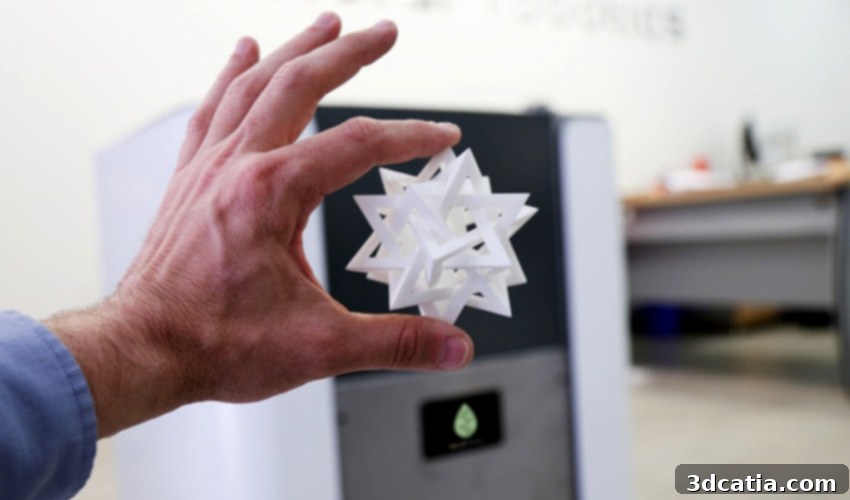
Democratizing Industrial-Grade 3D Printing: The Rise of Accessible Selective Laser Sintering (SLS) and Its Transformative Benefits
The landscape of additive manufacturing has been continuously evolving, bringing advanced fabrication technologies within reach of a wider audience. Among these, Selective Laser Sintering (SLS) stands out as a powerful method for creating robust and complex objects from powdered materials. Developed in the 1980s, SLS technology was initially an exclusive domain, largely due to the prohibitive cost of its equipment. Its early adoption was confined to well-funded research institutions and large industrial players. However, a significant shift occurred in 2014 when the foundational patents for SLS expired. This landmark event opened up a new era of innovation, allowing numerous companies to enter the market and develop their own SLS 3D printer solutions, drastically altering the accessibility paradigm for this cutting-edge technology.
In the years following the patent expiration, a new wave of manufacturers has emerged, passionately pursuing the democratization of selective laser sintering technology. These innovators aim to make industrial-grade 3D printing accessible to small and medium-sized enterprises (SMEs), educational institutions, and even prosumers. Among these pioneering companies is Natural Robotics, a Spanish firm that has made significant strides in this endeavor. Natural Robotics recently garnered widespread attention through a highly successful campaign on Kickstarter for their flagship product, the VIT. The VIT is specifically designed to be a low-cost SLS 3D printer, challenging the long-held notion that selective laser sintering must come with an astronomical price tag. We had the opportunity to speak with the team at Natural Robotics to gain deeper insights into the myriad benefits of integrating an SLS 3D printer into various manufacturing workflows.
Unlocking Unprecedented Design Freedom and Part Performance with SLS 3D Printing
When considering the advantages of an SLS 3D printer, two key factors immediately rise to prominence: the exceptional resistance and the unparalleled complexity of the parts that can be manufactured. Unlike many other additive manufacturing processes, selective laser sintering utilizes a bed of powdered material, typically Nylon PA12, where a laser selectively fuses particles layer by layer. This process, by its very nature, eliminates the need for any support structures to hold the part during printing. The unfused powder surrounding the object provides all the necessary support, allowing for an extraordinary degree of design freedom. This inherent characteristic not only simplifies post-processing but also facilitates the creation of highly intricate geometries and the implementation of advanced design techniques such as topological optimization, which would be impossible or exceedingly difficult with other manufacturing methods.
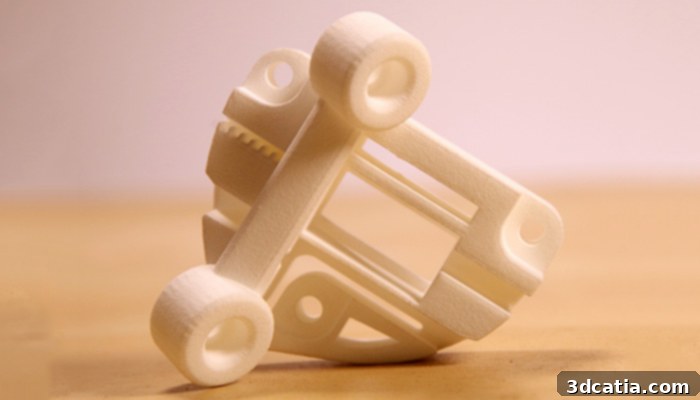
A part created with Natural Robotic’s SLS 3D printer, showcasing intricate details and strength.
Superior Strength and Durability of SLS Parts
The parts produced via selective laser sintering are renowned for their mechanical properties. Unlike filament-based 3D printing methods (like FDM/FFF) which often suffer from anisotropic properties due to visible layer lines, SLS parts exhibit isotropic mechanical characteristics. This means their strength is uniform in all directions, making them incredibly robust and durable. The dense fusion of nylon powder, typically Nylon PA12, creates components that are not only strong but also possess excellent chemical resistance, heat resistance, and a degree of flexibility. These qualities make SLS ideal for functional prototypes and even end-use parts that must withstand rigorous operational conditions. This superior material performance contributes significantly to the longevity and reliability of products, particularly in demanding industrial applications.
Complex Geometries and Topological Optimization Made Possible
The ability to print without external support structures fundamentally transforms design possibilities. Engineers and designers can now explore and realize highly complex internal geometries, lattice structures, and interlocking parts that were previously unattainable with traditional manufacturing or even other additive manufacturing techniques. This design freedom is particularly beneficial for topological optimization, an advanced design methodology where material is strategically distributed within a given design space to maximize performance while minimizing weight. SLS technology is the perfect partner for topological optimization, as it can accurately reproduce the organic, often non-intuitive, shapes that result from these algorithms, leading to incredibly lightweight yet strong components. Furthermore, the absence of support structures means drastically reduced post-processing time and effort, contributing to a more efficient and cost-effective production workflow.
Efficiency in Production and Prototyping
Beyond design complexity, the user benefits in multiple ways from the inherent efficiency of SLS 3D printing. Hector Esteller, CEO of Natural Robotics, elaborates: “You can benefit in time, since you can fine-tune several different prints from one day to another or in a matter of hours. You can create very strong parts and test these complex parts that you cannot do in the same way with other technologies.” This rapid iteration capability is invaluable for product development cycles, allowing engineers to quickly test and refine designs. The ability to “nest” multiple parts within the build volume of an SLS printer also maximizes throughput, enabling the production of numerous unique or identical components in a single print job. This makes SLS an incredibly versatile tool for both rapid prototyping and efficient small-batch manufacturing.
Diverse Applications Across Key Industries
Historically, SLS was predominantly utilized for rapid prototyping, especially within the rigorous demands of the aerospace sector. Its capability to produce robust, functional prototypes quickly allowed for accelerated testing and validation of critical components. However, its utility has expanded far beyond initial prototyping. SLS is now perfectly viable for producing end-use parts, such as small runs of specialized machinery components, custom tooling, and intricate functional assemblies. This makes it an attractive alternative to traditional manufacturing processes when low volumes or high customization are required.
We specifically inquired with Natural Robotics whether SLS 3D printing could genuinely substitute established methods like injection molding. Their response affirmed its potential: “In the short series. If we start from properly designed objects, we can get to replace injection parts.” This highlights a crucial area where SLS shines: producing high-quality, complex parts for low-volume production where the upfront tooling costs of injection molding would be prohibitive. For bespoke items, custom spares, or limited edition products, SLS offers a cost-effective and agile manufacturing solution.
Today, selective laser sintering technology is a cornerstone in a diverse array of industries, including but not limited to aerospace, automotive, medical, and consumer goods. It is driving significant developments in robotics, enabling custom robotic components and grippers; in drones, allowing for lightweight yet durable airframes and specialized mounts; in the creation of highly customized tools and jigs; and in advanced prosthetics and orthotics, where personalized fit and function are paramount. Its most profound and widely recognized application remains in rapid prototyping, primarily because SLS empowers designers and engineers to develop and test customized pieces at unprecedented speeds. Furthermore, it allows for the creation of parts that previously could only be made by expensive industrial machines requiring substantial initial investments and long lead times.
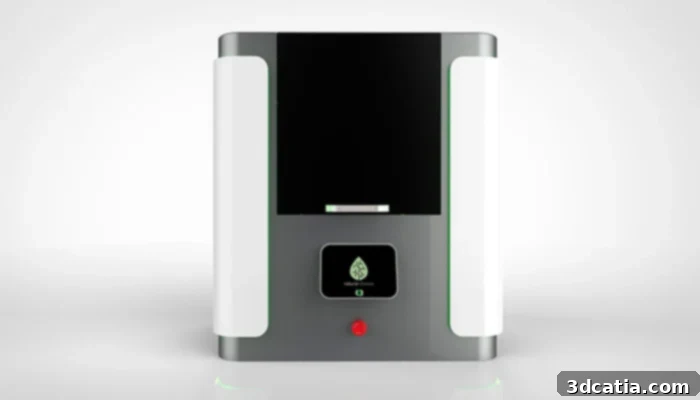
The VIT, a game-changer in accessible SLS 3D printing.
Natural Robotics and the VIT: A New Era for SLS Accessibility
Natural Robotics, a visionary company based in Barcelona, Spain, has been at the forefront of the movement to make advanced additive manufacturing more accessible. Their commitment to democratizing SLS technology culminated in the development of their groundbreaking printer, the VIT. The journey to create the VIT was an extensive one, spanning three years of dedicated research, engineering, and refinement. This significant investment of time and expertise aimed to overcome the traditional barriers of cost and complexity associated with selective laser sintering systems.
Upon its release, the VIT quickly captured the attention of the global 3D printing community. Its Kickstarter campaign dramatically exceeded its initial funding goals, a clear testament to the market’s hunger for an affordable and reliable SLS solution. The reasons for its overwhelming success are multifaceted: not only does the VIT make industrial-grade SLS technology physically accessible, but it also shatters the financial barriers that previously prevented many from utilizing this powerful manufacturing method. During its Kickstarter campaign, the VIT was offered at an incredible price point of just €5,999. This represented a substantial 45% discount off its anticipated retail price, an offer that was available only until the campaign’s conclusion. This aggressive pricing strategy, combined with the printer’s robust capabilities, positioned the VIT as a true game-changer in the additive manufacturing space.
By successfully engineering and launching a reasonably priced SLS machine, Natural Robotics has taken a monumental step toward their goal of democratizing this advanced technology. This accessibility will undoubtedly bring significant benefits across various industries, fostering innovation in product development, enabling localized manufacturing, and allowing smaller businesses and individual creators to leverage capabilities previously reserved for large corporations. The VIT signifies a pivotal moment, ushering in an era where the advantages of industrial-grade SLS 3D printing are no longer an exclusive luxury but a tangible reality for a much broader audience. This shift will undoubtedly accelerate technological advancements and creative endeavors globally.
Discover more about their innovative work and the VIT printer by checking out their successful Kickstarter campaign here. You can also delve deeper into Natural Robotics’ vision and product offerings by visiting their official website here.
Did you find this exploration of SLS technology and the VIT printer intriguing? We’d love to hear your thoughts! Share your comments below or engage with us on our Facebook and Twitter pages. And don’t forget to sign up for our free weekly Newsletter, delivering all the latest news and insights in 3D printing straight to your inbox!