
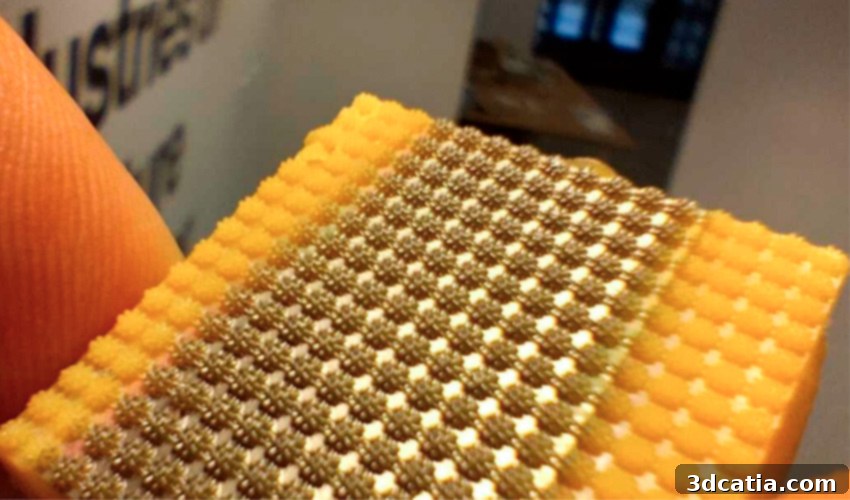
Revolutionizing Solar Energy: 3D Solar Pioneers High-Efficiency Panels with Additive Manufacturing
Additive manufacturing, commonly known as 3D printing, has rapidly transformed numerous industries, moving from a prototyping tool to a critical component in production chains across various sectors. Its adoption is evident in automotive, consumer goods, aerospace, and even oil and gas, demonstrating its versatility and capacity for innovation. Among the many industries poised for significant disruption, the energy sector stands out as a frontier where 3D printing can unlock unprecedented advancements. In this context, the U.S. company 3D Solar has emerged as a trailblazer, developing a proprietary process that harnesses the power of additive manufacturing to redefine solar energy capture. We had the opportunity to speak with their visionary team to delve deeper into their technological approach and its profound implications for the future of sustainable energy.
An Introduction to Daniel Clark and His Journey with 3D Printing
“My name is Daniel Clark, and I’m 41 years old,” he begins. His connection to the world of photopolymers, the foundation of many 3D printing processes, dates back to his childhood. “I was introduced to photopolymers when I was 12 years old through my great-uncle Dennis Gustafson.” This early exposure laid the groundwork for a lifelong fascination with advanced materials and manufacturing. His first significant immersion into the professional 3D printing landscape came in 2014 at the RAPID + TCT conference, a premier event for additive manufacturing. “My first real experience with 3D printing at shows was in 2014 at RAPID + TCT, when Kevin Ayers had me come to Detroit and introduced me to Simon Scott, Graham Tromans, and Todd Grimm.” This encounter proved pivotal, leading to a collaborative plan to explore unconventional materials. “We made a plan to run silicon through a Renishaw Metals 3D printer,” a testament to Clark’s early ambition to push the boundaries of what 3D printing could achieve, even with challenging materials like silicon.
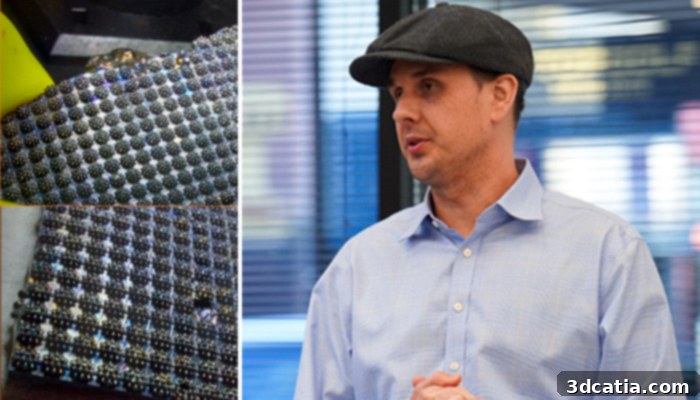
On the right is Daniel Clark of 3D Solar.
The Genesis of 3D Solar: A Vision for Next-Generation Energy Harvesting
The core mission of 3D Solar is ambitious yet vital: “The goal of 3D Solar is to revolutionize the solar energy sector with a highly efficient method for harnessing solar power.” This revolution is anchored in a fundamentally new design philosophy. Clark explains, “I crafted a novel three-dimensional solar cell/panel that maximizes energy production within a minimal footprint.” Unlike traditional flat solar panels that capture sunlight from a limited angle, 3D solar structures are designed to interact with light from multiple directions throughout the day, significantly increasing the effective surface area for energy absorption. This innovative approach is deeply inspired by nature and geometry. “Drawing inspiration from biomimicry and sacred geometric shapes, I have engineered an innovative solar cell that captures up to two to three times more power at almost half the cost of conventional silicon-based cells.” This bold claim highlights not just a technological leap in efficiency but also a potential economic paradigm shift, making solar energy dramatically more accessible and competitive.
Clark’s journey to this groundbreaking concept began in an unexpected field. “My innovation journey began in 2010 with ‘vertical gardening,’ a technique that involves cultivating plants in vertically stacked layers.” This agricultural application provided a crucial insight into optimizing space and resource distribution. “By integrating vertical 3D hydroponics, I was able to distribute water and the plants evenly, resulting in a 300% increase in plant yield.” The success in maximizing biological output within a confined vertical space sparked a profound question: “It was this concept of maximizing utility in a constrained space that led me to wonder about its potential applications in 3D solar energy.” The realization was clear: if a 3D structure could dramatically improve plant growth per square foot, it could similarly revolutionize energy capture per square foot of land or roof space.
3D Solar is now actively “redefining the way we harness solar energy by increasing the surface area of 3D glass micro substrates by 300% compared to a flat substrate through its hybrid 3D printing IP.” This substantial increase in surface area is critical; more surface means more opportunities for photovoltaic material to interact with sunlight, leading to higher energy yields. To achieve this, 3D Solar has collaborated closely on materials science. “We have chemically modified the Tethon Genesis Development high-loading resin for casting and molding.” This modification is vital for their production process, enabling the rapid and efficient creation of their unique 3D structures. “Thus, we can make eco-friendly parts every 15-30 seconds with this material.” This speed and environmental consciousness are key differentiators. Furthermore, “3D Solar has a cutting-edge vision with an electrochemical manufacturing approach in the coating of 3D solar micro solar cells for solar energy harvesting,” suggesting an advanced, integrated manufacturing process that combines 3D printing with precise material deposition to create functional, high-performance solar cells.
Additive Manufacturing Technologies and Materials at 3D Solar
The choice of materials and manufacturing technologies is fundamental to 3D Solar’s success. “Tethon 3D provides the base resin, which we then chemically modify using two formulations.” These custom formulations are central to overcoming the limitations of conventional additive manufacturing and achieving their specific performance goals. Clark elaborates on the first formulation: “One is designed for volumetric printing, casting, and molding of metals, semiconductors, and ceramics.” Volumetric printing represents a significant departure from traditional layer-by-layer 3D printing, promising faster build times and more isotropic properties. A crucial innovation in this formulation is its photo initiator. “It uses a special photo initiator that operates with infrared light.” This infrared capability is revolutionary because it “overcomes Beer-Lambert’s law, enabling printing at depths of up to 2-3 inches inside the volume of the resin, even within dark, metal and metal oxide-filled resin.” Beer-Lambert’s law typically describes the attenuation of light as it passes through a medium, limiting the penetration depth of UV light in conventional stereolithography (SLA) or Digital Light Processing (DLP) 3D printing, especially with dark or highly filled resins. By using infrared light, 3D Solar can cure entire volumes of material simultaneously, dramatically accelerating the process and enabling the use of previously challenging opaque materials for structural and functional components.
The second custom resin formulation addresses another critical material challenge: “The second Tethon custom resin formulation is for volumetric printing, casting, and molding of glass in large volumes without cracking or overheating.” Printing glass, especially in complex 3D forms, is notoriously difficult due to its brittle nature and susceptibility to thermal stress during manufacturing. This specialized resin and process allow for the creation of intricate glass micro-substrates, which are essential for 3D Solar’s high-efficiency panels, without compromising structural integrity. Beyond these two primary formulations, 3D Solar is pushing the envelope further. “There is a third ingredient we are using to inhibit light in our dual-color continuous volumetric 3D printer, which we are developing with the help of Marijn van Antwerpen, whose uncle is the brains behind Admatech.” This suggests an ongoing development in multi-material or multi-functional printing, potentially allowing for integrated functionalities within a single print, further enhancing the capabilities and applications of their technology. Admatech is known for its expertise in high-performance ceramic and metal additive manufacturing, indicating a strong collaboration on advanced material processing.
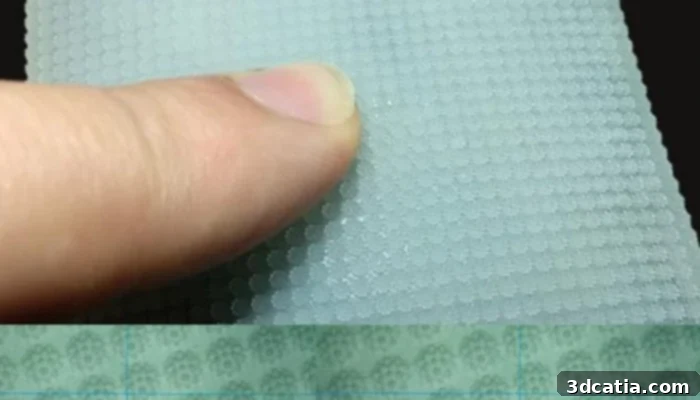
Piece developed with the company’s technology (Photo Credits: 3D Solar)
Navigating the Limitations of 3D Printing in High-Precision Sectors
While additive manufacturing offers immense potential, it also presents unique challenges, particularly when applied to high-precision industries like solar energy, micro-optics, and semiconductors. Clark highlights a critical limitation: “Solar, micro-optics, and the semiconductor industries need very smooth glass substrates without layer lines.” Traditional 3D printing, especially layer-by-layer methods, often produces visible layer lines or surface roughness. For applications where light transmission, reflection, or semiconductor performance is paramount, even microscopic imperfections can significantly degrade efficiency. Layer lines can cause light scattering and undesirable diffraction, which are detrimental to solar cell efficiency and the precision required for micro-optical components. This stringent requirement for surface finish narrows down the applicable 3D printing technologies. “So, you are limited to photo-polymer printers like those from Nanoscribe, Boston Micro Fabrication, Axtra 3D, and niche LCD printers.” These specialized printers are known for their ability to achieve extremely high resolutions and ultra-smooth surfaces, often operating at the micro or nanoscale, making them suitable for these demanding applications where optical quality and precise geometries are non-negotiable.
The Future of 3D Printing in the Energy Industry: A Decade Ahead
Looking ten years into the future, Daniel Clark envisions a dramatic transformation in the additive manufacturing landscape, particularly its role in industrial production. “Most of the low-volume printing players will disappear, and a new era of high-volume manufacturers will emerge.” This forecast suggests a consolidation in the market, where the emphasis shifts from bespoke, low-batch production to scalable, industrial-grade manufacturing. The growth and maturity of the technology will demand machines capable of continuous, rapid output. Clark elaborates on this vision for the future, describing a fusion of technologies: “I’m talking about printers like MoldJet but for high-volume production, where our hybrid casting/molding is combined with a 3D printer in one machine, achieving faster production than injection molding.” MoldJet technology, for example, combines binder jetting with casting, hinting at a future where 3D printing is integrated seamlessly with rapid post-processing or traditional manufacturing techniques to achieve unprecedented speeds. The audacious goal of surpassing injection molding, a cornerstone of mass production for decades, signifies a profound leap in additive manufacturing’s capabilities, driven by integrated processes, novel materials, and optimized workflows for true industrial scale.
A Final Word: Embracing Evolution for a Quantum Leap
Daniel Clark’s parting thoughts underscore the imperative for innovation and adaptability in the rapidly evolving additive manufacturing sector. He uses a prominent industry example to illustrate his point: “Shapeways is an example of not embracing evolution.” While Shapeways has been a pivotal platform for accessible 3D printing services, offering customization and prototyping, Clark suggests that the industry’s future lies in a different direction – one focused on scaling and high-volume industrial production. He firmly believes that 3D Solar possesses the key to this next phase. “Our IP could have helped them make that quantum leap I am talking about from low volume to high volume!” This statement emphasizes the critical need for businesses in additive manufacturing to evolve beyond niche applications and embrace technologies and strategies that enable mass production. The ability to transition from creating individual, customized items to producing millions of complex, high-performance parts at competitive costs will define the leaders of tomorrow’s industrial landscape. 3D Solar’s vision points towards a future where additive manufacturing is not just a tool for innovation but a foundational method for sustainable, large-scale energy solutions.
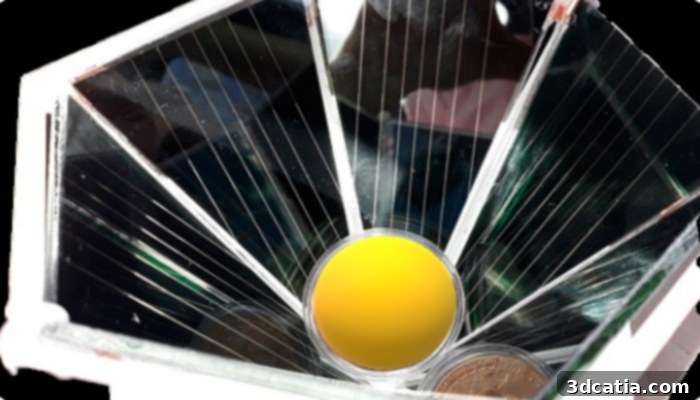
Photo Credits: 3D Solar
What do you think of 3D Solar’s innovative use of additive manufacturing in the energy sector? Share your thoughts in a comment below or connect with us on our LinkedIn or Facebook pages! Don’t forget to sign up for our free weekly Newsletter to receive the latest 3D printing news directly in your inbox. You can also find all our videos and more insightful content on our YouTube channel.
*Cover Photo Credits: 3D Solar